What Is a Microscope?
A microscope is a scientific instrument that magnifies
extremely small objects, allowing detailed observation of structures that
cannot be seen with the unaided eye. Depending on design and technology,
microscopes may use:
- Visible
light and optical lenses
- Digital
sensors and image processors
- Electron
beams for ultra-high resolution
Magnification can range from simple 5× lenses to over
1,000,000× in electron microscopes, making microscopes foundational to modern
medicine and science.
Why Microscopes Are Critical in Healthcare and Science
Microscopes are not just laboratory tools they are
decision-making instruments that directly impact patient outcomes, research
accuracy, and scientific progress.
Key Roles of Microscopes
- Detection
of bacteria, parasites, and fungi
- Diagnosis
of blood disorders and cancers
- Analysis
of tissue biopsies
- Monitoring
cell growth in IVF and research labs
- Drug
discovery and pharmaceutical quality assurance
- Training
of medical, nursing, and paramedical professionals
Without microscopes, early diagnosis, preventive healthcare,
and modern biomedical research would be impossible.
Classification of Microscopes
Microscopes can broadly be classified into:
- Optical
(Light) Microscopes
- Digital
Microscopes
- Electron
Microscopes
- Specialized
Microscopes for research and analysis
Each category serves a distinct purpose depending on
magnification needs, specimen type, and application.
1. Simple Microscope
A simple microscope is the most basic type of microscope and
consists of a single convex lens.
Magnification Range
- Up
to 10×
Uses
- Basic
observation
- Reading
fine print
- Preliminary
inspection of small objects
Applications
- Educational
demonstrations
- Jewellery
and watch inspection
- General-purpose
magnification
Although limited in capability, simple microscopes laid the
foundation for the development of advanced microscopy.
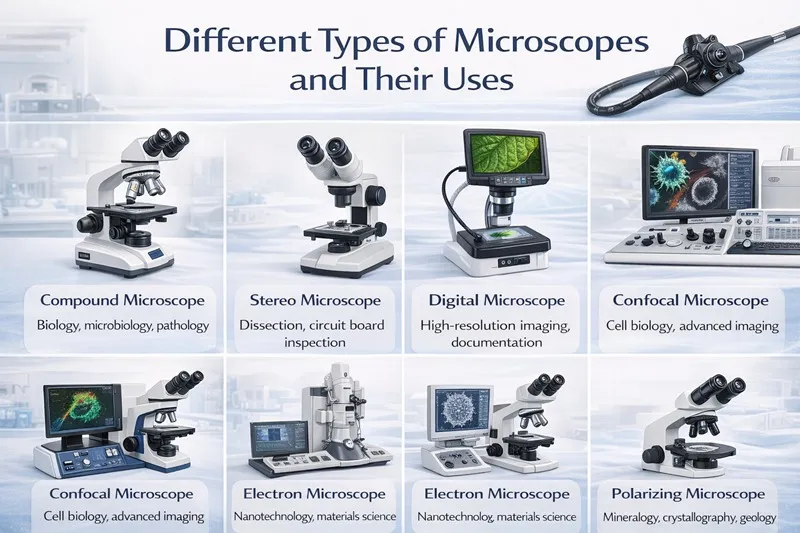
2. Compound Microscope
The compound microscope is the backbone of medical and
educational laboratories. It uses multiple lenses objective lenses and an
eyepiece to achieve high magnification.
Magnification Range
- 40×
to 1000×
Medical and Laboratory Uses
- Pathology
labs for tissue examination
- Microbiology
labs for bacteria and parasites
- Hematology
labs for blood smear analysis
- Schools
and colleges for biological studies
Why It’s Important
Compound microscopes offer an ideal balance of
affordability, accuracy, and ease of use, making them essential for routine
diagnostics.
3. Stereo (Dissecting) Microscope
Stereo microscopes provide a three-dimensional image of
specimens and are used for surface observation and manipulation.
Magnification Range
- 10×
to 50×
Uses
- Dissection
and anatomy studies
- Dental
and ENT procedures
- Electronics
and medical device inspection
Key Advantage
- Natural
depth perception
- Comfortable
viewing for extended periods
These microscopes are ideal for tasks that require hand-eye
coordination and surface detail rather than cellular magnification.
4. Inverted Microscope
In an inverted microscope, the objective lenses are
positioned below the stage, allowing observation of samples placed in culture
dishes or flasks.
Magnification Range
- 40×
to 400×
Uses
- Cell
culture laboratories
- IVF
and fertility clinics
- Live
cell and tissue observation
Clinical Significance
Inverted microscopes are essential in reproductive medicine
and cell research, where samples must remain undisturbed in liquid media.
5. Digital Microscope
A digital microscope replaces traditional eyepieces with a
camera and digital display system.
Magnification Range
- 20×
to 500× (varies by model)
Uses
- Medical
and nursing education
- Telemedicine
and remote consultations
- Documentation
and presentations
- Quality
inspection of medical devices
Advantages
- Image
and video capture
- Easy
sharing and storage
- Reduced
eye strain
Digital microscopes are increasingly used in modern training
environments and collaborative healthcare settings.
6. Phase Contrast Microscope
Phase contrast microscopes enhance contrast in transparent
specimens without staining, making them ideal for observing living cells.
Magnification Range
- 100×
to 1000×
Uses
- Live
cell imaging
- Cytology
and microbiology research
- Clinical
labs studying unstained samples
Why It Matters
Staining can kill or alter cells. Phase contrast microscopy
allows observation of cells in their natural, living state.
7. Fluorescence Microscope
Fluorescence microscopes use specific wavelengths of light
to excite fluorescent dyes attached to cellular components.
Magnification Range
- 100×
to 1000×
Uses
- Cancer
diagnostics
- Immunology
and molecular biology
- Detection
of infectious agents
Key Advantage
- High
specificity and contrast
- Ability
to identify targeted molecules
Fluorescence microscopy is a cornerstone of modern
diagnostic and research laboratories.
8. Confocal Microscope
Confocal microscopes use laser scanning and optical
sectioning to generate sharp, high-resolution images of thick specimens.
Uses
- Advanced
biomedical research
- 3D
tissue and cell imaging
- Neuroscience
and oncology studies
Key Advantage
- Superior
image clarity
- Three-dimensional
reconstruction
Confocal microscopy is widely used in cutting-edge research
institutions.
9. Electron Microscope
Electron microscopes use electron beams instead of light,
providing magnification far beyond optical limits.
Types
- Scanning
Electron Microscope (SEM): Surface imaging
- Transmission
Electron Microscope (TEM): Internal ultrastructure
Magnification Range
- Up
to 1,000,000×
Uses
- Virology
- Nanotechnology
- Advanced
pathology research
- Material
science
Due to cost and complexity, electron microscopes are mainly
found in research and specialized laboratories.
10. Polarizing Microscope
Polarizing microscopes use polarized light to study
anisotropic materials.
Uses
- Mineralogy
and geology
- Forensic
investigations
- Pharmaceutical
quality analysis
These microscopes help identify crystalline structures and
material composition.
How to Choose the Right Microscope
Before selecting a microscope, consider:
- Intended
application (education, diagnostics, research)
- Magnification
and resolution requirements
- Type
of specimen (living, stained, solid, liquid)
- Budget
and maintenance support
- Need
for digital imaging or reporting
Choosing the correct microscope ensures accurate results, efficiency, and long-term value.
Conclusion
Understanding the different types of microscopes and their
uses is crucial for healthcare professionals, students, researchers, and
laboratory buyers. Each microscope serves a specific purpose, and selecting the
right one directly influences diagnostic accuracy, research quality, and
educational outcomes.
At Aarogyaa Bharat, we are committed to making medical
knowledge and equipment selection clear, reliable, and accessible empowering
better healthcare decisions across India.