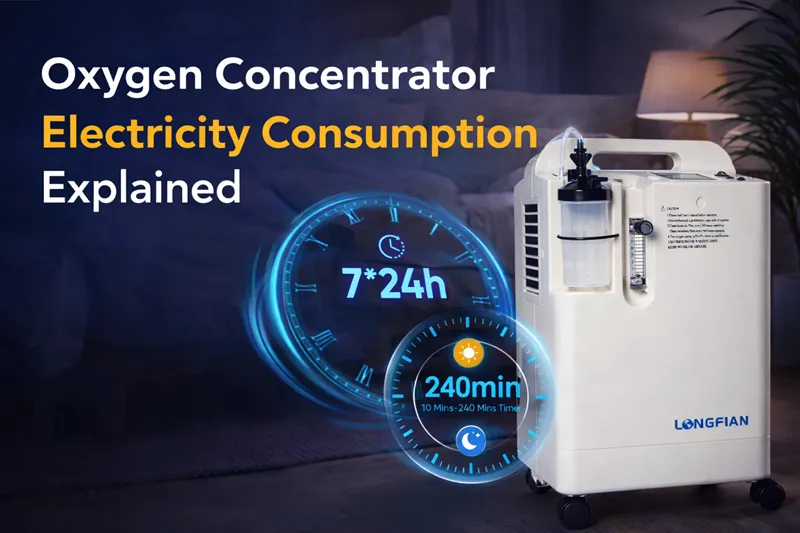
The second concern, very quickly, becomes electricity consumption. Families start worrying about rising power bills, inverter backup requirements, voltage fluctuations, and whether the concentrator can run safely during long hours without damaging the machine or overloading the home’s electrical system.
This concern is completely valid. An oxygen concentrator is not just another household appliance like a fan or television it is a life-support medical device that often runs for 8, 12, or even 24 hours a day. If you do not understand how much power it consumes and how to manage that consumption properly, it can lead to unnecessary expenses, unsafe power setups, and sudden therapy interruptions during power cuts.
At Aarogyaa Bharat - Live Healthy, Live Better, we regularly guide Indian families through oxygen concentrator power planning. This in-depth guide explains oxygen concentrator electricity consumption in simple terms, including wattage, monthly cost estimates, inverter sizing, safety tips, and real-world savings strategies.
What Is Oxygen concentrator Power Consumption?
Electricity consumption refers to the amount of electrical
power an oxygen concentrator uses while running. It is measured in watts (W) or
kilowatts (kW). The higher the wattage of a machine, the more electricity it
consumes per hour.
Oxygen concentrators use electricity mainly to power the
compressor, cooling fan, control electronics, and oxygen filtration system.
Larger machines with higher flow capacity require stronger compressors and
therefore consume more power. Smaller machines and portable concentrators
consume less electricity because they use smaller motors and pulse-dose
technology.
Understanding this power usage helps families estimate
monthly electricity bills, choose the right inverter or UPS backup, and avoid
overloading home circuits.
Typical Power Consumption of Oxygen Concentrators
Different oxygen concentrators consume different amounts of
electricity depending on their capacity, technology, and build quality.
A standard 5-litre per minute (LPM) oxygen concentrator
typically consumes between 300 and 600 watts per hour. best-quality
medical-grade models operate around 350-450 watts under normal conditions.
These machines are the most commonly used for home care in
India and offer a balanced mix of performance, energy efficiency, and
affordability. They are usually safe to run on standard household wiring and
medium-capacity inverters.
10 LPM Oxygen Concentrator
A 10 LPM oxygen concentrator consumes significantly more
power, typically between 600 and 1,200 watts per hour depending on the model
and oxygen purity load.
These machines are designed for severe respiratory cases and
ICU-level home care. Because of their higher power demand, they require
heavy-duty wiring, voltage stabilizers, and strong inverter backup systems.
Running a 10L machine without proper electrical planning can cause frequent
power trips and device damage.
Portable Oxygen Concentrator (POC)
Portable oxygen concentrators consume much less electricity
compared to stationary units. On average, they use 100-300 watts while
charging and much less when running on battery.
POCs use pulse-dose technology, which releases oxygen only
when the user inhales. This makes them highly energy-efficient and ideal for
travel, outdoor use, and low-flow oxygen therapy.
Oxygen Concentrator Power Consumption Table
|
Type of
Concentrator |
Typical
Wattage |
Best Use
Case |
|
5 LPM
Stationary |
300-600 W |
Home care,
COPD, post-COVID |
|
10 LPM
Stationary |
600-1,200 W |
Severe cases,
ICU care |
|
Portable POC |
100-300 W |
Travel,
outdoor mobility |
How Much Does an Oxygen Concentrator Increase Your
Electricity Bill?
To calculate electricity cost, we use the formula:
Electricity Cost = (Wattage × Hours Used Per Day × Days Used
Per Month) ÷ 1,000 × Cost Per Unit (₹)
Example 1: 5 LPM Concentrator (10 Hours Per Day)
• Power: 400 W
• Daily use: 10 hours
• Monthly usage: 30 days
Monthly units consumed = (400 × 10 × 30) ÷ 1,000 = 120 units
If electricity cost is ₹8 per unit:
Monthly cost = 120 × 8 = ₹960 per month
Example 2: 10 LPM Concentrator (12 Hours Per Day)
• Power: 900 W
• Daily use: 12 hours
• Monthly usage: 30 days
Monthly units consumed = (900 × 12 × 30) ÷ 1,000 = 324 units
If electricity cost is ₹8 per unit:
Monthly cost = 324 × 8 = ₹2,592 per month
Example 3: Portable Oxygen Concentrator (Charging 4 Hours
Daily)
• Power: 200 W
• Daily charging: 4 hours
• Monthly usage: 30 days
Monthly units consumed = (200 × 4 × 30) ÷ 1,000 = 24 units
Monthly cost = 24 × 8 = ₹192 per month
Does Oxygen Flow Rate Affect Electricity Consumption?
Yes, oxygen flow rate directly impacts electricity usage.
When you increase the flow rate, the compressor works harder to push more
oxygen through the system. This increases motor load and raises power
consumption slightly.
At lower flow rates, such as 1-2 LPM, a 5L concentrator
consumes less electricity than when operating at 4-5 LPM. However, the
difference is not massive because the machine still needs to run its cooling
fan and core electronics at all times.
This is why choosing the correct capacity matters. Buying a
10L concentrator for a patient who only needs 2 LPM results in unnecessary
power wastage and higher monthly electricity bills.
Why Voltage Stability Is Critical in India
India experiences frequent voltage fluctuations, power
surges, and blackouts. Oxygen concentrators are sensitive medical devices that
can be damaged by unstable electricity.
Low voltage can cause the compressor to overheat, while high
voltage can damage internal circuits. Both situations reduce machine lifespan
and can lead to sudden therapy interruptions.
That is why Aarogyaa Bharat strongly recommends using a
voltage stabilizer and inverter or UPS backup system for all home oxygen
setups.
Inverter & UPS Requirements for Oxygen Concentrators
• Minimum inverter capacity: 900 VA - 1.5 kVA
• Battery recommendation: 150-200 Ah
• Backup duration: 2-6 hours (depending on load)
For 10 LPM Concentrators
• Minimum inverter capacity: 2.5 kVA - 5 kVA
• Battery recommendation: 300-600 Ah
• Backup duration: 1-4 hours (depending on load)
For Portable Oxygen Concentrators
• No inverter needed for short outages
• External power banks or spare batteries recommended
• Car charging support for road travel
Safety Tips for Electrical Use At Home
• Always plug the concentrator directly into a wall socket
• Avoid extension cords or overloaded power strips
• Use a dedicated power outlet if possible
• Install a voltage stabilizer
• Keep power cables away from water
• Do not run heavy appliances on the same circuit
• Switch off the concentrator before relocating it
How to Reduce Oxygen Concentrator Electricity Costs
• Choose the correct machine capacity (5L vs 10L)
• Use only the doctor-prescribed flow rate
• Keep air filters clean for efficient operation
• Place the concentrator in a well-ventilated area
• Use energy-efficient branded models
• Avoid unnecessary continuous operation
• Turn off the machine when not needed
• Invest in a solar inverter backup if feasible
Renting vs Buying: Electricity Cost Impact
Electricity consumption remains the same whether you rent or
buy a concentrator. However, buying an energy-efficient model allows you to
choose lower-wattage machines with better long-term power savings.
When renting, always ask for wattage specifications and
choose newer, low-power models to reduce your monthly electricity bill.
Why Aarogyaa Bharat Is India’s Trusted Oxygen Partner
At Aarogyaa Bharat, we don’t just supply oxygen
concentrators we help families build safe, reliable, and power-efficient home
oxygen setups.
We offer:
• Energy-efficient concentrator models
• Doctor-guided machine selection
• Power backup consultation
• Installation and demo support
• Rental and purchase options
• After-sales service
• Emergency replacement support
Our mission is to protect both patient health and family
finances.
Conclusion
Oxygen concentrator electricity consumption is not something
families should ignore. Understanding wattage, monthly cost, inverter sizing,
and voltage safety can prevent dangerous therapy interruptions and unnecessary
power bills.
With the right machine, proper power backup, and good usage
habits, oxygen therapy can remain safe, affordable, and uninterrupted at home.
At Aarogyaa Bharat - Live Healthy, Live Better, we are
always here to help you breathe easier without shocking electricity bills.