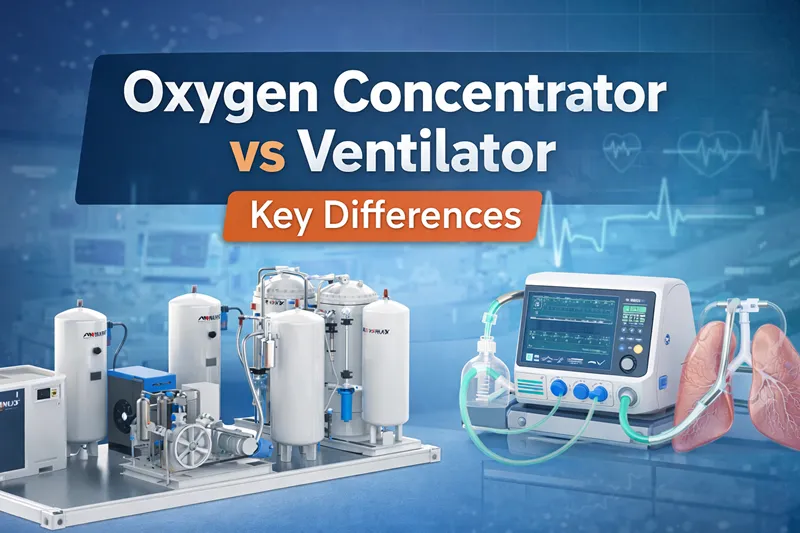
In reality, oxygen concentrators and ventilators are fundamentally different medical devices designed for completely different physiological problems. Using the wrong device in a critical situation can delay proper treatment, worsen the patient’s condition, and create dangerous false reassurance. An oxygen concentrator is meant to supply extra oxygen to a patient who is breathing independently but has low blood oxygen levels, while a ventilator is meant to mechanically assist or fully take over breathing for a patient who cannot breathe adequately on their own. Understanding the key differences between these two devices is not just a technical detail it is a life-saving knowledge requirement for families caring for elderly parents, lung disease patients, heart patients, post-surgical patients, and anyone at risk of respiratory distress. This ultra-comprehensive guide by Aarogyaa Bharat explains in clear, practical terms what an oxygen concentrator is, what a ventilator is, how each device works, when each is needed, who should use them, how they differ in function and risk, and how to make the right choice for home or hospital care.
What Is an Oxygen Concentrator and How It Works
An oxygen concentrator is an electrically powered medical
device that extracts oxygen from the surrounding air, filters out nitrogen
using molecular sieve technology, and delivers concentrated oxygen to the
patient through a nasal cannula or oxygen mask. Instead of storing oxygen like
a cylinder, it generates oxygen continuously as long as electricity is
available, making it fundamentally safer and more sustainable for home and
long-term use. The concentrator works in a cyclic process where room air is
drawn into the machine, compressed, passed through sieve beds that remove
nitrogen molecules, and then released as oxygen-enriched air with purity levels
typically ranging from ninety percent to ninety-five percent. Internal sensors
continuously monitor oxygen purity, pressure, and airflow, triggering alarms if
performance falls outside safe limits. From a physiological standpoint, an oxygen concentrator does
not create oxygen; it simply concentrates the oxygen already present in ambient
air, increasing the fraction of inspired oxygen (FiO₂) that reaches the lungs.
This allows more oxygen to diffuse into the bloodstream with each breath,
improving blood oxygen saturation without altering the patient’s natural
breathing pattern. Oxygen concentrators are designed for patients who are able
to breathe on their own but whose lungs cannot absorb enough oxygen due to
illness or injury. The device does not breathe for the patient; it simply
increases the oxygen content of the air they inhale, making each breath more
effective at delivering oxygen to the bloodstream
What Is a Ventilator and How It Works
A ventilator is a sophisticated life-support machine that
mechanically assists or completely replaces a patient’s breathing when they are
unable to breathe adequately on their own. It pushes air or oxygen-rich air
into the lungs under controlled pressure and volume, ensuring that oxygen
reaches the alveoli and carbon dioxide is expelled from the body.
Ventilators work through a breathing tube inserted into the
patient’s airway (invasive ventilation) or through a tight-fitting mask
(non-invasive ventilation such as BiPAP or CPAP). They are commonly used in
intensive care units, emergency rooms, operating theaters, and advanced home
ICU setups. From a physiological standpoint, a ventilator actively
controls breathing mechanics by setting parameters such as breath rate, tidal
volume, inspiratory pressure, oxygen concentration, positive end-expiratory
pressure (PEEP), and inhalation-exhalation timing. These machines do not just
deliver oxygen; they physically move air in and out of the lungs, compensating
for respiratory muscle failure or neurological impairment. Ventilators require constant medical supervision because
incorrect settings can cause lung overinflation, oxygen toxicity, carbon
dioxide retention, airway injury, and fatal complications.
The Core Functional Difference Between the Two Devices
The most important difference between an oxygen concentrator
and a ventilator lies in what they actually do for the patient at a biological
level. An oxygen concentrator supplies oxygen but does not assist breathing,
while a ventilator assists or replaces breathing but does not necessarily
supply oxygen unless connected to an oxygen source. An oxygen concentrator assumes that the patient’s lungs and
respiratory muscles are still functioning but need extra oxygen to compensate
for reduced lung efficiency or impaired gas exchange. A ventilator assumes that
the patient’s breathing is insufficient or failing altogether and therefore
takes over the work of breathing either partially or completely. This means that an oxygen concentrator is a support device
for hypoxemia, while a ventilator is a life-support device for respiratory
failure. Confusing these two roles is one of the most dangerous
mistakes families can make during a respiratory emergency.
When Is an Oxygen Concentrator Needed
An oxygen concentrator is needed when a patient is breathing
independently but has low blood oxygen levels due to medical conditions that
impair oxygen absorption or delivery. Common situations where an oxygen concentrator is used
include asthma flare-ups, COPD exacerbations, pneumonia, post-COVID lung
damage, pulmonary fibrosis, bronchiectasis, heart failure episodes,
post-surgical recovery, altitude sickness, anemia-related hypoxemia, and
chronic respiratory diseases that cause persistent oxygen deficiency. In all these cases, the patient can still inhale and exhale
without mechanical assistance, but the oxygen content of room air is not
sufficient to maintain healthy blood oxygen levels. The concentrator enriches
inhaled air with extra oxygen, stabilizing oxygen saturation and reducing
strain on the heart and brain. Oxygen concentrators are widely used at home, in clinics,
and in hospital wards because they are easy to operate, relatively low-risk,
and suitable for long-term therapy without constant medical supervision
When Is a Ventilator Needed
A ventilator is needed when a patient cannot breathe
adequately on their own or when their breathing is dangerously weak, irregular,
or absent. Situations that require ventilator support include severe
COVID-19 pneumonia, acute respiratory distress syndrome (ARDS), coma, major
head injury, spinal cord injury, neuromuscular diseases such as ALS, severe
drug overdose, anesthesia during surgery, advanced lung failure, and
respiratory arrest. Ventilators are also used during emergency resuscitation and
in critical care settings where precise control of oxygen delivery and
breathing mechanics is required. Unlike oxygen concentrators, ventilators are not suitable
for unsupervised home use because they require medical expertise, invasive
procedures, and continuous monitoring to prevent life-threatening
complications.
Real-Life Emergency Scenarios: Which Device Is Actually
Needed
In a post-COVID patient with sudden breathlessness and
oxygen saturation of 88 percent but who is still breathing normally, an oxygen
concentrator is the correct first-line device. In a COPD patient who is drowsy, gasping for air, and
showing signs of carbon dioxide retention, a ventilator may be required instead
of or in addition to oxygen therapy. In a heart failure patient experiencing fluid buildup in the
lungs but still breathing independently, an oxygen concentrator can stabilize
oxygen levels until hospital care is arranged. In a trauma victim with irregular breathing and reduced
consciousness, a ventilator is necessary because oxygen alone will not restore
effective breathing. These examples highlight why medical judgment is essential
when choosing between these two devices.
Risks of Using the Wrong Device
Using an oxygen concentrator when a patient actually needs a
ventilator can delay life-saving intervention and lead to respiratory collapse
because the concentrator cannot breathe for the patient. Conversely, using a ventilator unnecessarily when a patient
only needs supplemental oxygen can cause lung injury, infection, discomfort,
and serious complications due to invasive airway procedures. This is why correct diagnosis and medical guidance are
essential before choosing between these two devices.
Oxygen Concentrator vs Ventilator: Expanded Comparison
Table
|
Feature |
Oxygen
Concentrator |
Ventilator |
|
Primary
Function |
Supplies
oxygen |
Assists or
replaces breathing |
|
Breathing
Support |
No |
Yes |
|
Oxygen Source |
Extracts from
room air |
External
oxygen or room air |
|
Invasiveness |
Non-invasive |
Often
invasive |
|
Home Use |
Yes |
Rare |
|
Medical
Supervision |
Minimal |
Constant |
|
Risk Level |
Low |
Very high |
|
Cost |
Moderate |
Extremely
high |
|
Maintenance |
Low |
Very high |
|
Training
Required |
Basic |
Advanced
medical training |
|
Typical
Setting |
Home,
clinics, wards |
ICU,
emergency rooms |
|
Suitable for
Long-Term Use |
Yes |
No |
|
Power
Dependency |
Yes |
Yes |
|
Emergency Use |
Yes (first
aid) |
Yes (critical
care) |
|
Infection
Risk |
Low |
High |
|
Lung Injury
Risk |
Minimal |
Significant |
|
Setup
Complexity |
Simple |
Highly
complex |
|
Psychological
Comfort |
High |
Low |
|
Mobility |
Moderate |
Very low |
Which Device Is Right for Home Use
For most home healthcare needs, an oxygen concentrator is
the correct choice because it provides safe, continuous oxygen support for
patients who are still breathing independently. It is easy to operate,
affordable, and suitable for long-term use without constant medical
supervision. Ventilators, on the other hand, are rarely appropriate for
home use unless under specialized medical programs with trained caregivers,
doctors on call, and continuous monitoring equipment. They are complex,
expensive, and potentially dangerous if misused. Families should never attempt to replace a ventilator with
an oxygen concentrator or vice versa without explicit medical advice.
Cost, Accessibility, and Practicality Considerations
An oxygen concentrator typically costs a fraction of what a
ventilator costs and is widely available for home rental or purchase. It
requires minimal training and basic electrical infrastructure. A ventilator, by contrast, is extremely expensive, requires
trained medical staff, invasive procedures, constant monitoring, backup power
systems, and hospital-grade hygiene protocols. From a practical standpoint, an oxygen concentrator is the
only realistic respiratory support device for most households.
Why Aarogyaa Bharat Recommends Oxygen Concentrators for
Home Care
At Aarogyaa Bharat, we focus on matching the right
respiratory support solution to the patient’s actual medical needs rather than
selling high-risk equipment unnecessarily. We recommend oxygen concentrators for home care because they
provide reliable oxygen support, eliminate refill dependency, reduce safety
risks, and improve quality of life for patients with chronic or temporary
hypoxemia. Our team provides delivery, installation, training, and
service support so that families can use oxygen concentrators safely and
confidently at home.
Conclusion
An oxygen concentrator and a ventilator may both be
respiratory devices, but they serve entirely different medical purposes and
should never be confused or used interchangeably. An oxygen concentrator supplies oxygen to patients who are
breathing independently but have low blood oxygen levels. A ventilator
mechanically assists or replaces breathing for patients who cannot breathe
adequately on their own. Choosing the wrong device can delay treatment, worsen
outcomes, and create serious health risks. Understanding these key differences
empowers families to make safe, informed decisions and seek the right medical
care at the right time.