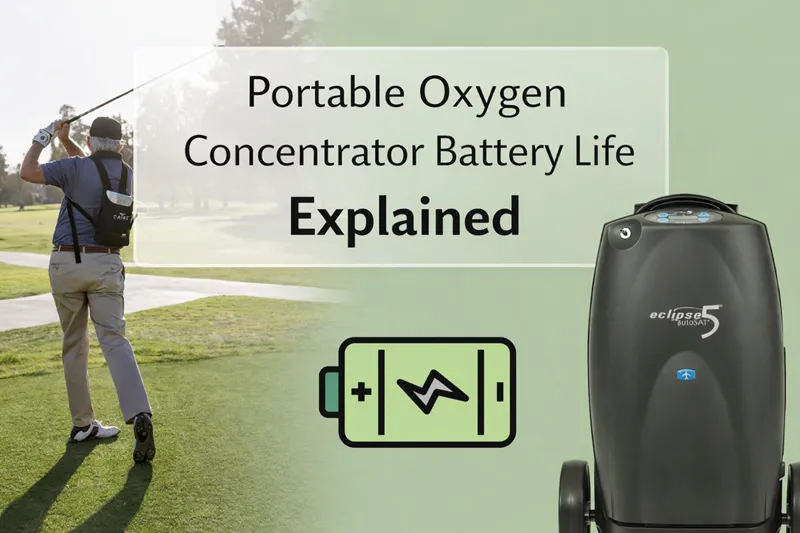
Many people assume that all portable oxygen concentrators offer similar battery performance, but in reality, battery life can vary dramatically depending on the model, oxygen flow setting, usage pattern, and even the weather. Some users experience a comfortable six to eight hours of runtime, while others struggle to get more than two hours from a fully charged unit. This confusion often leads to wrong buying decisions, unnecessary anxiety during travel, and avoidable emergencies.
This in-depth guide by Aarogyaa Bharat explains everything
you need to know about portable oxygen concentrator battery life in simple,
real-world terms. Whether you are planning to buy, rent, or upgrade a portable
oxygen concentrator, this article will help you understand how battery life
really works, what affects it, how to extend it, and which type of user needs
what level of backup.
What Is a Portable Oxygen Concentrator Battery and Why It
Matters
A portable oxygen concentrator battery is a rechargeable
lithium-ion power source that allows the machine to operate without being
connected to mains electricity. Unlike traditional oxygen cylinders, which
store a limited amount of oxygen gas, a concentrator produces oxygen
continuously from the surrounding air. This makes power availability the only
limiting factor for how long the device can run.
In everyday life, battery life determines how confidently a
patient can move around their home, go for medical checkups, attend family
functions, travel by train or air, or handle unexpected power cuts. A strong
battery setup can mean the difference between independence and dependency,
especially for elderly patients and people with chronic respiratory conditions.
Average Battery Life: What You Can Expect in Real Usage
Manufacturers often advertise ideal battery runtimes based
on laboratory conditions, but real-world usage usually delivers slightly lower
results. On average, portable oxygen concentrators in India fall into the
following broad categories:
Lightweight travel concentrators usually offer between two
and four hours of battery life on a single standard battery. Mid-range portable
models typically provide four to eight hours depending on flow settings.
High-capacity concentrators with dual batteries or extended battery packs can
run anywhere from eight to twelve hours or more. Some premium models, when
combined with optional extended batteries, can deliver up to sixteen or even
eighteen hours of total runtime.
However, these numbers are not fixed. The actual battery
life you experience depends heavily on how the machine is used, how much oxygen
is being delivered, and the surrounding environmental conditions.
Factors That Directly Affect Battery Life
Oxygen Flow Setting
The most important factor influencing battery performance is
the oxygen flow rate. Higher flow settings draw more power and reduce runtime
significantly. A user operating at a low setting such as level one or two will
experience much longer battery life than someone who requires level five or
six. For patients who only need mild oxygen supplementation, battery life can
often exceed advertised figures. For those with higher oxygen needs, battery
backup must be planned very carefully
Pulse Dose vs Continuous Flow
Portable oxygen concentrators generally operate in two
modes. Pulse dose machines release oxygen only when the user inhales, which
makes them far more energy efficient and ideal for mobile users. Continuous
flow machines provide a steady stream of oxygen regardless of breathing
pattern, which consumes significantly more power. While continuous flow is
medically necessary for some patients, it comes with the trade-off of shorter
battery life
Battery Capacity and Watt-Hour Rating
Battery capacity is measured in watt-hours, and higher
watt-hour ratings mean longer runtimes. Smaller batteries in the ninety to one
hundred watt-hour range typically last two to four hours. Mid-size batteries
between one hundred fifty and two hundred watt-hours may run four to eight
hours. Large extended batteries above two hundred fifty watt-hours can provide
eight to twelve hours or more. Some advanced concentrators support
hot-swappable batteries, allowing users to replace a drained battery without
turning off the device.
Temperature and Indian Climate Conditions
India’s climate plays a major role in battery performance.
High ambient temperatures cause lithium-ion batteries to drain faster, while
extreme cold reduces efficiency. Most portable oxygen concentrators perform
best between fifteen and thirty degrees Celsius. Using a concentrator outdoors
in peak summer heat can reduce battery life by fifteen to twenty-five percent
compared to indoor use.
Battery Age and Wear
Like mobile phone batteries, oxygen concentrator batteries
degrade over time. A new battery operates at full capacity, but after one year,
it may only hold eighty-five to ninety percent of its original charge. After
two to three years, capacity can drop to sixty-five to seventy-five percent.
This natural wear makes periodic battery replacement essential for long-term
users.
Realistic Battery Runtime by Flow Setting
|
Flow
Setting |
Estimated
Battery Life |
|
Level 1 |
6 to 10 hours |
|
Level 2 |
5 to 8 hours |
|
Level 3 |
4 to 6 hours |
|
Level 4 |
3 to 5 hours |
|
Level 5 to 6 |
2 to 4 hours |
These figures vary by model and battery size, but they
provide a practical expectation for everyday use.
How to Extend Portable Oxygen Concentrator Battery Life
Most users can significantly improve battery performance by
following a few simple habits. Carrying at least one spare battery ensures
uninterrupted oxygen supply during long outings or travel. Using pulse mode
whenever medically allowed can extend runtime by forty to sixty percent
compared to continuous flow. Avoiding direct sunlight and heat exposure
protects battery health and prevents overheating. Turning off the device when
not actively using it, even for short breaks, helps conserve power. Charging the
unit whenever a power source is available, whether at home, in a car, or at
public places, reduces dependence on a single battery cycle.
Charging Options Available in Most Portable Oxygen
Concentrators
Modern portable oxygen concentrators are designed for
flexible charging. Most models support wall chargers for home use, car chargers
for road travel, external battery docks for faster charging, and in some cases,
compatibility with high-capacity power banks. Charging time usually ranges
between two and five hours depending on battery size and charger strength.
Battery Life for Travel in India
Air travel requires careful planning because most airlines
mandate that passengers carry enough battery backup for at least one hundred
fifty percent of the total flight duration. Only FAA-approved concentrators are
permitted onboard, and spare batteries must be carried in hand luggage. Train
travel in India also demands strong battery backup due to limited charging
points and frequent power interruptions. For overnight journeys, a combined
backup of ten to twelve hours is recommended. For road trips, using a car
charger while driving helps preserve battery life for outdoor stops and
emergencies.
Common Battery Problems and Practical Solutions
|
Problem |
Likely
Cause |
Solution |
|
Battery
drains too fast |
High flow
setting |
Reduce flow
if medically allowed |
|
Battery not
charging |
Faulty
charger or cable |
Replace
adapter |
|
Sudden
shutdown |
Overheating |
Let device
cool and restart |
|
Reduced
runtime |
Old battery |
Replace
battery pack |
|
Slow charging |
Low-power
outlet |
Use wall
charger |
Buy vs Rent: Which Is Better for Battery Needs
Renting a portable oxygen concentrator is ideal for
short-term use such as post-COVID recovery, temporary oxygen therapy, travel
requirements, or trial before purchase. Rentals usually include fully tested
batteries, service support, and replacement options without extra cost. Buying
a concentrator is more suitable for long-term users with chronic conditions
like COPD. Ownership allows customized battery upgrades, long-term cost
savings, and full control over maintenance schedules.
Why Aarogyaa Bharat Focuses on Battery-Optimized Models
At Aarogyaa Bharat, we do not recommend machines based only
on price or advertised flow rates. We evaluate concentrators based on
real-world Indian usage conditions, battery backup reliability, service
availability, spare battery cost, charging versatility, and overall
portability. Every customer is guided toward a model that matches their medical
prescription, daily movement pattern, and travel requirements, ensuring
practical usability rather than just technical compliance.
Conclusion
Battery life is not just a technical specification. It defines your freedom to move, your confidence while traveling, your safety during power cuts, and your peace of mind every single day. Choosing the right portable oxygen concentrator means understanding how many hours you are away from power daily, whether you need travel backup, whether you can manage spare batteries, and whether pulse or continuous flow is right for your condition. Making the right decision today can prevent stress, emergencies, and extra expenses tomorrow.