Oxygen concentrators are commonly used to provide
supplemental oxygen to people who have been prescribed oxygen therapy by a
healthcare professional. Unlike traditional oxygen cylinders that store a
limited amount of compressed oxygen, concentrators take oxygen from surrounding
air and deliver concentrated oxygen through a prescribed delivery system.
However, not every concentrator is designed for the same purpose. Portable and
stationary oxygen concentrators have different designs, power requirements, mobility
options, operating characteristics, and practical uses. A stationary model is
generally designed for regular use at home, while a portable model is designed
to make movement and travel more convenient. Choosing between the two depends
on the patient's prescribed oxygen requirements, lifestyle, mobility, duration
of use, power availability, and healthcare provider's recommendations.
Understanding these differences can help patients and caregivers make a more
informed equipment decision.
Medical Disclaimer: Oxygen concentrators should be used only
according to the prescription and instructions provided by a qualified
healthcare professional. Do not change oxygen flow settings, discontinue
oxygen, or select a device based only on online information.
What Is an Oxygen Concentrator?
An oxygen concentrator is a medical device that takes air
from the surrounding environment and separates oxygen from other gases to
provide a higher concentration of oxygen to the user. The device generally uses
a compressor, filtration system, molecular sieve technology, and other internal
components to process air. Oxygen is then delivered through tubing and an
appropriate patient interface such as a nasal cannula, depending on the
prescribed therapy. Concentrators are available in different sizes and configurations,
including models designed primarily for home use and smaller units designed for
mobility. The actual oxygen concentration, flow capability, delivery mode,
battery performance, and operating instructions vary between models. Patients
should therefore review the manufacturer's specifications and consult their
healthcare professional before selecting a machine.
What Is a Stationary Oxygen Concentrator?
A stationary oxygen concentrator is generally designed to
remain in one location, most commonly inside a patient's home. These machines
are usually larger and heavier than portable models and are designed for
extended operation when connected to a suitable electrical power source. A
stationary unit can be useful for patients who spend most of their time at home
and require oxygen therapy for several hours a day or for longer periods
according to medical instructions. Many stationary models are designed to provide
continuous oxygen flow, although exact capabilities vary by model. Because they
are primarily intended for home use, they may offer higher airflow capabilities
and larger internal components compared with compact portable devices. Patients
should always verify the exact specifications of a particular model rather than
assuming that every stationary concentrator provides the same oxygen output.
What Is a Portable Oxygen Concentrator?
A portable oxygen concentrator is designed to provide
greater mobility for people who need supplemental oxygen while moving around
outside the home or between different locations. Portable models are generally
smaller and lighter than stationary machines and may include rechargeable
batteries, carrying handles, shoulder straps, carts, or other mobility
accessories. Depending on the model, oxygen may be delivered through continuous
flow, pulse-dose delivery, or both. Pulse-dose systems detect inhalation and provide
oxygen when the user breathes in, which can help conserve battery power.
However, pulse-dose delivery is not automatically appropriate for every patient
or every oxygen requirement. A healthcare professional should determine whether
the device's delivery mode and specifications are suitable for the patient's
prescribed therapy before purchase or rental.
Portable vs. Stationary Oxygen Concentrators: Key
Differences
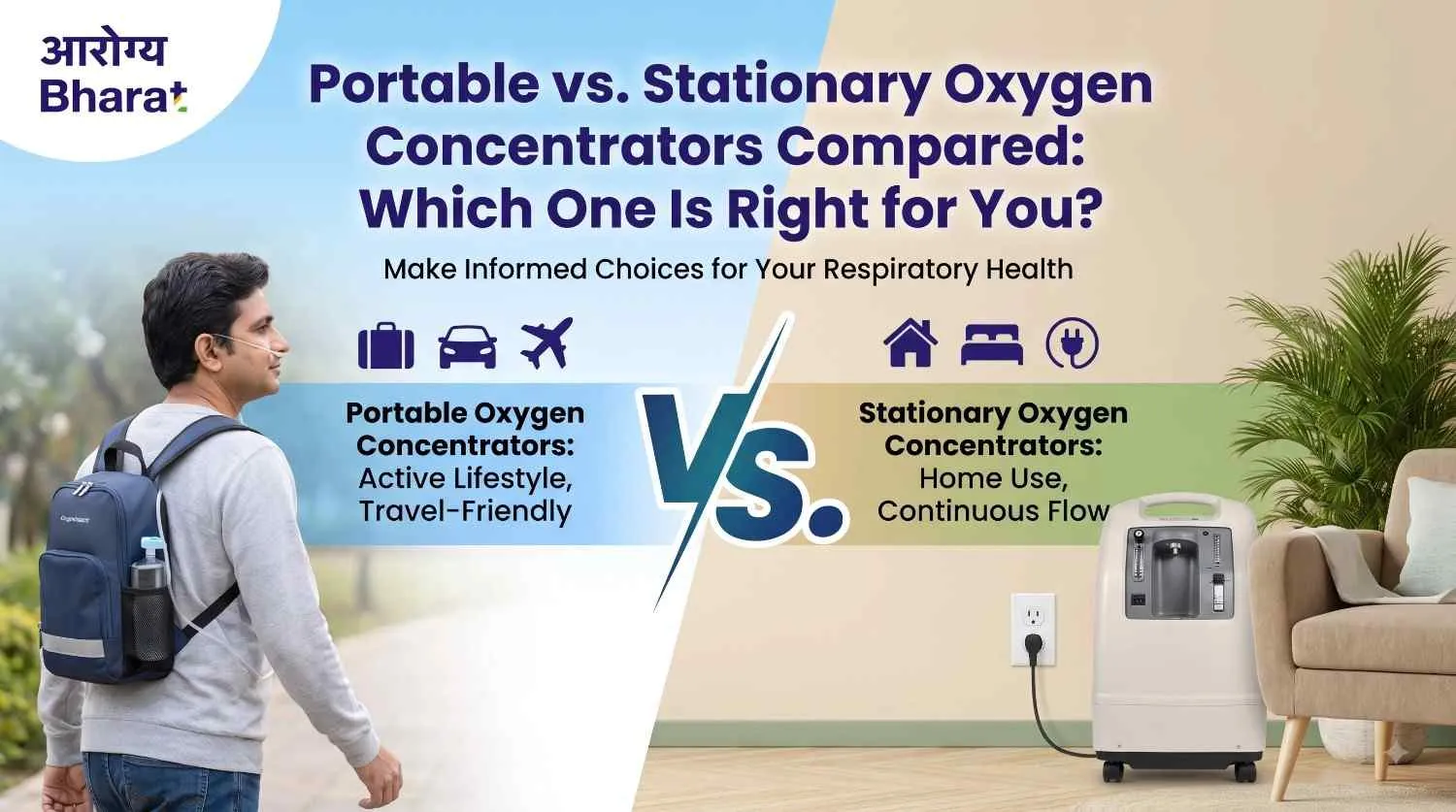
The biggest difference between portable and stationary
oxygen concentrators is their intended use. Stationary units prioritize
continuous home operation, while portable models prioritize mobility and
convenience. Portable machines are generally easier to carry and may operate
using batteries, making them useful for outdoor activities and travel when
medically appropriate. Stationary machines usually depend on household
electricity and are less convenient to move frequently. Portable models can
also have limitations involving battery duration, oxygen delivery mode, and
maximum flow compared with larger home units. The correct choice should
therefore be based on the patient's prescription rather than simply selecting
the smallest or most convenient machine. Some patients may benefit from having
both types available, with a stationary concentrator for regular home use and
an appropriate portable solution for mobility.
|
Feature |
Portable
Oxygen Concentrator |
Stationary
Oxygen Concentrator |
|
Main Purpose |
Mobility and
travel |
Regular home
use |
|
Size |
Compact |
Larger |
|
Weight |
Generally
lighter |
Generally
heavier |
|
Power |
Battery
and/or AC power |
Primarily AC
power |
|
Mobility |
High |
Limited |
|
Battery |
Usually
available |
Usually not
designed for battery mobility |
|
Delivery
Modes |
Often
pulse-dose, some continuous-flow models |
Commonly
continuous-flow, depending on model |
|
Travel
Convenience |
Better |
Less
convenient |
|
Home Use |
Suitable |
Highly
suitable |
|
Long
Operating Periods |
Depends on
battery/power |
Generally
designed for extended operation |
|
Best Choice |
Patients
needing mobility |
Patients
primarily using oxygen at home |
Portability and Ease of Movement
Portability is one of the most important advantages of a
portable concentrator. Patients who need oxygen but want to move between rooms,
attend appointments, visit family, or travel may find a compact machine easier
to manage. Some portable units can be carried using a shoulder bag, while
others can be placed on a small wheeled cart. Their lighter design can reduce
the physical effort involved in transporting the equipment. However,
portability should not be confused with suitability for every oxygen prescription.
A compact machine may not provide the flow capability required by a particular
patient. Families should check the prescribed oxygen requirement and compare it
with the device's actual specifications before choosing a portable unit.
Convenience is valuable, but medical suitability should always come first.
Home Use and Long-Term Oxygen Therapy
Stationary concentrators can be particularly practical for
patients who spend most of their time at home and require oxygen for extended
periods. Their larger design can accommodate components intended for prolonged
operation, while direct electrical power eliminates the need to monitor battery
capacity during normal household use. A stationary concentrator can be placed
in a suitable room with adequate ventilation and connected to the patient's
oxygen tubing. Caregivers should ensure that the tubing is arranged safely to
avoid creating a trip hazard. The machine should also be positioned according
to the manufacturer's ventilation requirements and kept away from heat, smoke,
flames, and other hazards. Patients who require oxygen for many hours each day
should discuss the most appropriate equipment configuration with their
healthcare professional and equipment provider.
Battery Life and Power Requirements
Power requirements are another major difference between
portable and stationary concentrators. Portable models may include rechargeable
batteries that allow the user to operate the device away from a wall outlet for
a specified period. Actual battery duration depends on the model, oxygen
delivery setting, battery condition, temperature, and usage pattern. Patients
planning to travel should understand the expected battery duration and charging
requirements before leaving home. Stationary machines generally operate from
household electrical power, which makes them convenient for extended home use
but limits mobility during power interruptions. Families using a stationary
device should discuss appropriate backup arrangements with their healthcare
provider and equipment supplier if uninterrupted oxygen is medically required.
Power backup decisions should be based on the patient's clinical needs and the
specific equipment being used.
Oxygen Delivery: Continuous Flow vs. Pulse Dose
Oxygen delivery mode is one of the most important factors
when comparing concentrators. Continuous-flow systems deliver oxygen
continuously at the prescribed rate, while pulse-dose systems provide oxygen in
response to detected inhalation. Portable concentrators often use pulse-dose
technology to improve battery efficiency, although some portable models also
provide continuous-flow options. Not every patient can use a pulse-dose system
successfully, particularly if their breathing pattern or medical requirements
make reliable breath detection difficult. A patient should never switch from
continuous flow to pulse dose simply because a portable machine is more
convenient. The healthcare professional should determine which delivery mode is
appropriate. Equipment selection should therefore begin with the oxygen
prescription and only then consider portability, battery life, size, and other
convenience features.
Which Oxygen Concentrator Is Better for Travel?
For patients who have been medically cleared to travel with
oxygen, a portable concentrator can provide greater convenience than a
stationary model. Its compact design can make transportation easier during car
journeys, appointments, and other activities. Some portable models are designed
with rechargeable batteries and travel accessories that support greater
mobility. However, travel planning should include battery requirements,
charging options, destination conditions, airline or transport rules where
applicable, and backup arrangements. Patients should not assume that every
portable concentrator is approved for every type of travel. The specific model
and travel requirements should be confirmed before departure. A healthcare
professional should also confirm that the patient's oxygen needs can be safely
managed during the planned journey.
Choosing Equipment for Home and Outdoor Use
Patients who spend most of their time indoors may find a
stationary concentrator sufficient for their normal routine. Someone who
regularly leaves home for medical appointments, family activities,
rehabilitation, or other approved activities may benefit from a portable option
if it meets their prescription. In some situations, having separate home and
portable equipment may provide greater flexibility. A stationary machine can
remain in the primary living area while a portable unit can be used for mobility.
Families should consider whether the patient can safely carry or control the
portable device and whether the battery can support the expected activity. The
best equipment setup is not necessarily the one with the most features. It is
the one that safely matches the patient's prescribed oxygen requirements, daily
routine, physical ability, and environment.
Maintenance Differences Between Portable and Stationary
Models
Both types of oxygen concentrators require appropriate
maintenance. Filters, tubing, electrical connections, ventilation areas, and
other user-serviceable components should be maintained according to the
manufacturer's instructions. Portable machines may require additional attention
to battery condition, charging practices, carrying accessories, and physical
protection during transportation. Stationary machines may require particular
attention to ventilation, dust accumulation, operating hours, and placement.
Neither type should be opened or internally repaired by an unqualified user.
Professional servicing may be required when the machine develops unusual noise,
overheating, alarms, reduced output, unexpected shutdowns, or other performance
problems. Regular maintenance can help identify potential issues earlier and
support reliable equipment operation.
Portable Oxygen Concentrator for Active Seniors
A portable oxygen concentrator may provide greater
independence for seniors who have been prescribed oxygen and are medically able
to remain active. Instead of remaining beside a stationary machine, the user
may be able to move around the home or participate in suitable activities with
a portable device. However, the patient's physical strength, balance, walking
ability, and ability to manage the equipment should also be considered.
Carrying a device or pulling a cart may not be suitable for someone with significant
weakness. In such situations, caregiver support or another equipment
arrangement may be necessary. The goal should be safe mobility rather than
simply maximizing activity. A healthcare professional can help determine
whether portable oxygen equipment fits the patient's mobility level and
treatment requirements.
Stationary Oxygen Concentrator for Home-Based Patients
A stationary concentrator may be appropriate for patients
who require oxygen primarily while resting or sleeping at home and do not
frequently need to travel. Its larger frame is less important when the machine
remains in one room, and direct electrical operation can be convenient for
extended use. Families can position the device in a clean, well-ventilated area
and organize tubing so that the patient can move safely. If the patient needs
to move between rooms frequently, the family may need to consider whether the
tubing length and layout are practical and safe. A professional assessment can
help identify potential trip hazards and determine whether additional mobility
equipment is needed. The machine should always be used according to the
manufacturer's instructions and the patient's prescription.
Cost Considerations When Choosing an Oxygen Concentrator
Cost is an important consideration when selecting medical
equipment, but it should not be the only factor. Portable oxygen concentrators
may have higher costs because of their compact design, batteries, portability
features, and specialized technology. Stationary units can be more practical
for long-term home use when mobility is not a major requirement. Rental may
also be an option for patients who need oxygen equipment temporarily or want to
evaluate a device before making a purchase, depending on availability and
medical requirements. Families should compare the complete cost rather than
only the initial purchase price. Factors such as servicing, accessories,
batteries, warranty, replacement parts, electricity consumption, and technical
support can affect the long-term cost of ownership.
How to Choose the Right Oxygen Concentrator
The right oxygen concentrator should be selected by
considering medical requirements first and convenience second. Start by
understanding the prescribed oxygen flow, required duration, delivery mode, and
whether oxygen is needed continuously or during particular activities. Then
consider whether the patient spends most of the day at home or needs regular
mobility. Weight, battery life, charging options, noise level, oxygen output,
dimensions, portability, maintenance requirements, and service availability can
then be compared. Patients should also consider whether they can safely carry,
pull, or operate the equipment. If the user has difficulty with mobility or
hand strength, caregiver assistance may be required. A qualified healthcare
professional and reliable equipment provider can help match the device to the
patient's actual needs.
Important Features to Compare Before Buying
When comparing oxygen concentrators, patients and caregivers
should look beyond appearance and advertised portability. Check the
manufacturer's specifications for oxygen concentration, flow capability,
delivery mode, battery capacity, operating noise, dimensions, weight, power
requirements, warranty, and service support. For portable models, understand
whether the quoted battery duration applies to the exact flow or pulse-dose
setting that the patient will use. For stationary machines, consider operating
hours, ventilation requirements, tubing length, and power backup needs.
Customers exploring Oxygen Equipment should also confirm whether
accessories such as batteries, chargers, tubing, carrying cases, or carts are
included. Equipment should always be matched to the patient's prescribed oxygen
therapy rather than selected purely on price or convenience.
Oxygen Concentrator Rental: When It May Be Useful
Rental can be useful when oxygen therapy is needed
temporarily, when a patient is recovering after hospitalization, or when a
family wants equipment for a limited period. It can also reduce the need for a
large upfront purchase in some situations. Customers exploring Oxygen
Concentrator Rental should ask about rental duration, equipment condition,
servicing, replacement arrangements, delivery, installation guidance,
accessories, and technical support. The rental provider should also confirm
that the machine's specifications match the patient's prescription. Families
should not assume that a rented machine is automatically appropriate simply
because it is available. Medical suitability should be confirmed before use. A
rental agreement should clearly explain responsibilities for maintenance,
damage, replacement, and emergency technical support.
Other Healthcare Products for Oxygen Users
Some patients who require oxygen may also need additional
equipment to support mobility, comfort, and daily living. Depending on the
patient's condition, a healthcare professional may recommend products such as a
wheelchair, walker, hospital bed, commode, or other support equipment. Aarogyaa
Bharat provides healthcare-related product categories that can help families
explore different home-care requirements. Customers can explore Home
Healthcare Products when creating a suitable care environment for a
patient. Other useful categories may include Respiratory Care Products, Patient
Care Products, and Mobility Aids, depending on individual
requirements. Products should be selected according to the patient's physical
condition, home environment, and professional recommendations rather than
purchasing multiple products without a clear need.
Oxygen Safety at Home
Oxygen safety is essential regardless of whether the patient
uses a portable or stationary concentrator. Oxygen supports combustion, so
smoking, flames, candles, incense, gas appliances, and other ignition sources
should be kept away from oxygen equipment. The concentrator should be placed
where ventilation is adequate and where its openings are not blocked. Tubing
should be positioned carefully to reduce the risk of tripping. Electrical
connections should be used according to manufacturer instructions, and damaged
cables or plugs should not be used. Families can explore Home Safety
Products when preparing a safer home environment. Caregivers should also
understand the equipment's alarms and emergency procedures. If a machine
develops a burning smell, smoke, sparks, severe overheating, or another serious
fault, follow the manufacturer's safety instructions and contact appropriate
technical or emergency support.
Portable vs. Stationary: Which One Should You Choose?
There is no single oxygen concentrator that is best for
every patient. A stationary model may be more suitable for someone who spends
most of the day at home and requires extended oxygen use from an electrical
supply. A portable model may be more suitable for someone who has a medically
approved need for oxygen while moving around and requires greater mobility.
Some patients may need a combination of home and portable solutions. The final
choice should depend on the prescribed oxygen requirements, delivery method,
physical ability, lifestyle, travel needs, battery requirements, and
availability of technical support. Customers should compare models carefully
and consult their healthcare professional before changing equipment.
Convenience should never take priority over appropriate oxygen delivery.
Healthcare Information and Support from Aarogyaa Bharat
Aarogyaa Bharat provides healthcare information and
equipment resources for patients, caregivers, and families managing home-care
needs. Customers can explore Medical Equipment and related healthcare
categories according to their requirements. When choosing an oxygen
concentrator, it is important to consider not only the machine but also
availability of servicing, accessories, technical support, delivery, and
after-sales assistance. Families may also review Aarogyaa Bharat Hospital
Page for healthcare-related information and resources. Online information
can help users understand equipment features and terminology, but the patient's
doctor or qualified healthcare professional should remain the primary source
for medical decisions. This is especially important when selecting oxygen
delivery modes or changing equipment.
Aarogyaa Bharat City Pages and Local Healthcare Access
Healthcare equipment availability and service support can
vary depending on location. Patients searching for oxygen concentrators,
rentals, mobility products, and home healthcare solutions may benefit from
checking Aarogyaa Bharat City Pages for location-specific information.
Before ordering or renting equipment, customers should confirm current product
availability, delivery options, service coverage, and technical support in
their area. Local availability can be especially important when equipment is
needed urgently after hospital discharge. Families should also confirm whether
installation guidance and replacement support are available. Choosing a
provider that can offer reliable local assistance can make equipment management
easier, especially for patients who depend on oxygen therapy for extended
periods.
Healthcare Calculator and Oxygen Requirements
Online tools can provide general health information, but a Healthcare
Calculator should never be used to determine or change a patient's oxygen
prescription. Oxygen requirements depend on the individual's medical condition
and should be established by a qualified healthcare professional. A pulse
oximeter reading, symptoms, or an online calculation should not be interpreted
independently to change the oxygen flow rate. If oxygen saturation changes or
the patient experiences worsening symptoms, medical advice should be obtained.
Similarly, equipment selection should be based on the prescribed oxygen flow
and delivery requirements rather than a general online recommendation.
Healthcare calculators can support education, but they do not replace clinical
assessment or professional oxygen-therapy guidance.
Quick Checklist Before Buying or Renting
- Confirm
the patient's prescribed oxygen flow and delivery method.
- Determine
whether continuous flow or pulse dose is required.
- Decide
whether oxygen is primarily needed at home or during mobility.
- Check
the concentrator's oxygen concentration specifications.
- Compare
weight and dimensions.
- Check
battery capacity for portable models.
- Confirm
charging requirements and power options.
- Review
noise level and operating requirements.
- Check
warranty and professional service availability.
- Ask
about accessories and replacement parts.
- Confirm
rental or purchase terms.
- Check
delivery and technical support availability.
- Consider
backup power or oxygen arrangements when medically required.
- Make
sure the user can safely manage the equipment.
- Consult
a healthcare professional before making a major equipment change.
Conclusion
Portable and stationary oxygen concentrators both provide important advantages, but the right choice depends on the patient's prescribed oxygen requirements, lifestyle, mobility, home environment, and need for travel. Stationary concentrators are generally better suited to extended home use, while portable models offer greater freedom for patients who need oxygen while moving around or traveling. However, portability alone should never determine the decision because battery duration, oxygen delivery mode, flow capability, and the patient's medical needs are equally important. Before purchasing or renting a concentrator, compare the technical specifications, service support, maintenance requirements, power options, and total cost. Most importantly, use the device exactly as prescribed and consult a qualified healthcare professional before changing oxygen equipment or delivery settings.
Medical Disclaimer
This article is provided for general educational purposes
only and does not replace professional medical advice, diagnosis, or treatment.
Oxygen therapy should be used only when prescribed by a qualified healthcare
professional. Never increase, decrease, or discontinue prescribed oxygen
without medical guidance. The suitability of continuous-flow or pulse-dose
oxygen depends on the patient's individual clinical needs. Always follow the
manufacturer's instructions for operating, cleaning, charging, storing, and
maintaining an oxygen concentrator. If a patient experiences severe breathing
difficulty, chest pain, confusion, loss of consciousness, or rapidly worsening
symptoms, seek urgent medical attention.