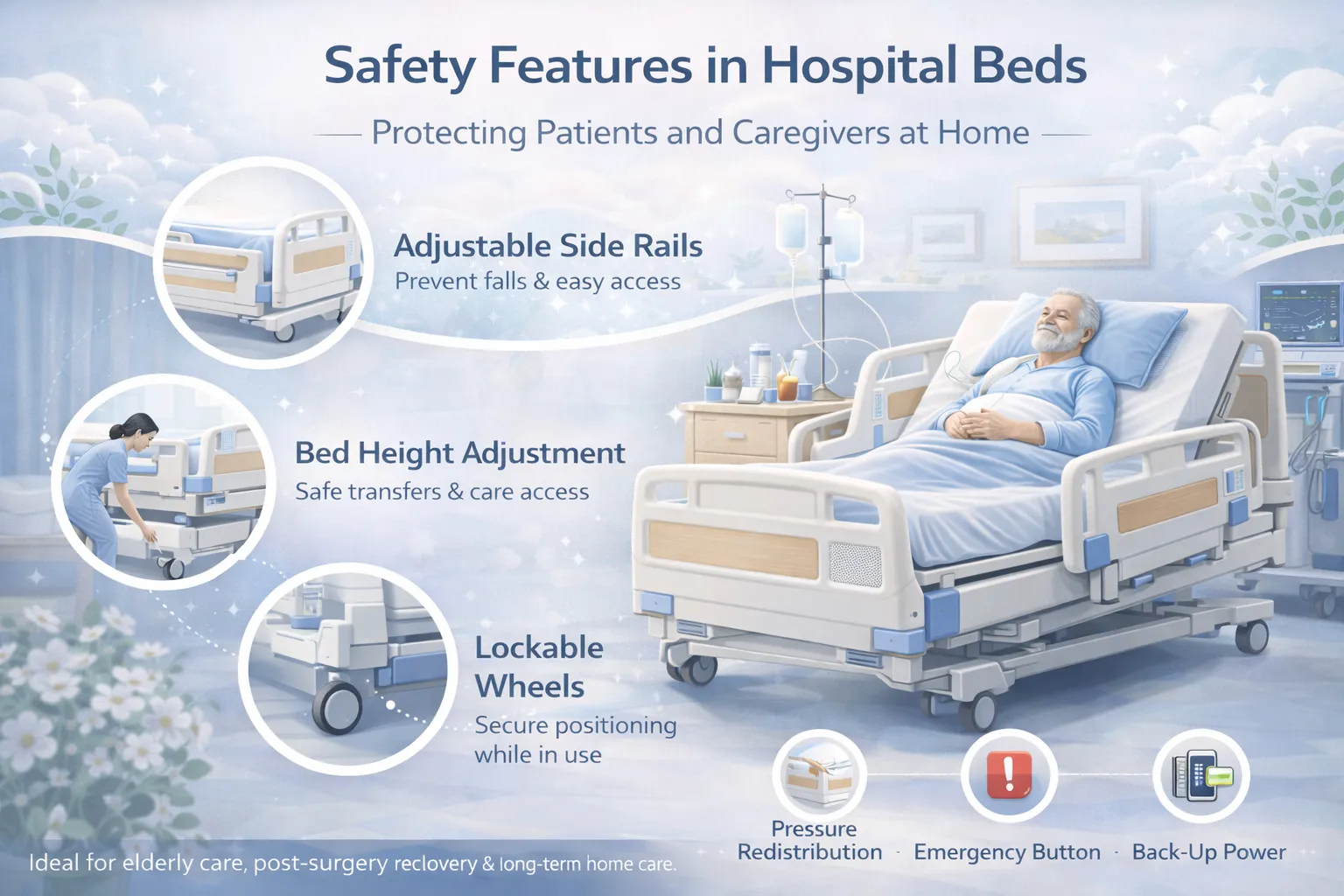
Why Safety in Hospital Beds Is So Important
Patients receiving care at home often face:
- Weak balance
- Limited mobility
- Dizziness or confusion
- Risk of falling while turning or standing
- Dependence on caregivers for movement
A normal household bed offers no built-in protection for these challenges.
Hospital beds for home care are engineered to:
- Prevent falls and injuries
- Support safe movement and transfers
- Protect patients during sleep and repositioning
- Reduce physical strain on caregivers
Core Safety Features in Modern Hospital Beds
1. Side Rails: Preventing Falls and Providing Support
Side rails are one of the most essential safety features.
They:
- Prevent accidental falls from bed
- Provide support while turning or sitting up
- Offer psychological reassurance to anxious patients
- Help patients reposition themselves safely
Side rails are especially important for:
- Elderly
patients
- Bedridden
individuals
- Patients
with neurological conditions
- Post-surgery
recovery
2. Height Adjustment for Safe Transfers
A bed that is too high or too low can make standing up or
sitting down dangerous.
Hospital beds with height adjustability allow:
- Lower bed height for safe entry and exit
- Higher bed height for caregiver access
- Reduced risk of falls during transfers
- Easier movement between bed and wheelchair
This feature is vital for both patient safety and caregiver
ergonomics.
3. Electric Controls for Controlled Movement
Electric hospital beds allow patients or caregivers to
change positions using a remote control.
This ensures:
- Smooth, jerk-free movement
- No sudden posture changes
- Reduced physical lifting
- Lower risk of muscle strain or injury
For patients with limited strength, this provides
independence and safer positioning.
4. Lockable Wheels and Stable Frames
Hospital beds are often mobile for cleaning or repositioning
within the room.
Safety comes from:
- Lockable caster wheels to prevent unwanted movement
- Strong, medical-grade frames for stability
- Anti-slip foot design
These features ensure the bed remains secure when the
patient is resting or transferring.
5. Anti-Entrapment Design
Modern hospital beds are designed to minimize gaps between:
- Mattress
and side rails
- Bed
frame and moving sections
This prevents:
- Limbs getting trapped
- Risk of suffocation
- Accidental injuries during repositioning
6. Compatibility with Safety Mattresses
Hospital beds support specialized mattresses such as:
- Anti-bed-sore (pressure-relief) mattresses
- Air mattresses
- Medical-grade foam mattresses
These reduce:
- Pressure ulcers
- Skin breakdown
- Circulation problems
How Safety Features Protect Different Types of Patients
Elderly Patients
- Reduced
fall risk
- Easier
entry and exit
- Better
night-time security
Bedridden & Long-Term Care Patients
- Prevention
of bed sores
- Safe
repositioning
- Reduced
complications
Neurological & Paralysis Patients
- Protection
during involuntary movements
- Support
during physiotherapy
- Improved
caregiver control
Post-Surgery & Rehabilitation Patients
- Stable
recovery environment
- Controlled
posture changes
- Lower
risk of re-injury
Respiratory & Cardiac Patients
- Safe
elevation for breathing
- Reduced
strain during position changes
- Better
oxygen therapy support
Caregiver Safety: Often Overlooked but Crucial
Safety is not only about the patient it also protects
caregivers.
Hospital bed features reduce:
- Heavy lifting
- Awkward bending
- Back injuries
- Fatigue during daily care
With adjustable height and electric movement:
- Repositioning
becomes easier
- Hygiene
care is safer
- Transfers
are more controlled
Common Safety Mistakes in Home Care
- Using a regular bed for immobile patients
- No side rails for fall prevention
- Improper bed height
- Slippery floors around the bed
- Inadequate lighting at night
- Poor mattress support
These mistakes can lead to falls, pressure sores, and
caregiver injuries.
Practical Safety Tips for Using Hospital Beds at Home
- Always lock bed wheels after positioning
- Keep side rails raised when the patient is resting
- Ensure remote controls are within reach
- Maintain clutter-free surroundings
- Use night lights for visibility
- Regularly check bed mechanisms and mattress condition
Small safety habits prevent major accidents.
Why Aarogyaa Bharat Prioritizes Safety
At Aarogyaa Bharat, every hospital bed is selected with
patient protection, caregiver ease, and long-term reliability in mind.
What We Provide:
- Hospital beds with advanced safety features
- Expert guidance for choosing the safest configuration
- Professional installation and setup
- Equipment designed for Indian home environments
- Ongoing support for home care needs
We don’t just supply beds we help families create a safe
care environment.
Conclusion: Safety Is Not Optional It’s Essential
In home healthcare, safety is not an extra feature it is the
foundation of every successful care plan. A hospital bed equipped with proper
safety mechanisms ensures:
Protection from falls and injuries
Comfort during long-term care
Confidence for patients
Peace of mind for families
Reduced caregiver strain
With Aarogyaa Bharat, you are not just choosing equipment you
are building a safer, more dignified, and more compassionate care environment
for your loved ones.