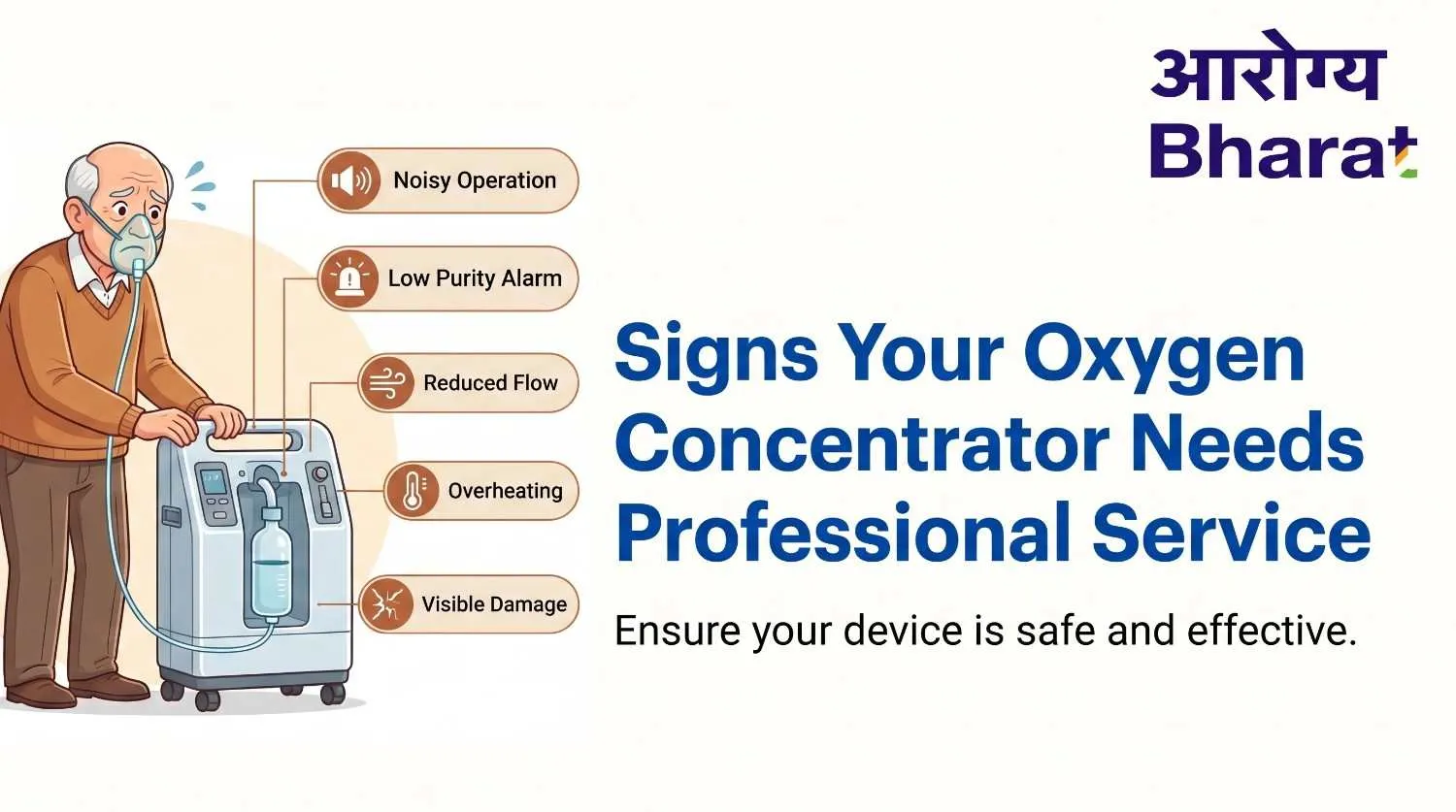
An oxygen concentrator is an important medical device used
to provide supplemental oxygen to patients who have been prescribed oxygen
therapy. Because many concentrators operate for several hours each day, their
internal components can experience continuous mechanical, electrical, and
thermal stress. Dust, poor ventilation, dirty filters, voltage fluctuations,
moisture, and long operating hours can gradually affect performance. In some
cases, the machine may continue running even though its oxygen output or
internal performance is no longer ideal. This makes it important for patients
and caregivers to recognize early warning signs instead of waiting for a
complete breakdown. Aarogyaa Bharat recommends regular maintenance, filter
care, ventilation, and professional servicing because problems such as unusual
noise, overheating, reduced oxygen flow, frequent alarms, and unexpected
shutdowns can indicate that technical inspection is required.
Medical Disclaimer: An oxygen concentrator should be
used only according to the oxygen prescription and instructions provided by a
qualified healthcare professional. Never change the prescribed oxygen flow rate
because of a machine problem without professional medical guidance.
Why Professional Oxygen Concentrator Service Is Important
Professional servicing is different from routine cleaning
that patients or caregivers can perform at home. Basic maintenance may include
cleaning external surfaces, checking tubing, maintaining the recommended
filter-cleaning routine, and keeping the machine in a properly ventilated
location. Professional service involves checking the internal performance of
the device and identifying problems that may not be visible from the outside.
Depending on the model, a qualified technician may inspect the compressor,
cooling system, oxygen sensors, filters, sieve beds, electrical components,
alarms, airflow, and oxygen concentration. Aarogyaa Bharat recommends
professional servicing at appropriate intervals depending on the machine type
and usage intensity, with heavier-use machines potentially requiring more
frequent attention. Regular professional inspection can help identify gradual
performance deterioration before it develops into a major breakdown,
particularly for patients who rely on oxygen therapy for extended periods.
Sign 1: Oxygen Flow Seems Lower Than Normal
A noticeable reduction in oxygen flow is one of the most
important signs that a concentrator may require attention. If the flowmeter
appears to behave differently from normal, oxygen seems weaker than expected,
or the patient notices a difference despite the prescribed setting remaining
unchanged, the equipment should be checked. A reduction can sometimes be caused
by a kinked tube, blocked cannula, loose connection, or another simple issue,
but persistent reduced output may indicate a deeper equipment problem. Internal
components such as the compressor, sieve beds, valves, sensors, or filtration
system can affect the machine's ability to produce the expected oxygen
concentration and flow. Patients should not simply increase the flow setting to
compensate for suspected equipment problems. If the basic external checks do
not resolve the issue, contact a qualified service provider and follow the
patient's medical plan.
Sign 2: The Oxygen Concentrator Starts Making Unusual
Noise
Oxygen concentrators naturally produce some operating noise
because they contain compressors, fans, and other mechanical components.
However, a sudden change in sound should not be ignored. A machine that becomes
significantly louder than usual, develops a rattling sound, produces repeated
clicking, or begins vibrating unusually may require inspection. Increased noise
can sometimes result from restricted airflow or dirty filters, while persistent
vibration or mechanical sounds may indicate wear or a component that requires
professional attention. Aarogyaa Bharat identifies loud or unusual noise and
vibration as important warning signs during long-term concentrator use. Before
calling a technician, caregivers can check whether the machine is positioned
correctly and whether its external ventilation areas are clear. If the unusual
sound continues after basic checks, professional servicing is safer than
opening the machine or attempting an internal repair.
Sign 3: The Machine Becomes Excessively Hot
Some warmth during operation can be normal, but excessive
heat from the concentrator casing can indicate restricted ventilation, a
cooling problem, or excessive internal stress. The machine should always have
adequate space around its ventilation openings so that air can circulate
properly. Placing the concentrator against a wall, under bedding, inside a
cupboard, or close to curtains can restrict airflow and cause overheating.
Dirty filters can also make the compressor work harder, increasing heat generation.
Aarogyaa Bharat recommends keeping the device in a cool, dry, well-ventilated
location and avoiding conditions that restrict airflow. If the concentrator
repeatedly becomes unusually hot even after proper placement and cleaning, stop
relying on it as though nothing is wrong and contact the equipment provider.
Overheating accompanied by an alarm, shutdown, burning smell, or electrical issue
deserves immediate technical attention.
Sign 4: Frequent Alarms or Warning Lights Appear
Oxygen concentrators may include alarms and indicator lights
designed to alert users to conditions such as power failure, low oxygen
concentration, blocked airflow, overheating, or other equipment problems. A
single alarm caused by a temporary issue may sometimes be resolved by following
the manufacturer's troubleshooting instructions. However, frequent or
unexplained alarms should not be ignored. If the machine repeatedly beeps
despite apparently normal operation, the alarm system or an underlying component
may need professional inspection. Aarogyaa Bharat specifically advises users
not to ignore alarm and error indicators because they can provide early warning
of performance or safety problems. Patients should consult the machine's manual
and equipment provider to understand the alarm before attempting any repair.
Never repeatedly silence an alarm simply to continue using the machine without
determining why it is occurring.
Sign 5: The Concentrator Shuts Down Unexpectedly
Unexpected shutdowns are another major warning sign,
particularly when the patient depends on continuous or frequent oxygen therapy.
A concentrator may shut down because of overheating, electrical problems,
internal component failure, blocked airflow, or another fault depending on the
model. If the machine switches off unexpectedly once, check the manufacturer's
basic troubleshooting instructions and power connection. If shutdowns happen
repeatedly, professional service is necessary. Aarogyaa Bharat lists automatic
shutdowns among signs that a concentrator may need servicing during extended
operation. Patients who require uninterrupted oxygen should have an appropriate
backup plan established in advance rather than waiting until a machine failure
occurs. The correct backup oxygen source should be discussed with the patient's
healthcare professional and equipment provider.
Sign 6: You Notice a Burning Smell
A burning smell from an oxygen concentrator should be
treated seriously. It may indicate an electrical problem, overheating
component, damaged cable, or another fault that requires immediate attention.
Do not continue operating a machine that produces a strong burning or
electrical smell simply because oxygen is still coming through the tubing.
Switch off the equipment if it is safe to do so, disconnect it from the power
source when appropriate, keep ignition sources away, and contact the equipment
provider or qualified technician. Aarogyaa Bharat identifies a burning smell as
a warning sign requiring immediate attention. Oxygen also supports combustion,
so fire safety around oxygen equipment is particularly important. Never smoke
or allow open flames, candles, incense, or other ignition sources near a
patient receiving oxygen.
Important Safety Warning: If you see sparks, smoke,
melted electrical components, or signs of fire, move away from the equipment
and follow your local emergency procedure. Do not attempt an electrical repair
yourself.
Sign 7: Oxygen Purity Appears to Be Dropping
Oxygen purity is an important performance characteristic
that cannot always be judged simply by looking at the machine. A concentrator
may continue running while its internal performance gradually deteriorates.
Problems involving molecular sieve beds, sensors, compressors, valves, filters,
or airflow can affect oxygen concentration. Professional technicians can use
appropriate testing equipment to evaluate oxygen concentration and other
operating parameters. Aarogyaa Bharat notes that professional servicing can
include oxygen purity testing, compressor inspection, flow calibration, and
internal component checks. Patients should never assume that oxygen is being
delivered at the expected concentration merely because the machine is switched
on. If the device has an oxygen purity indicator and it shows a persistent
abnormal reading, follow the manufacturer's instructions and contact a
qualified service provider rather than changing the flow rate independently.
Sign 8: The Machine Vibrates More Than Before
A concentrator normally has some mechanical movement because
of its compressor and fan system, but a noticeable increase in vibration can be
a warning sign. Stronger vibration may result from an unstable surface, damaged
fan, loose component, compressor wear, or another internal issue. First make
sure the concentrator is standing on a stable, level surface and is not
touching a wall or furniture. If the vibration continues or has clearly
increased over time, professional inspection is recommended. Persistent
vibration can sometimes accompany increased noise and heat, making the
combination more concerning than any single symptom alone. Patients using
long-term oxygen therapy should pay attention to changes in the machine's
normal operating behavior because gradual changes are often easier to identify
when caregivers know how the equipment normally sounds and feels.
Sign 9: The Machine Takes Longer to Start or Operate
Normally
A noticeable change in startup behavior can also indicate
developing equipment problems. If the concentrator suddenly takes longer than
usual to reach normal operating conditions, repeatedly struggles during
startup, or displays unusual warning indicators, it should be monitored
carefully. A startup issue can sometimes be related to power supply problems,
environmental conditions, internal components, or a developing electrical
fault. Aarogyaa Bharat lists slower startup time among warning signs that may
require technical attention. Do not repeatedly switch the machine on and off in
an attempt to force it to work if the problem continues. Record what happens,
check the basic manufacturer-approved troubleshooting steps, and contact the
supplier or service team. Early inspection may help prevent the problem from
developing into complete equipment failure.
Sign 10: Filters Become Dirty Very Quickly
Filters are essential because they help protect the
concentrator from dust and airborne particles. In homes with heavy dust, pets,
construction activity, or poor ventilation, filters may become dirty more
quickly than expected. A dirty filter can restrict airflow and place additional
stress on the machine. Aarogyaa Bharat recommends regular external filter
cleaning, with frequency depending on environmental conditions and manufacturer
instructions. Filter cleaning that users are specifically instructed to perform
can be part of routine maintenance, but internal filtration components should
not be opened or replaced without proper technical knowledge. If filters become
unusually dirty despite normal cleaning, or if the machine continues to show
performance problems after the filter is maintained correctly, professional
inspection may be required.
Sign 11: The Concentrator Keeps Overheating After
Cleaning
Cleaning an external filter and improving ventilation may
solve some overheating problems, but persistent overheating should not be
treated as normal. If the machine continues to become excessively hot even when
it has sufficient space, clean external filters, and appropriate room
conditions, an internal problem may be developing. The cooling fan, compressor,
internal airflow, electrical components, or other parts may need inspection.
Continued operation under excessive heat can increase mechanical stress and may
lead to automatic shutdown or component damage. If overheating is accompanied
by unusual noise, burning smell, alarms, or reduced performance, professional
service should be arranged promptly. A machine that repeatedly overheats should
not simply be covered or moved into a smaller space to reduce noise because
doing so can make ventilation worse.
Sign 12: Electrical Problems Keep Occurring
Electrical problems can affect concentrator performance and
may create safety concerns. Warning signs include repeated power-related
alarms, loose plugs, damaged cables, frequent circuit trips, unusual electrical
sounds, or the machine switching off unexpectedly when the household power
supply appears normal. Voltage fluctuations can also contribute to equipment
damage, particularly in areas where electricity is unstable. Aarogyaa Bharat
recommends appropriate electrical precautions and avoiding overloaded sockets
when operating oxygen equipment. Users should never attempt to repair internal
wiring, modify the plug, bypass safety features, or open the machine. If
electrical behavior changes, stop treating the issue as a simple inconvenience
and contact an authorized service provider. A qualified technician can
determine whether the problem is with the concentrator, power supply, or
another component.
Sign 13: The Machine Has Visible Physical Damage
Cracks, broken housings, damaged switches, loose components,
exposed wiring, damaged wheels, or impact marks should be taken seriously.
Physical damage can affect the safety and performance of the concentrator even
if it appears to continue working. Equipment may be damaged after being
dropped, moved incorrectly, exposed to water, or struck by furniture. Do not
cover cracks with tape or attempt temporary repairs that could affect
ventilation or electrical safety. If the device has been exposed to water, disconnect
it safely and contact the equipment provider before attempting to use it again.
Rental users should also inform the rental provider about physical damage
rather than attempting unauthorized repairs. Proper inspection is especially
important because external damage may sometimes indicate that internal
components have also been affected.
Sign 14: Performance Changes Despite Correct Settings
If the prescribed flow setting has remained unchanged but
the machine behaves differently, this can indicate a performance problem. The
patient may notice that the oxygen delivery feels different, alarms occur more
often, or the machine takes longer to operate normally. However, symptoms alone
should never be used to diagnose a concentrator problem or determine that
oxygen flow should be increased. The patient may require medical evaluation
rather than an equipment adjustment. When a performance change occurs,
caregivers should document what they observe and contact both the equipment
provider and healthcare professional when appropriate. A professional
technician can test the machine, while the medical team can determine whether
the patient's oxygen prescription or clinical condition needs reassessment.
Oxygen Concentrator Problems That Need Professional
Attention
|
Warning
Sign |
Possible
Cause |
Recommended
Action |
|
Reduced
oxygen flow |
Tubing
blockage, filter issue, internal fault |
Check
external connections and contact service if persistent |
|
Frequent
alarms |
Low purity,
airflow, overheating, power issue |
Check manual
and arrange technical inspection |
|
Excessive
heat |
Poor
ventilation, dirty filter, internal fault |
Improve
ventilation and seek service if it continues |
|
Unusual noise |
Compressor,
fan, vibration, loose component |
Arrange
professional inspection |
|
Burning smell |
Electrical or
overheating problem |
Switch off
safely and contact technical support |
|
Unexpected
shutdown |
Overheating,
electrical or internal fault |
Use backup
plan and contact service |
|
Low purity
indication |
Sieve bed,
sensor, compressor or airflow issue |
Professional
oxygen purity testing |
|
Visible
damage |
Impact, water
or electrical damage |
Stop use if
unsafe and contact provider |
|
Repeated
power issues |
Cable,
socket, voltage or internal fault |
Check safe
power connection and seek service |
|
Persistent
vibration |
Fan,
compressor or loose component |
Professional
inspection recommended |
When Basic Maintenance Is Not Enough
Basic maintenance can prevent many avoidable problems, but
it cannot replace professional technical servicing. Users can normally perform
only the cleaning and inspection tasks specifically permitted by the
manufacturer, such as checking external tubing, cleaning approved filters,
wiping the exterior, and maintaining accessories according to instructions.
Internal parts such as compressors, sieve beds, oxygen sensors, circuit boards,
valves, and internal filters require appropriate technical knowledge and testing
equipment. Aarogyaa Bharat recommends professional servicing because oxygen
purity and internal performance cannot always be judged visually. If a problem
continues after basic troubleshooting, do not repeatedly operate the machine
hoping that the issue will disappear. Professional inspection is particularly
important for patients who depend on the equipment for extended periods.
Professional Service vs Regular Cleaning
Regular cleaning and professional servicing have different
purposes. Cleaning helps reduce dust, maintain airflow, and keep accessories
hygienic, while professional service evaluates the machine's internal
performance and condition. During professional maintenance, technicians may
inspect the compressor, oxygen concentration, airflow, filters, sensors,
cooling system, alarms, electrical components, and other parts depending on the
model. Aarogyaa Bharat's maintenance guidance recommends professional servicing
at intervals based on usage and machine type, while heavy-use equipment may
need more frequent inspection. Patients should keep records of service visits,
repairs, filter replacements, and other maintenance activities. This can help
caregivers understand the equipment's history and identify recurring problems
before they become serious.
How Often Should an Oxygen Concentrator Be Professionally
Serviced?
There is no single service interval that applies to every
oxygen concentrator because requirements depend on the manufacturer, model,
operating hours, environment, and condition of the machine. Aarogyaa Bharat's
long-term maintenance guidance recommends professional servicing approximately
every 6 to 12 months depending on usage and machine type, with high-use
machines potentially requiring more frequent attention. The manufacturer's
maintenance schedule should always take priority. Patients using a concentrator
for many hours each day should be particularly careful about service intervals.
Dusty or hot environments can also increase maintenance needs. Rather than waiting
for a breakdown, families should maintain a service schedule and contact the
provider when warning signs appear between planned service visits.
Professional Service for Rental Oxygen Concentrators
Rental equipment also requires proper maintenance and
technical support. Patients renting an oxygen concentrator should ask the
rental provider about the machine's service history, cleaning procedure,
warranty or rental support, emergency replacement policy, and technical
assistance. Aarogyaa Bharat provides oxygen equipment rental and support
options and emphasizes maintenance, installation guidance, and technical
assistance for home oxygen users. If a rented machine develops unusual noise,
overheating, alarms, reduced output, or another serious problem, the renter
should contact the provider instead of taking the machine to an unauthorized
repair shop. Rental providers may have specific procedures for replacement or
technician visits, and unauthorized modification could create additional safety
and warranty issues.
How Aarogyaa Bharat Supports Oxygen Concentrator
Maintenance
Aarogyaa Bharat provides healthcare equipment and
oxygen-related solutions for patients, caregivers, families, and home-care
requirements. Its published maintenance guidance highlights filter care, proper
ventilation, equipment inspection, oxygen purity checks, servicing, and
technical support as important parts of long-term concentrator care. Customers
looking for Oxygen Concentrator Rental can discuss their requirements
with the provider and understand the available equipment and support options.
Families can also explore Respiratory Care Equipment and related
home-care solutions depending on the patient's requirements. When selecting
equipment, customers should consider prescribed oxygen requirements, usage
duration, service availability, power requirements, and the manufacturer's
recommendations rather than choosing a machine only on price.
Other Healthcare Equipment for Patients Using Oxygen
Patients requiring oxygen therapy may also experience
mobility or daily-care challenges, particularly after hospitalization or during
recovery. Depending on their condition, they may require equipment such as a
wheelchair, hospital bed, walker, commode, or other patient-support products.
Aarogyaa Bharat provides multiple healthcare categories designed for home-care
requirements. Families can explore Home Healthcare Equipment when
planning a safer and more comfortable care environment. Other relevant options
may include Mobility Aids, Patient Care Products, and Medical
Equipment Rental, depending on the patient's needs. Equipment should be
selected according to the patient's physical condition and professional
recommendations. Combining appropriate respiratory support with suitable
mobility and daily-care equipment can make home recovery easier for patients
and caregivers.
Oxygen Concentrator Maintenance and Home Safety
The environment around an oxygen concentrator can have a
major effect on its reliability. The machine should be kept in a clean, dry,
well-ventilated location with adequate clearance around ventilation openings.
Oxygen equipment should be kept away from smoking, open flames, excessive heat,
and other ignition sources. Tubing should also be arranged carefully so that it
does not create a trip hazard for patients or caregivers. Families can explore Home
Safety Products when preparing a room for a patient receiving oxygen
therapy. Aarogyaa Bharat's guidance also recommends avoiding blocked
ventilation, maintaining filters, and following appropriate electrical
precautions. A safe environment supports both patient safety and equipment
performance.
What to Do When Your Oxygen Concentrator Shows Warning
Signs
When a warning sign appears, the first step is to stay calm
and follow the manufacturer's approved troubleshooting instructions. Check
simple issues such as whether the power connection is secure, whether tubing is
kinked, and whether ventilation openings are blocked. Do not change the
patient's prescribed oxygen flow rate to compensate for suspected equipment
problems. If the issue continues, contact the equipment provider or qualified
technician. Patients who depend heavily on oxygen should follow their established
backup oxygen plan while technical assistance is arranged. Aarogyaa Bharat
recommends prompt attention to alarms, overheating, unusual noise, reduced
airflow, burning smells, and unexpected shutdowns. If the patient develops
serious breathing difficulty or other emergency symptoms, medical attention
should be sought immediately rather than waiting for equipment servicing.
Quick Oxygen Concentrator Service Checklist
- Check
whether oxygen flow appears lower than usual.
- Listen
for new or unusually loud sounds.
- Look
for excessive vibration.
- Check
whether the machine is overheating.
- Pay
attention to repeated alarms or warning lights.
- Inspect
the power cable and plug for visible damage.
- Check
tubing for bends, cracks, leaks, or blockage.
- Keep
external filters clean according to manufacturer instructions.
- Make
sure ventilation openings are not blocked.
- Watch
for burning or unusual electrical smells.
- Record
repeated shutdowns or startup problems.
- Check
for visible physical damage.
- Keep
your service and maintenance records updated.
- Contact
an authorized technician when problems continue.
- Maintain
a suitable backup oxygen plan when medically required.
Why You Should Not Repair an Oxygen Concentrator Yourself
An oxygen concentrator contains electrical components, a
compressor, sensors, valves, filtration systems, and other internal parts that
require specialized knowledge to inspect safely. Opening the machine without
proper training can create electrical hazards, damage internal components,
affect oxygen performance, and potentially invalidate warranty or service
coverage. Aarogyaa Bharat specifically advises users not to attempt internal
repairs unless they are qualified technicians. Even if a machine appears to
have a simple mechanical problem, the underlying cause may be more complicated.
For example, unusual noise could be caused by a filter problem, fan issue,
compressor wear, or another internal fault. Professional testing is the safest
way to identify the actual problem and determine whether cleaning, calibration,
component replacement, or further repair is required.
Aarogyaa Bharat City Pages for Healthcare Support
Families searching for medical equipment and home-care
services in different locations can use Aarogyaa Bharat City Pages to
explore location-related healthcare information. Availability of specific
oxygen concentrator models, rental services, delivery, installation, and
technical support can vary by location. Patients should confirm current
availability and service arrangements before booking equipment. Aarogyaa Bharat
publishes city-specific healthcare information and oxygen-related rental
resources for customers looking for home medical equipment. Location-specific
support can be particularly valuable when a patient has recently been
discharged from hospital and needs equipment quickly. Families should also
confirm the equipment's prescribed flow capability and service support before
accepting a machine.
Aarogyaa Bharat Hospital and Healthcare Resources
Patients and caregivers can also refer to the Aarogyaa
Bharat Hospital Page when exploring healthcare-related information and
support resources. However, online information should not replace the discharge
instructions or treatment plan provided by the patient's doctor. If a patient
has been prescribed oxygen, the family should understand the exact flow rate,
duration, delivery method, and emergency instructions before setting up the
equipment at home. Aarogyaa Bharat provides educational content covering oxygen
concentrators, home healthcare, maintenance, and medical equipment. Families
can use these resources to understand equipment terminology and maintenance
concepts while continuing to rely on qualified healthcare professionals for
clinical decisions.
Healthcare Calculator and Oxygen Therapy Decisions
Online health resources such as a Healthcare Calculator
can be useful for general educational purposes, but they should never be used
to independently determine oxygen requirements. Oxygen therapy is prescribed
based on a patient's medical condition and clinical assessment. A patient
should not increase oxygen flow simply because an online calculation, pulse
oximeter reading, or general article suggests a different number. Similarly, a
machine problem should not be solved by changing the prescribed setting. If
oxygen saturation changes, symptoms worsen, or the concentrator behaves
abnormally, contact the appropriate healthcare professional and equipment
provider. The purpose of online healthcare information is to improve
understanding, not replace individualized medical assessment.
Why Early Oxygen Concentrator Service Can Save You From
Bigger Problems
Calling a technician when the first warning signs appear can
sometimes prevent a minor equipment issue from becoming a major breakdown. A
dirty filter, restricted airflow, worn component, or developing electrical
problem may initially produce only noise, heat, alarms, or reduced performance.
If ignored, the issue can potentially place additional stress on other
components and increase repair requirements. Aarogyaa Bharat's maintenance
guidance emphasizes early identification of warning signs and regular professional
servicing to maintain reliable operation. This is particularly important for
patients who depend on their concentrator for long periods. Professional
service is not simply about extending the machine's life; it is also about
maintaining confidence that the equipment is operating as intended.
Conclusion
An oxygen concentrator should not be treated like an ordinary household appliance because reliable performance can be an important part of a patient's oxygen therapy plan. Warning signs such as reduced oxygen flow, frequent alarms, unusual noise, excessive heat, strong vibration, unexpected shutdowns, burning smells, electrical problems, visible damage, and persistent performance changes should never be ignored. Basic cleaning and proper ventilation can prevent some problems, but internal performance requires professional inspection and testing. Follow the manufacturer's maintenance schedule, use the prescribed oxygen setting, maintain a suitable backup plan when medically required, and contact an authorized service provider whenever problems continue. Early professional servicing can help identify developing faults and support safer, more reliable long-term oxygen equipment use.
Medical Disclaimer
This article is intended for general educational and
informational purposes only. It does not provide medical diagnosis, treatment,
or individualized oxygen-therapy instructions. Oxygen should be used only when
prescribed by a qualified healthcare professional and at the prescribed flow
rate and duration. Never increase, decrease, or discontinue oxygen therapy
without medical advice. If a patient experiences severe breathing difficulty,
chest pain, confusion, blue or grey lips or skin, loss of consciousness, or
rapidly worsening symptoms, seek urgent medical attention. For equipment
problems, follow the manufacturer's instructions and contact a qualified or
authorized service provider.