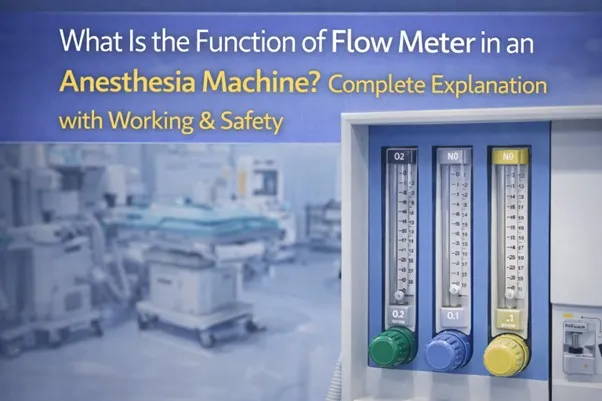
What Is a Flow Meter in an
Anesthesia Machine?
A flow meter is a device
that measures, controls, and displays the rate of medical gas flow
delivered to a patient during anesthesia.
It allows the anesthesiologist
to:
- Set accurate gas flow rates
- Control oxygen concentration
- Mix gases safely
- Prevent hypoxic gas delivery
Flow meter in anesthesia machine, anesthesia gas flow control, anesthesia
flowmeter
Why Is the Flow Meter So
Important in Anesthesia?
During surgery, the patient
depends entirely on the anesthesia system for:
- Oxygen supply
- Anesthetic gas delivery
- Ventilation safety
The flow meter ensures:
- Precise gas dosage
- Stable anesthesia depth
- Patient oxygenation
- Prevention of gas imbalance
Where Is the Flow Meter
Located in an Anesthesia Machine?
The flow meter is located:
- After pressure regulators
- Before the vaporizer
This positioning ensures that:
- Gas pressure is stable
- Gas flow is accurately measured
- Anesthetic vapor concentration remains correct
Basic Working Principle of a
Flow Meter
Flow meters in anesthesia
machines typically work on the variable area principle.
How It Works (Step-by-Step):
- Gas enters the flow tube
- Gas lifts a floating indicator (bobbin/ball)
- Height of the float indicates flow rate
- Scale on tube shows flow in L/min
- Gas exits toward vaporizer
Higher flow → float rises
Lower flow → float falls
Flow Meter Working Diagram
Main Functions of Flow Meter
in an Anesthesia Machine
Controls Gas Flow Rate
Allows precise adjustment of:
- Oxygen (O₂)
- Nitrous Oxide (N₂O)
- Medical Air
Each gas has an independent flow
meter.
Enables Accurate Gas Mixing
Flow meters help achieve:
- Correct oxygen concentration
- Safe anesthetic depth
- Balanced gas delivery
Prevents Hypoxic Gas Mixtures
Flow meters are arranged so that:
- Oxygen is delivered last
- Hypoxic mixtures are avoided
This is a critical patient safety
feature.
Provides Visual Confirmation
The anesthesiologist can:
- Visually confirm gas flow
- Detect leaks or blockages
- Monitor sudden flow changes
Correct gas flow ensures:
- Accurate anesthetic vapor concentration
- Stable anesthesia delivery
Types of Flow Meters Used in
Anesthesia Machines
Rotameter (Glass Tube Flow
Meter)
The most common type.
Features:
- Tapered transparent tube
- Floating bobbin or ball
- Graduated scale
Advantages:
- Simple
- Reliable
- Visual monitoring
Digital / Electronic Flow
Meters
Used in modern anesthesia
workstations.
Features:
- Sensor-based flow measurement
- Digital display
- Integrated alarms
Advantages:
- Higher accuracy
- Automated safety systems
Rotameter vs Digital Flow Meter
|
Component |
Function |
|
Tapered tube |
Controls gas
velocity |
|
Float
(bobbin) |
Indicates
flow rate |
|
Control valve |
Adjusts gas
flow |
|
Scale
markings |
Display flow
in L/min |
Each component must work
flawlessly to ensure safety.
Gas-Specific Flow Meters
Each gas has:
- Separate flow meter
- Color-coded controls
- Distinct connectors
Standard Colour Codes
- Oxygen - Green/White
- Nitrous Oxide - Blue
- Air - Yellow
Prevents wrong gas
administration.
Safety Features Related to
Flow Meters
- Oxygen flow meter placed last
- Hypoxic guard system
- Minimum oxygen flow requirement
- Audible alarms in digital systems
These features reduce
anesthesia-related accidents.
Common Problems with Flow
Meters
|
Issue |
Cause |
|
Float stuck |
Dirt or
moisture |
|
Inaccurate
reading |
Tilted
machine |
|
Gas leak |
Worn seals |
|
Broken tube |
Physical
damage |
Regular inspection prevents
failures.
Maintenance & Calibration
of Flow Meters
- Daily visual inspection
- Leak testing
- Annual calibration
- Replacement of damaged tubes
Well-maintained flow meters
ensure long-term accuracy.
Difference Between Flow Meter
and Pressure Regulator
|
Feature |
Flow Meter |
Pressure
Regulator |
|
Function |
Controls flow
rate |
Controls
pressure |
|
Location |
After
regulator |
Before flow
meter |
|
Units |
L/min |
PSI/bar |
Both work together but serve
different purposes.
Modern Advances in Flow Meter
Technology
- Electronic gas mixing
- Touchscreen control
- Automated oxygen ratio control
- Integrated patient safety alarms
Future systems aim for zero human
error.
Why Hospitals Must Choose
High-Quality Flow Meters
- Accurate anesthesia delivery
- Reduced medico-legal risk
- Compliance with OT safety standards
- Improved patient outcomes
- Low-quality components compromise safety.
Conclusion
The flow meter in an anesthesia
machine is far more than a measuring device it is a critical safety component
that ensures patients receive the correct amount of oxygen and anesthetic gases
throughout surgery.
From controlling gas flow and
preventing hypoxia to supporting vaporizer accuracy, the flow meter directly
impacts patient safety and surgical success.
For hospitals and surgical
centers, investing in high-quality anesthesia machines with reliable flow
meters is non-negotiable.
At Aarogyaa Bharat, we help
healthcare providers choose certified anesthesia equipment with robust flow
control systems because in anesthesia, precision saves lives.