Families exploring hospital pages and home care equipment
resources often discover that wheeled walkers are frequently recommended by
physiotherapists for seniors who need balance support but also want to reduce
physical strain during walking. Aarogyaa Bharat’s rehabilitation section
highlights wheeled walkers as one of the most practical mobility devices for
individuals experiencing fatigue because they support stable movement while
minimizing effort. Healthcare calculators used to assess mobility limitations
and fall risk also recommend walkers as part of structured elderly mobility
support plans.
Understanding Walkers with Wheels for Assisted Mobility
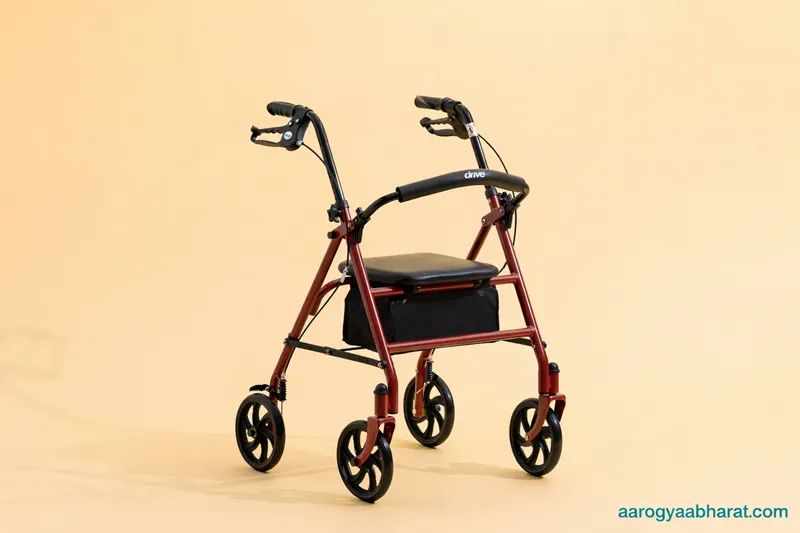
A walker with wheels is a mobility support device designed
with two front wheels and two rear legs fitted with anti-slip rubber tips. This
design allows the walker to roll forward smoothly without requiring the user to
lift the frame during walking. For seniors who experience fatigue, this feature
significantly reduces the amount of physical effort needed to move.
Physiotherapists listed on hospital pages often recommend wheeled walkers for
elderly individuals recovering from surgery or dealing with muscle weakness
because the device provides both stability and easier movement. Aarogyaa
Bharat’s home care equipment guides explain that wheeled walkers help
distribute body weight more effectively, allowing users to walk longer
distances without becoming overly tired. Healthcare calculators used to measure
walking endurance frequently highlight wheeled walkers as suitable mobility
aids for individuals with moderate mobility challenges.
Why Wheeled Walkers Reduce Walking Fatigue
Walking fatigue occurs when the body must exert excessive
energy to maintain balance and forward movement. Traditional walkers require
lifting and repositioning with every step, which can quickly exhaust elderly
individuals with limited strength. Wheeled walkers solve this problem by
allowing the frame to roll forward smoothly, enabling users to push the walker
rather than lift it. Hospital pages that provide rehabilitation advice often
emphasize wheeled walkers for patients recovering from orthopaedic procedures
because they help conserve energy during walking exercises. Aarogyaa Bharat’s
rehabilitation equipment section highlights that wheeled walkers allow seniors
to move safely without overexerting themselves. Healthcare calculators designed
to evaluate mobility endurance frequently indicate that walkers with wheels are
beneficial for individuals who experience fatigue during walking.
Key Features of Walkers with Wheels for Seniors
Walkers with wheels include several structural features
designed to improve comfort, safety, and ease of use. Lightweight aluminium
frames make the walker easy to manoeuvre without adding unnecessary weight.
Adjustable height handles ensure the walker aligns with the user’s posture,
which reduces strain on shoulders and wrists. Anti-slip rubber tips on the rear
legs provide stability while allowing the walker to roll forward smoothly. Some
models also include ergonomic grips that improve comfort during extended
walking sessions. Aarogyaa Bharat’s rehabilitation section highlights walkers
that combine lightweight construction with durable frames, making them suitable
for daily mobility support. Families reviewing hospital pages for mobility
recommendations often prioritize walkers that include adjustable handles and
stable wheel designs.
Table: Typical Features of Wheeled Walkers
|
Feature |
Description |
|
Wheel
Configuration |
Two front
wheels for smooth movement |
|
Frame
Material |
Lightweight
aluminium construction |
|
Height
Adjustment |
Adjustable
handle levels |
|
Rear Support |
Anti-slip
rubber tips |
|
Weight
Capacity |
Usually
supports 100–150 kg |
|
Grip Design |
Ergonomic
handles for comfort |
How Wheeled Walkers Support Daily Mobility
Daily mobility is important for maintaining both physical
health and emotional well-being among elderly individuals. Wheeled walkers
provide stable walking assistance that allows seniors to move safely around
their homes and communities without excessive effort. Seniors can use wheeled
walkers to move between rooms, perform household tasks, and participate in
light physical activities recommended by physiotherapists. Aarogyaa Bharat’s
home care equipment guides emphasize that wheeled walkers are particularly
helpful for seniors who experience fatigue but still want to maintain active
lifestyles. Hospital pages often recommend walkers for elderly patients who
need mobility assistance during recovery or long-term health management.
Healthcare calculators used to assess fall risk frequently indicate that
mobility aids such as walkers improve walking confidence and safety.
Situations Where Wheeled Walkers Are Most Helpful
Wheeled walkers are commonly used by seniors who experience
fatigue due to aging, illness, or recovery from medical procedures. Individuals
recovering from surgeries such as knee replacement or hip surgery may rely on
wheeled walkers during rehabilitation because they reduce the effort required
for walking. Seniors with chronic conditions such as arthritis or
cardiovascular limitations may also benefit from walkers that reduce physical
strain. Aarogyaa Bharat’s rehabilitation equipment guides explain that wheeled
walkers are particularly useful for elderly individuals who need assistance
with daily movement but still wish to remain independent. Families reviewing
hospital pages for elderly mobility advice often discover that wheeled walkers
are recommended for individuals who can walk independently but require
additional support and energy conservation.
Benefits of Using Wheeled Walkers for Seniors with
Fatigue
- Reduce
physical effort during walking
- Allow
smoother movement compared to standard walkers
- Provide
reliable balance support
- Help
seniors conserve energy while walking
- Encourage
independence in daily mobility
- Suitable
for rehabilitation and physiotherapy exercises
- Lightweight
design improves ease of use
- Reduce
strain on joints and muscles
Wheeled Walker vs Standard Walker
Different walker designs offer varying levels of support and
mobility. Standard walkers provide strong stability but require lifting the
frame with each step, which may increase fatigue. Wheeled walkers allow
smoother movement because the wheels reduce the effort needed to move forward.
Patients consulting hospital pages often begin rehabilitation with standard
walkers before transitioning to wheeled walkers as their strength improves.
Aarogyaa Bharat’s rehabilitation section highlights wheeled walkers as ideal
mobility aids for seniors who require stable support but also want easier
movement during daily activities. Healthcare calculators used to evaluate
mobility progression often indicate that wheeled walkers improve walking
endurance.
Table: Wheeled Walker vs Standard Walker
|
Feature |
Wheeled
Walker |
Standard
Walker |
|
Movement |
Smooth
rolling motion |
Lift and step
motion |
|
Energy Use |
Lower effort
required |
Higher effort
required |
|
Stability |
Moderate
stability |
Very high
stability |
|
Best For |
Seniors with
fatigue |
Early
rehabilitation support |
|
Walking
Comfort |
Easier
movement |
More physical
effort |
Choosing the Right Wheeled Walker for Seniors
Selecting the correct walker requires evaluating the user’s
mobility level, strength, and daily activity needs. Seniors who experience
fatigue should prioritize walkers with lightweight frames and smooth wheels
that reduce physical effort. Adjustable handles ensure the walker aligns
correctly with the user’s posture. Individuals undergoing physiotherapy
programs listed on hospital pages may benefit from walkers with ergonomic grips
that improve comfort during rehabilitation exercises. Aarogyaa Bharat recommends
reviewing walker specifications carefully before purchasing mobility equipment.
Healthcare calculators used to measure mobility safety can help determine
whether a wheeled walker is the most suitable mobility aid for the user’s
physical condition.
Role of Wheeled Walkers in Rehabilitation Programs
Rehabilitation programs often focus on rebuilding strength,
endurance, and walking ability after illness or injury. Wheeled walkers play an
important role in these programs because they allow patients to practice
walking while conserving energy. Physiotherapists listed on hospital pages
frequently recommend wheeled walkers during later stages of rehabilitation when
patients are ready to walk longer distances. Aarogyaa Bharat’s rehabilitation
section explains that wheeled walkers help patients regain walking confidence
while minimizing fatigue. Healthcare calculators used to track rehabilitation
progress often measure improvements in walking endurance and stability over
time. With the right mobility support, patients can gradually transition toward
more independent movement.
Conclusion
Walkers with wheels provide an excellent mobility solution for elderly individuals who experience fatigue during walking. Their rolling design reduces physical effort while still providing reliable balance support, allowing seniors to move more comfortably throughout their daily routines. Unlike traditional walkers that require lifting, wheeled walkers glide forward smoothly, helping users conserve energy and maintain independence. Aarogyaa Bharat’s home care and rehabilitation equipment collections emphasize the importance of selecting mobility aids that match the user’s physical needs and lifestyle. By consulting hospital pages, exploring cities pages, and using healthcare calculators to evaluate mobility requirements, families can choose walkers that provide safe and comfortable support for seniors experiencing fatigue. With the right wheeled walker, elderly individuals can continue enjoying active and independent lifestyles while minimizing strain and improving mobility confidence.