Choosing the right hospital bed is important when a patient
needs extended bed rest, post-surgical recovery, elderly care, or home-based
medical support. Fowler and Semi-Fowler positions are commonly used in
adjustable hospital beds because they allow the patient's upper body to be
raised instead of keeping the body completely flat. The difference between
these positions mainly relates to the angle of elevation of the upper body. A
Fowler position generally involves a more elevated upper body, while a Semi-Fowler
position uses a lower elevation. These positions can support comfort, feeding,
communication, rest, and certain clinical care activities when recommended by
healthcare professionals. Adjustable beds can also make it easier for
caregivers to assist patients with repositioning and daily routines. However,
the appropriate bed position depends on the patient's condition, mobility,
medical instructions, and comfort. Families should understand the differences
before selecting a hospital bed for home use.
Medical Disclaimer: Fowler and Semi-Fowler
positioning should be used according to the patient's healthcare professional's
recommendations. Bed positioning does not replace medical treatment and may not
be appropriate for every patient or medical condition.
What Is the Fowler Position?
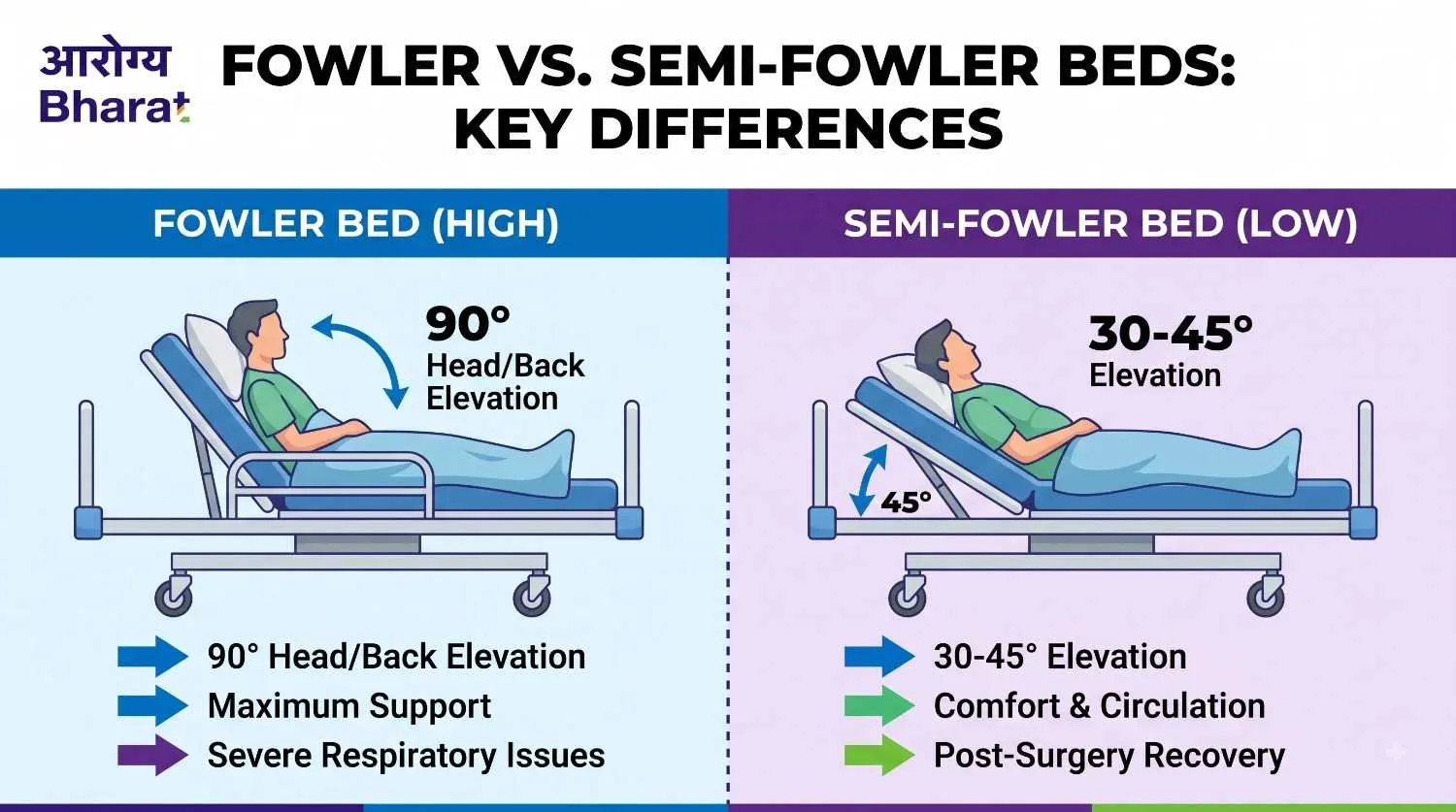
The Fowler position refers to a patient position in which
the upper body is elevated significantly while the lower body remains
comparatively lower. The exact angle can vary depending on the clinical
definition and the patient's needs, but Fowler positioning is commonly
associated with an upper-body elevation of approximately 45–90 degrees. This
position can make it easier for a patient to sit more upright in bed for
activities such as eating, reading, communicating, or performing certain
daily-care activities. It can also be useful when healthcare professionals
recommend an elevated upper-body position for specific patients. An adjustable
hospital bed can achieve this position through its motorized or manual backrest
mechanism. The exact angle should be selected according to the patient's
comfort and medical instructions rather than assuming that the highest possible
elevation is always better.
What Is the Semi-Fowler Position?
The Semi-Fowler position is a less upright variation of the
Fowler position. The upper body is elevated at a lower angle, commonly around
30–45 degrees, although the exact positioning can vary according to clinical
practice and the patient's needs. This moderate elevation can provide a
comfortable compromise between lying flat and sitting upright. It may be useful
during rest, sleep, feeding, or certain care routines when a fully upright
position is unnecessary or uncomfortable. Patients recovering at home may find
Semi-Fowler positioning more comfortable for longer periods than a highly
elevated position. However, the appropriate angle depends on the individual's
medical condition. Caregivers should follow the instructions provided by the
doctor, nurse, physiotherapist, or other qualified professional when
positioning a patient.
Fowler vs. Semi-Fowler: The Main Difference
The primary difference between Fowler and Semi-Fowler
positioning is the degree of upper-body elevation. Fowler positioning generally
places the patient more upright, while Semi-Fowler positioning keeps the upper
body at a moderate elevation. A higher Fowler position can be useful when a
patient needs to sit upright for eating or certain activities, whereas
Semi-Fowler positioning may provide greater comfort for resting or sleeping.
The exact angle should not be treated as a fixed rule because healthcare terminology
and positioning practices can vary. Adjustable hospital beds allow caregivers
to modify the backrest gradually according to the patient's requirements. The
patient's comfort, medical condition, circulation, breathing, mobility, and
doctor's recommendations should all be considered when selecting a position.
|
Feature |
Fowler
Position |
Semi-Fowler
Position |
|
Upper Body
Elevation |
Generally
higher |
Generally
moderate |
|
Common Angle
Range |
Approximately
45–90° |
Approximately
30–45° |
|
Body Position |
More upright |
Partially
upright |
|
Suitable For |
Sitting,
feeding, activities |
Resting,
sleeping, feeding |
|
Comfort |
More upright
support |
Often
comfortable for extended rest |
|
Mobility
Support |
Easier for
upright activities |
Better for
moderate positioning |
|
Caregiver
Access |
Good for
upper-body care |
Good for
routine care |
|
Bed
Requirement |
Adjustable
backrest |
Adjustable
backrest |
|
Best Use |
When greater
elevation is required |
When moderate
elevation is preferred |
Why Patient Positioning Matters
Patient positioning is an important part of home healthcare
because remaining in one position for long periods can affect comfort and
mobility. An appropriate bed position can make daily activities easier and may
help caregivers provide personal care more effectively. Raising the upper body
can also allow some patients to eat, drink, communicate, read, or watch
television without requiring them to sit completely upright on the edge of the
bed. For patients with limited mobility, an adjustable bed can reduce the
physical effort needed to change positions. However, positioning should always
take into account the patient's medical condition and individual needs.
Families should not use a particular position solely because it is commonly
recommended online. A healthcare professional can provide personalized guidance
about the safest and most appropriate bed position.
Benefits of Fowler Positioning
A higher Fowler position can make the patient more upright
and may be useful for activities that require sitting or upper-body engagement.
Patients may find it easier to eat meals, drink fluids, communicate with
caregivers, read, use electronic devices, or participate in certain activities
while the backrest is elevated. Caregivers may also find it easier to provide
certain forms of personal care when the patient is positioned more upright. For
some patients, an elevated upper-body position may also be recommended as part
of their clinical care plan. An adjustable hospital bed can provide controlled
positioning without requiring the caregiver to manually lift the patient's
upper body. However, excessive elevation may be uncomfortable for some
individuals, so the position should be adjusted gradually and according to
professional guidance.
Benefits of Semi-Fowler Positioning
Semi-Fowler positioning provides moderate upper-body
elevation and can be useful when a patient wants to rest without lying
completely flat. The position may provide a comfortable posture for reading,
watching television, eating, or resting in bed. It can also reduce the need for
the patient to remain completely horizontal during prolonged periods of bed
rest. For some individuals, moderate elevation can feel more natural than a
highly upright position. Caregivers can use an adjustable bed to make small changes
to the backrest angle until the patient reaches a comfortable position within
the recommended range. The patient's comfort should be monitored regularly
because prolonged positioning can create pressure on certain areas of the body.
Repositioning should follow the patient's care plan, particularly for
individuals with limited mobility.
Fowler vs. Semi-Fowler for Sleeping
The ideal sleeping position varies from person to person and
depends on medical conditions, comfort, and professional recommendations. Some
patients may find Semi-Fowler positioning comfortable because the upper body is
moderately elevated while the body remains supported by the mattress. A highly
elevated Fowler position may be more appropriate for specific activities rather
than continuous sleeping. Patients with particular respiratory, cardiac,
orthopedic, or post-operative requirements may receive specific positioning
instructions from their healthcare team. Families should not assume that an
elevated position is automatically safer or more comfortable for every patient.
An adjustable hospital bed allows caregivers to make gradual changes, but the
patient's medical plan should guide the final positioning. If the patient
develops pain, dizziness, breathing difficulty, or discomfort in a particular
position, the caregiver should seek professional guidance.
Fowler vs. Semi-Fowler for Feeding
Feeding a patient while they are positioned appropriately
can improve comfort and make eating easier. A more upright Fowler position can
be useful for patients who need to sit up during meals, while Semi-Fowler may
provide a moderate elevation when full upright positioning is not required.
Patients with swallowing difficulties may have specific positioning
instructions from a doctor, nurse, speech-language pathologist, or other
healthcare professional. Caregivers should follow those instructions carefully.
Positioning alone cannot eliminate the risk of aspiration or swallowing
complications. The patient's head, neck, and upper body may need to be
positioned according to an individualized care plan. After feeding, the patient
may also be advised to remain elevated for a specific period depending on their
medical condition.
Fowler and Semi-Fowler for Elderly Patients
Older adults may spend extended periods in bed because of
illness, injury, reduced mobility, or recovery from surgery. An adjustable
hospital bed can make it easier for elderly individuals to change between lying
and elevated positions without requiring a caregiver to physically lift their
upper body. Semi-Fowler positioning may provide a comfortable moderate
elevation for resting, while Fowler positioning can support activities
requiring a more upright posture. Seniors with weakness, balance problems, or limited
mobility may require additional assistance when changing positions. Families
should also consider pressure-relief requirements, mattress support, side rails
where appropriate, and safe bed height. The goal should be a combination of
comfort, safety, mobility, and appropriate medical positioning rather than
simply selecting the highest or lowest angle.
Fowler and Semi-Fowler After Surgery
Post-operative patients may receive specific positioning
instructions depending on the type of surgery they have undergone. An
adjustable hospital bed can make it easier to maintain the recommended posture
without repeatedly moving the patient manually. Fowler or Semi-Fowler
positioning may be recommended for certain patients, but the appropriate angle
depends entirely on the surgery and the surgeon's instructions. For example,
patients recovering from abdominal or orthopedic procedures may have different
positioning requirements from patients recovering from other procedures.
Caregivers should never assume that a commonly used hospital-bed position is
appropriate after every surgery. Follow the discharge instructions provided by
the hospital and contact the medical team if the patient experiences increasing
pain, dizziness, swelling, breathing difficulty, or other concerning symptoms.
Fowler Position for Daily Activities
One advantage of a higher Fowler position is that it can
make several everyday activities easier for patients who need to remain in bed.
A patient may be able to read a book, communicate with family, eat a meal, use
a phone, or watch television more comfortably when the upper body is elevated.
Caregivers may also find it easier to assist with grooming, oral care, and
other personal-care activities. An adjustable bed can reduce the need for
repeated manual repositioning. However, the patient should remain properly
supported, especially if they have poor trunk control or weakness. Bed
accessories should also be used according to the manufacturer's instructions.
Families should avoid attaching unauthorized equipment that could interfere
with the bed's movement or create safety risks.
Semi-Fowler Position for Rest and Comfort
Semi-Fowler positioning can provide a comfortable middle
ground between lying flat and sitting upright. This makes it useful for
patients who want to rest while keeping their upper body somewhat elevated. The
position can also make communication and certain bedside activities easier.
Patients with limited mobility may appreciate the ability to change their
posture without needing to sit at the edge of the bed. However, comfort can
vary significantly between individuals. Mattress quality, body weight, joint condition,
back support, and the patient's medical condition can all affect how
comfortable a particular angle feels. Caregivers should observe the patient and
make gradual adjustments. If the patient experiences pain or difficulty
breathing, the position should be reassessed according to professional advice.
How Adjustable Hospital Beds Make Positioning Easier
An adjustable hospital bed can provide multiple positioning
options by allowing the backrest and sometimes the leg section to move
independently. Electric models generally use a hand controller, allowing
caregivers or patients with sufficient ability to make gradual adjustments.
Manual beds require physical adjustment using a crank or another mechanism.
Adjustable positioning can reduce the effort involved in moving a patient and
may improve comfort during meals, rest, personal care, and other activities. Families
considering Hospital Beds should compare factors such as adjustment
mechanisms, mattress compatibility, weight capacity, side-rail options, caster
design, bed height, and service support. The bed should be selected according
to the patient's needs and the available space in the home.
Electric vs. Manual Hospital Beds
Both electric and manual hospital beds can support Fowler
and Semi-Fowler positioning, but they differ in how the adjustments are made.
Electric beds allow the user or caregiver to change the backrest using a hand
control, which can be particularly useful when frequent repositioning is
required. Manual beds generally require a caregiver to operate a mechanical
adjustment system. Electric models may provide greater convenience for patients
who can safely operate the controls themselves. Manual models can be simpler
and may be suitable when frequent electrical adjustment is not required. When
comparing Electric Hospital Beds, families should consider motor
quality, control accessibility, power requirements, emergency lowering
features, weight capacity, and service availability. The best choice depends on
the patient's mobility and care environment.
Choosing the Right Bed for Home Healthcare
Selecting a hospital bed for home use requires more than
choosing between Fowler and Semi-Fowler positioning. Families should evaluate
the patient's medical condition, mobility level, caregiver requirements, room
size, bed dimensions, mattress needs, weight capacity, and expected duration of
use. If the patient spends most of the day in bed, comfort and pressure
management become especially important. If caregivers need to provide frequent
personal care, height adjustment may also be useful. Patients who have
difficulty getting in and out of bed may require additional mobility support.
Customers exploring Home Healthcare Equipment should consider the
complete care environment rather than looking at the bed alone. A healthcare
professional can also recommend suitable positioning and equipment based on the
patient's individual needs.
Fowler vs. Semi-Fowler for Respiratory Comfort
Elevating the upper body can feel more comfortable for some
patients with breathing difficulties, but the appropriate position depends on
the individual's medical condition. A healthcare professional may recommend an
elevated position as part of a patient's care plan. Fowler positioning provides
greater upper-body elevation, while Semi-Fowler provides a more moderate angle.
Neither position should be considered a universal treatment for respiratory
conditions. Patients experiencing new or worsening shortness of breath should
not rely solely on changing the bed position. Medical evaluation may be
required. Families should follow the patient's prescribed respiratory care plan
and seek urgent medical assistance when serious symptoms occur. Positioning
should be viewed as one component of patient care rather than a replacement for
treatment.
Fowler vs. Semi-Fowler for Mobility
For patients with limited mobility, bed positioning can
affect how easily they perform movements such as sitting up, reaching, or
preparing to transfer from the bed. Fowler positioning may bring the patient
into a more upright posture, while Semi-Fowler provides moderate elevation. An
adjustable bed can help caregivers gradually change the patient's position and
may reduce the physical effort needed for repositioning. However, a raised
backrest does not automatically make a transfer safe. Patients with weakness or
poor balance may still need caregiver assistance, a transfer aid, or
professional instruction. Families should avoid allowing patients to transfer
independently unless they have been assessed as capable of doing so safely.
Appropriate Mobility Aids may also be considered when recommended by a
healthcare professional.
Mattress Selection for Adjustable Hospital Beds
The mattress is an important part of an adjustable bed
system because it needs to accommodate changes in the bed's position. A
standard mattress that is not designed for an adjustable frame may not bend
properly and could reduce comfort or interfere with movement. Patients who
remain in bed for long periods may also need a mattress designed to support pressure
management and proper body alignment. The correct mattress depends on the bed
model, patient weight, mobility, skin condition, and clinical requirements.
Customers exploring Patient Care Products should confirm mattress
compatibility before purchasing an adjustable hospital bed. A healthcare
professional can recommend specialized pressure-relief solutions when medically
appropriate.
Safety Tips When Adjusting Fowler and Semi-Fowler
Positions
Adjusting an electric hospital bed is generally
straightforward, but caregivers should still use caution. The patient should be
positioned securely before raising or lowering the backrest. Tubing, wires,
clothing, blankets, and other objects should be kept away from moving sections
of the bed. Caregivers should check that the patient's limbs are clear of
moving parts. If side rails are used, they should be positioned according to
the patient's needs and manufacturer's instructions. The bed should also be locked
when it is not being moved. Families using Patient Safety Products
should focus on reducing falls, entrapment risks, and equipment-related
hazards. Any unusual bed noise or movement should be checked by the service
provider rather than repaired without appropriate expertise.
Common Mistakes to Avoid
One common mistake is assuming that a higher bed angle is
always better. Excessive elevation may cause discomfort or place unnecessary
pressure on certain body areas. Another mistake is keeping a patient in one
position for too long without following an appropriate repositioning plan.
Caregivers may also forget to check that tubing, wires, and blankets are clear
before moving the bed. Using incompatible mattresses or unauthorized
accessories can create additional risks. Families should also avoid relying on
the bed's side rails as a substitute for professional mobility assessment. If a
patient has significant weakness, confusion, or a history of falls, a
healthcare professional should provide individualized safety recommendations.
Proper training can help caregivers use the bed more confidently and safely.
Fowler vs. Semi-Fowler: Which Is Better?
Neither Fowler nor Semi-Fowler positioning is universally
better because the appropriate position depends on the patient's medical and
functional requirements. Fowler positioning provides a greater degree of
upper-body elevation and may be useful for upright activities such as eating or
communicating. Semi-Fowler provides moderate elevation and may be more
comfortable for rest or sleep for some patients. An adjustable hospital bed
gives caregivers the flexibility to change between positions as required. The
final positioning decision should follow professional guidance, especially for
patients recovering from surgery, experiencing breathing difficulties, or
having swallowing problems. Comfort, safety, medical requirements, and pressure
management should all be considered together.
Why Choose Aarogyaa Bharat for Hospital Beds?
Aarogyaa Bharat provides healthcare and home-care solutions
for patients, caregivers, elderly individuals, and families managing medical
needs at home. Customers can explore hospital beds and related Home Care
Products according to their requirements. When selecting a bed, families
should consider whether they need manual or electric adjustment, the required
positioning options, weight capacity, mattress compatibility, side-rail
features, and available service support. Aarogyaa Bharat also provides
information about various healthcare products that can support home-based
patient care. Product selection should always be based on the user's condition
and practical requirements rather than choosing a bed solely based on appearance
or price.
Aarogyaa Bharat Hospital Page and Healthcare Resources
Families can refer to the Aarogyaa Bharat Hospital Page
for healthcare-related information and resources while arranging home care.
Hospital discharge instructions should always take priority when a patient has
specific positioning requirements after treatment or surgery. Doctors, nurses,
physiotherapists, occupational therapists, and other qualified healthcare
professionals can provide individualized recommendations. Online articles can
explain general differences between bed positions, but they cannot determine
the correct position for a specific patient. If a patient develops severe pain,
breathing difficulty, dizziness, confusion, or other concerning symptoms after
changing position, caregivers should seek professional medical advice rather
than continuing to adjust the bed independently.
Aarogyaa Bharat City Pages for Local Healthcare Products
Availability of hospital beds, rental services, mobility
equipment, and other home healthcare products may vary by location. Customers
can use Aarogyaa Bharat City Pages to explore location-specific
healthcare information and available services. Before purchasing or renting a
hospital bed, families should confirm delivery availability, installation
support, service coverage, rental terms, mattress availability, and replacement
policies. This is particularly important when equipment is required urgently
after hospital discharge. Local technical support can make it easier to address
equipment problems and arrange maintenance when needed. Customers should
confirm current availability directly with the provider before placing an
order.
Healthcare Calculator and Patient Care Decisions
A Healthcare Calculator can be useful for general
educational purposes, but it should not be used to determine a patient's
medical positioning requirements. Bed angle, mobility needs, pressure
management, and post-operative positioning depend on the patient's specific
condition. Families should follow the instructions given by healthcare
professionals rather than relying on generalized online calculations. If a
patient experiences discomfort, breathing difficulty, pain, dizziness, or other
concerning symptoms in a particular bed position, the position should be
reassessed with professional guidance. Online healthcare tools can support
awareness, but they cannot replace clinical evaluation or individualized care
planning.
Quick Checklist Before Choosing a Hospital Bed
- Check
whether Fowler and Semi-Fowler positioning is required.
- Confirm
the patient's recommended positioning with a healthcare professional.
- Decide
between manual and electric adjustment.
- Check
the bed's weight capacity.
- Measure
the available room space.
- Confirm
mattress compatibility.
- Consider
bed height adjustment.
- Check
side-rail options and safety features.
- Review
caster and wheel-lock mechanisms.
- Consider
caregiver access around the bed.
- Check
warranty and service support.
- Confirm
delivery and installation arrangements.
- Consider
whether the bed will be rented or purchased.
- Check
whether additional mobility equipment is required.
- Follow
all manufacturer and healthcare-provider instructions.
Conclusion
Fowler and Semi-Fowler positions are both useful positioning options for patients using adjustable hospital beds, but they serve different practical purposes because of their different levels of upper-body elevation. Fowler positioning provides a more upright posture that may be useful for activities such as eating, communication, and certain types of care, while Semi-Fowler provides moderate elevation that may be more comfortable for resting or sleeping for some patients. The right choice depends on the patient's medical condition, mobility, comfort, and healthcare instructions. Families choosing a hospital bed should also consider mattress compatibility, adjustment mechanisms, safety features, room space, weight capacity, and service support. With the right equipment and professional guidance, an adjustable bed can make daily care, repositioning, and home recovery more manageable.
Medical Disclaimer
This article is intended for general educational purposes
only and does not constitute medical advice, diagnosis, or treatment. Fowler
and Semi-Fowler positioning may not be appropriate for every patient. Patients
recovering from surgery, experiencing respiratory difficulties, swallowing
problems, severe weakness, or other medical conditions should follow
individualized instructions from their healthcare professional. If a patient
experiences severe breathing difficulty, chest pain, loss of consciousness, sudden
weakness, or rapidly worsening symptoms, seek urgent medical attention.