The Traditional Roots of Home Healthcare in Indian
Society
Home healthcare in India has always existed, but
historically it was driven by emotional responsibility rather than medical
structure. Families cared for elders, sick relatives, and recovering patients
using intuition, cultural practices, and limited medical guidance. While this
model preserved emotional closeness, it lacked safety protocols, planning, and
accountability. As long as illnesses were short-term and life expectancy was
lower, this approach functioned reasonably well. However, with modern medical
advancements allowing patients to survive longer with chronic conditions, the
old model began to show serious limitations. Homes were never designed to
function as care environments, and families were not equipped to manage complex
recovery needs. This historical gap laid the foundation for organized home
healthcare platforms to emerge.
Why Home Healthcare Is No Longer Optional in India
India’s healthcare demands have grown faster than hospital
infrastructure can expand. Urban hospitals face bed shortages, while rural
healthcare access remains uneven. Early discharge policies, cost pressures, and
patient preference for home recovery have accelerated the shift toward
home-based care. Home healthcare is no longer an alternative it is a necessity.
Without proper systems, however, this necessity becomes dangerous and
emotionally exhausting. Aarogyaa Bharat fits into this reality by transforming
home healthcare from an unavoidable burden into a structured, supported
experience that families can manage confidently.
Structural Weaknesses in India’s Existing Home Care
Practices
Despite growing demand, home healthcare in India remains
fragmented. Families often rely on local medical stores, scattered vendors, and
inconsistent advice. Equipment decisions are reactive, driven by urgency rather
than planning. There is no unified framework that connects hospital discharge
advice, equipment needs, caregiver capability, and home layout. This
fragmentation leads to frequent mistakes, safety risks, and caregiver burnout.
Aarogyaa Bharat exists precisely to address these structural weaknesses by
centralizing access, standardizing care pathways, and reducing dependence on
guesswork.
Where Aarogyaa Bharat Fits Within the Healthcare
Continuum
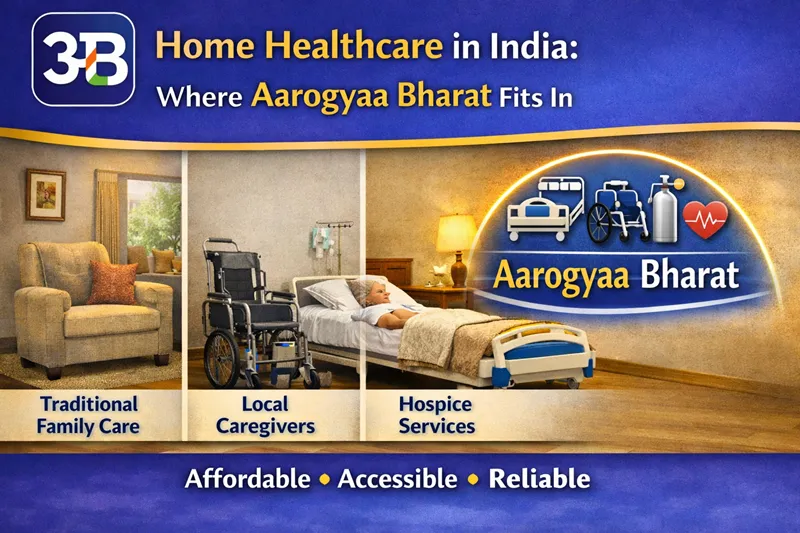
Aarogyaa Bharat operates in the critical space between
hospitals and homes a space that was historically neglected. Hospitals diagnose
and treat, families care and support, but the transition between these two
worlds was never systematized. Aarogyaa Bharat fills this gap by translating
medical intent into practical home solutions. It does not replace doctors,
nurses, or family caregivers but enables them to function more effectively
together. This positioning makes Aarogyaa Bharat an ecosystem enabler rather
than a standalone service.
Organized Home Healthcare vs Informal Care Models
|
Dimension |
Informal
Home Care |
Aarogyaa
Bharat–Enabled Care |
|
Planning |
Minimal |
Structured
and proactive |
|
Equipment
sourcing |
Scattered |
Centralized |
|
Caregiver
support |
Emotional
only |
Emotional +
practical |
|
Safety |
Inconsistent |
Standardized |
|
Continuity |
Broken |
End-to-end |
Supporting Post-Surgery Recovery in Indian Homes
Post-surgery recovery has become one of the most common
drivers of home healthcare adoption in India. Hospitals aim to reduce inpatient
days, but families are often unprepared for the responsibility that follows.
Aarogyaa Bharat fits into this phase by enabling homes to temporarily function
as recovery environments. Proper beds, mobility aids, and supportive equipment
help prevent complications and reduce readmissions. This support aligns with
modern healthcare goals of efficiency without compromising patient safety.
Enabling Aging in Place for India’s Senior Population
India’s elderly population is growing rapidly, and
institutional care is neither culturally preferred nor economically feasible
for most families. Aging in place allows seniors to remain in familiar
environments, preserving dignity and emotional stability. Aarogyaa Bharat
supports this preference by making mobility aids, safety solutions, and
comfort-focused equipment accessible at home. In doing so, it helps families
care for elders sustainably without overwhelming physical or emotional strain.
Chronic Illness Care Beyond Hospital Walls
Chronic diseases require consistency, not constant
hospitalization. Diabetes, cardiac conditions, neurological disorders, and
respiratory illnesses are better managed in stable environments. Aarogyaa
Bharat fits into chronic care by supporting daily living needs rather than
episodic emergencies. This reduces hospital dependency and allows patients to
maintain routines, which is critical for long-term mental and emotional health.
Redefining the Caregiver’s Role in Home Healthcare
Caregivers are central to India’s home healthcare system,
yet they remain under-supported. Aarogyaa Bharat strengthens the caregiver role
by reducing physical effort, simplifying decisions, and offering reliable
support systems. When caregivers are equipped with the right tools and
guidance, care becomes sustainable rather than exhausting. This empowerment is
essential for long-term home care success.
How Aarogyaa Bharat Reduces Systemic Healthcare Pressure
|
System
Challenge |
Without
Organized Home Care |
With
Aarogyaa Bharat |
|
Hospital
overcrowding |
Severe |
Reduced |
|
Readmissions |
Frequent |
Lower |
|
Caregiver
burnout |
High |
Controlled |
|
Long-term
care load |
Institutional |
Home-based |
|
Healthcare
sustainability |
Fragile |
Strengthened |
Adapting to India’s Diverse Living Conditions
Indian households vary widely in size, structure, and
caregiving capacity. Aarogyaa Bharat does not impose uniform clinical standards
but adapts care to real home environments. This flexibility is crucial for
scalability across urban apartments, independent houses, and multi-generational
homes. Care that fits into daily life is more likely to be used correctly and
consistently.
Cultural Shift from Reactive to Planned Home Care
One of the most important changes Aarogyaa Bharat brings is
cultural. Families are learning to approach home healthcare proactively rather
than reactively. Early planning reduces emergencies, improves outcomes, and
builds confidence. Over time, this cultural shift will redefine how healthcare
is practiced at the household level across India.
Long-Term Impact on India’s Healthcare Landscape
As organized home healthcare grows, India’s healthcare
system becomes more resilient. Hospitals can focus on acute care, families
experience less stress, and patients recover with dignity. Aarogyaa Bharat
contributes to a future where healthcare delivery is distributed, humane, and
sustainable rather than centralized and overburdened.
Conclusion: Aarogyaa Bharat’s Role in India’s Home
Healthcare Future
Aarogyaa Bharat fits into India’s home healthcare ecosystem
as a structural bridge that transforms informal care into organized, dignified,
and reliable support. By aligning hospitals, families, caregivers, and
equipment into a coherent system, it enables safer recovery, healthier aging,
and sustainable long-term care. As home healthcare becomes a permanent pillar
of Indian healthcare, Aarogyaa Bharat stands as a key enabler guiding this
transformation with clarity and compassion.