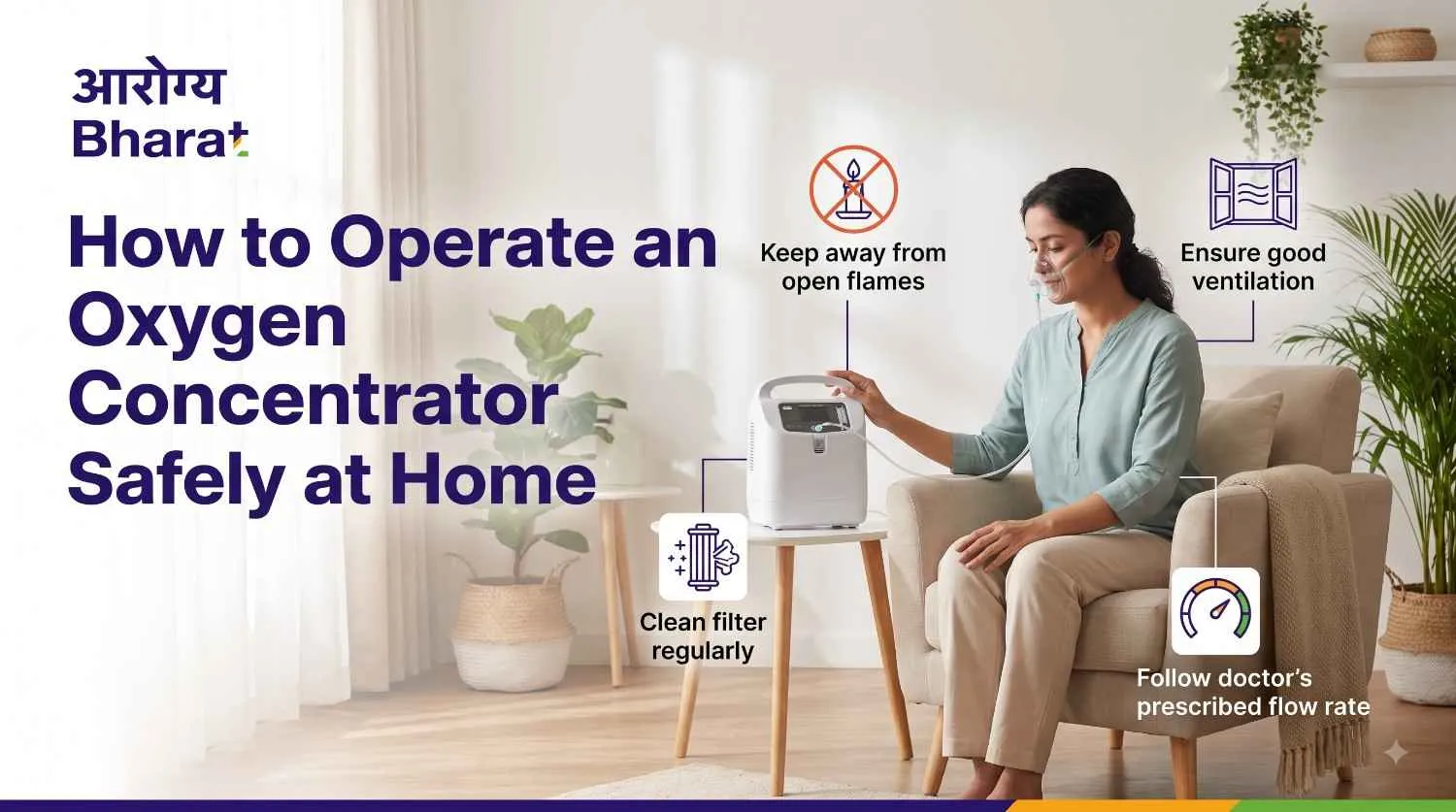
An oxygen concentrator can provide supplemental oxygen at
home for patients who have been prescribed oxygen therapy by a qualified
healthcare professional. Unlike an oxygen cylinder, a concentrator takes air
from the surrounding environment and concentrates oxygen for delivery through
tubing and a nasal cannula or other prescribed interface. However, using an
oxygen concentrator safely requires more than simply switching the machine on.
The correct flow rate, equipment positioning, electrical connection, tubing,
cleaning routine, ventilation, and fire-safety precautions all matter. The
American Lung Association recommends using the exact oxygen rate prescribed by
a healthcare provider and learning how to operate the equipment from the oxygen
supplier or healthcare team. Aarogyaa Bharat also emphasizes correct flow
settings, ventilation, maintenance, and keeping oxygen equipment away from
flames and smoking areas.
Medical Disclaimer: Oxygen is a medical treatment.
Always use an oxygen concentrator according to the prescription and
instructions provided by your doctor and equipment provider. Never increase,
decrease, start, or stop oxygen therapy without professional medical advice.
What Is an Oxygen Concentrator?
An oxygen concentrator is a medical device that draws room
air into the machine, separates nitrogen from the air, and delivers
concentrated oxygen to the patient. It can provide a continuous supply of
oxygen as long as the machine has an appropriate electrical power source and is
functioning correctly. This makes concentrators useful for certain patients who
require oxygen therapy at home. Aarogyaa Bharat explains that oxygen
concentrators are commonly used for home healthcare, respiratory support, recovery,
and longer-term oxygen requirements. Different models have different flow
capacities, oxygen concentration specifications, power requirements, and
operating features. The correct model should therefore be selected according to
the patient's prescribed oxygen requirement rather than simply choosing the
largest or most powerful machine. A healthcare professional should determine
whether oxygen therapy is appropriate and what flow rate should be used.
Who Should Use an Oxygen Concentrator at Home?
An oxygen concentrator should be used at home when oxygen
therapy has been recommended by a qualified healthcare professional. Patients
recovering from certain respiratory illnesses, surgery, hospitalization, or
other conditions may sometimes require supplemental oxygen, while some people
with long-term respiratory conditions may need ongoing oxygen therapy. The need
for oxygen should not be determined only by breathlessness or by comparing one
patient's oxygen requirement with another person's. A doctor may consider
oxygen saturation, symptoms, medical history, diagnosis, and other clinical
factors before prescribing therapy. The prescribed flow rate and duration can
also differ between patients and activities. The American Lung Association
states that healthcare professionals should determine the type and amount of
oxygen appropriate for the individual. Families should therefore obtain clear
instructions before operating the equipment independently at home.
Step 1: Choose the Correct Location for the Concentrator
The location of an oxygen concentrator is important because
the machine needs adequate airflow to operate properly. Place the concentrator
on a stable, level surface in a clean and well-ventilated area where its air
intake and exhaust vents are not blocked. Avoid placing the machine inside a
closed cupboard, directly against a wall, underneath bedding, or beside objects
that can restrict ventilation. The equipment should also be kept away from
water, excessive humidity, direct heat, and areas where it could be knocked
over. Aarogyaa Bharat recommends keeping oxygen concentrators in ventilated
areas and avoiding moisture exposure. Keeping the machine in an appropriate
location can support normal operation while making it easier for caregivers to
access the controls, tubing, and power connection when needed.
Step 2: Check the Machine Before Switching It On
Before operating the concentrator, inspect the machine and
its accessories for visible damage. Check the power cable, plug, oxygen tubing,
nasal cannula, humidifier bottle if supplied, and external housing. Make sure
the tubing is not crushed, sharply bent, disconnected, or blocked. Check that
the air vents are clear and that any required filter is correctly installed. If
the machine has an alarm indicator, display, oxygen purity indicator, or other
warning system, become familiar with its normal operating condition before
using it. Do not operate equipment that appears damaged, produces an unusual
smell, becomes excessively hot, or repeatedly displays an error. Instead,
contact the rental provider, manufacturer, or authorized service provider. A
properly maintained device is an important part of safe home oxygen use.
Step 3: Connect the Oxygen Tubing Correctly
Attach the oxygen tubing to the concentrator outlet
according to the manufacturer's instructions. If a humidifier bottle is
prescribed or supplied with the equipment, make sure it is connected correctly
and filled according to the instructions. The American Lung Association
recommends checking that oxygen tubing is properly attached and is not bent or
blocked. Keep the tubing long enough for normal movement but avoid creating
unnecessary loops across walking pathways. A loose tube across a hallway can become
a trip hazard, especially for elderly patients using walkers or other mobility
equipment. Inspect the tubing regularly for cracks, holes, discoloration, or
other damage. Replace accessories according to the manufacturer's
recommendations or when they become damaged or contaminated.
Step 4: Switch On the Oxygen Concentrator
After checking the connections, place the concentrator in
its recommended operating position and switch it on according to the
manufacturer's instructions. The machine may take a short period to reach its
specified operating condition, depending on the model. Pay attention to the
display, indicator lights, alarms, and other signals provided by the device. Do
not cover the machine while it is operating, and do not place objects on top of
ventilation areas unless the manufacturer specifically permits it. If an alarm
sounds, do not simply ignore it. Check the user manual to understand the alarm
and contact the equipment provider if the problem cannot be resolved safely.
Aarogyaa Bharat recommends paying attention to alarms and error indicators
because they may indicate problems such as low oxygen purity, blockage, or
power failure.
Step 5: Set the Prescribed Oxygen Flow Rate
The oxygen flow rate is one of the most important settings
on a concentrator. Flow is commonly measured in litres per minute, or LPM, and
different patients may receive different prescribed rates. Never increase the
flow because you feel more breathless, and never reduce it because you feel
better unless your healthcare provider specifically instructs you to do so. The
American Lung Association advises patients to use the exact oxygen rate
prescribed for each activity and not change the amount without consulting their
healthcare provider. Aarogyaa Bharat also identifies following the prescribed
flow rate as an essential oxygen concentrator safety precaution. The correct
setting should always come from the patient's medical treatment plan rather
than from the machine's maximum available capacity.
Step 6: Position the Nasal Cannula Correctly
Once the prescribed oxygen flow is established, place the
nasal cannula correctly according to the instructions provided by the
healthcare professional or equipment supplier. The prongs should sit
comfortably in the nostrils, and the tubing should be positioned so that it
does not place excessive pressure behind the ears or around the face. Breathe
normally unless the healthcare professional has provided different
instructions. If you are unsure whether oxygen is flowing, follow the equipment
provider's instructions for checking the system rather than changing the flow
setting yourself. The cannula should be kept clean and replaced according to
the manufacturer's or provider's recommendations. The American Lung Association
recommends routine cleaning and replacement of oxygen accessories as part of
home oxygen care.
Step 7: Keep the Room Safe From Fire and Heat
Oxygen itself is not flammable, but it supports combustion,
meaning materials can burn more readily in an oxygen-enriched environment. This
makes fire safety one of the most important parts of operating a concentrator
at home. Never smoke while using oxygen and do not allow anyone else to smoke
near the equipment. Keep candles, incense, gas flames, fireplaces, heaters, and
other ignition sources away from oxygen equipment. Aerosols, petroleum-based
products, oils, and other flammable materials should also be kept away from the
oxygen setup. The American Lung Association specifically advises keeping oxygen
away from open flames and heat sources and avoiding smoking around oxygen
equipment. Every family member and caregiver should understand these rules before
oxygen therapy begins.
Important Safety Warning: Never smoke or allow an
open flame near an oxygen concentrator or a person receiving oxygen. Oxygen can
make a fire spread much more rapidly.
Step 8: Keep Electrical Connections Safe
A stationary oxygen concentrator depends on electricity, so
safe electrical operation is essential. Use the power connection recommended by
the manufacturer and avoid overloaded sockets, damaged cables, loose plugs, or
unsuitable extension arrangements. Keep electrical connections away from water
and areas where spills may occur. Aarogyaa Bharat recommends using an
appropriate wall socket, avoiding overloaded power strips, keeping cables away
from water, and considering suitable voltage protection where required. The
exact electrical requirements vary between models, so caregivers should follow
the manufacturer's specifications instead of assuming that every concentrator
uses the same amount of power. If the machine repeatedly trips a circuit,
becomes unusually hot, or develops an electrical problem, stop using it and
contact the appropriate service provider.
Step 9: Prepare a Power Backup Plan
Because many home oxygen concentrators require mains
electricity, families should consider what will happen during a power outage. A
backup plan may be especially important for patients who depend on oxygen
continuously or for long periods. Depending on the patient's medical plan and
equipment, an appropriate backup arrangement may involve a medically suitable
oxygen cylinder, battery-supported equipment, inverter, UPS, generator, or
another solution recommended by the healthcare provider and equipment supplier.
Aarogyaa Bharat highlights power requirements and backup planning as important
considerations for home concentrator users. Do not connect a medical device to
an unsuitable backup system simply because it is available. The backup system
should be compatible with the concentrator's electrical requirements and the
patient's oxygen needs.
Step 10: Keep the Oxygen Tubing Away From Trip Hazards
Oxygen tubing can extend across rooms and may create a fall
risk if it is not organized properly. This is particularly important for
elderly patients, people with reduced balance, and patients who use walkers or
wheelchairs. Arrange the tubing along safe pathways without placing it across
stairs, doorways, or areas where people frequently walk. Do not shorten or
modify tubing unless the manufacturer or equipment provider specifically
recommends it. Caregivers should regularly check whether the patient can move
safely while connected to the oxygen system. Furniture placement may also need
to be adjusted to create a clear route between the bed, chair, bathroom, and
other frequently used areas. Good tubing management supports both oxygen
delivery and overall home mobility safety.
Step 11: Clean and Maintain the Concentrator Regularly
Regular maintenance helps keep an oxygen concentrator
functioning properly throughout its service life. Follow the manufacturer's
cleaning schedule for external surfaces, air filters, tubing, nasal cannula,
humidifier bottle, and other accessories. The American Lung Association
recommends routine cleaning of the cannula, air filter, and concentrator
exterior, along with appropriate replacement of tubing and other accessories.
Aarogyaa Bharat also recommends cleaning filters, maintaining ventilation, avoiding
moisture, and scheduling periodic servicing. Never immerse the electrical unit
in water or use cleaning products that are not approved for the device. If the
equipment requires internal servicing or repair, use the manufacturer's or
authorized service provider's instructions rather than attempting an unsafe
repair at home.
Step 12: Use Humidifier Bottles Correctly
Some oxygen therapy setups include a humidifier bottle to
add moisture to the delivered oxygen when prescribed or recommended. If your
setup includes one, it should be filled, cleaned, and maintained according to
the equipment provider's instructions. The American Lung Association recommends
using sterile or distilled water as directed and cleaning the humidifier bottle
regularly to help prevent contamination. Do not overfill the bottle, use
unapproved water, or allow old water to remain inside for extended periods.
Caregivers should check the bottle regularly and follow the manufacturer's
instructions regarding replacement and cleaning. If the humidifier becomes
cracked, cloudy, contaminated, or otherwise damaged, contact the equipment
provider for guidance.
Step 13: Monitor the Patient as Recommended
Depending on the patient's condition, the healthcare
professional may recommend monitoring oxygen saturation with a pulse oximeter
or observing specific symptoms. A pulse oximeter can provide useful
information, but readings should always be interpreted in the context of the
patient's medical condition and the instructions provided by the healthcare
professional. Do not increase oxygen simply because a single reading appears
lower than expected without following the patient's medical plan. If the patient
experiences worsening breathlessness, chest pain, confusion, unusual
drowsiness, bluish lips or fingernails, or other serious symptoms, seek medical
attention promptly. The American Lung Association lists several symptoms that
should prompt contacting a doctor, including difficulty breathing and changes
such as blue lips or fingernails.
Step 14: Understand Oxygen Concentrator Alarms
Modern oxygen concentrators may have alarms or indicator
lights for conditions such as power failure, low oxygen concentration,
overheating, or other operational problems. Caregivers should read the
manufacturer's manual and understand what the normal indicators mean before
relying on the machine. If an alarm occurs, first check the basic issues that
the manufacturer allows users to inspect, such as power connection, tubing
blockage, or ventilation. Do not repeatedly silence an alarm without
understanding its cause. Aarogyaa Bharat identifies ignoring alarms and error
indicators as a common mistake when using oxygen equipment at home. If the
alarm continues or the patient is becoming unwell, contact the equipment
provider or seek medical assistance according to the patient's emergency plan.
Step 15: Store and Position the Equipment Properly
When the concentrator is not being used, follow the
manufacturer's instructions for storage and positioning. Keep the device in a
clean, dry location where it is protected from physical damage, excessive heat,
moisture, and dust. Do not place heavy objects on the machine or store it in a
cramped space that blocks airflow. If oxygen accessories are stored separately,
keep them clean and protected from contamination. Caregivers should also know
where the user manual, service information, emergency contact details, and
backup oxygen equipment are located. A well-organized home oxygen setup makes
it easier to respond quickly when the patient needs assistance or when the
equipment develops a problem.
Common Mistakes to Avoid When Using an Oxygen
Concentrator
Many home oxygen problems can be prevented by avoiding
simple mistakes. Common errors include changing the prescribed flow rate
without medical advice, placing the concentrator in a closed area, blocking the
air vents, smoking near oxygen, using open flames nearby, ignoring alarms,
allowing tubing to become tangled, failing to clean filters, and using damaged
accessories. Another mistake is assuming that a concentrator will automatically
continue working during a power cut without a backup plan. Aarogyaa Bharat's
guidance identifies incorrect flow settings, poor ventilation, overloaded
electrical connections, poor maintenance, and ignored alarms among important
mistakes to avoid. Establishing a simple daily routine for equipment checks can
help patients and caregivers identify problems before they become more serious.
Important Daily Safety Checks
- Confirm
the prescribed oxygen flow rate.
- Check
that the concentrator is positioned in a ventilated area.
- Inspect
the tubing for bends, blockages, or damage.
- Make
sure the nasal cannula is clean and correctly positioned.
- Check
that power connections are secure.
- Keep
cigarettes, flames, candles, and heat sources away.
- Check
the machine for unusual alarms or warning lights.
- Keep
pathways clear of oxygen tubing.
- Check
the humidifier bottle if one is being used.
- Follow
the patient's prescribed oxygen schedule.
- Keep
emergency and backup oxygen arrangements ready when required.
- Contact
the provider if the machine behaves unusually.
Oxygen Concentrator Safety for Elderly Patients
Elderly patients may require additional assistance because
they may have reduced balance, vision problems, weakness, memory difficulties,
or limited ability to respond to equipment alarms. The concentrator should be
positioned where the patient and caregiver can access it safely without
creating a trip hazard. Oxygen tubing should be routed carefully, especially if
the patient uses a walker or wheelchair. Families may also need other Patient
Care Equipment to support daily activities during home recovery. Aarogyaa
Bharat provides medical equipment and home-care solutions that can be used
alongside respiratory support depending on the patient's needs. Caregivers
should receive proper instruction before operating the machine and should know
the patient's prescribed oxygen settings, emergency plan, and equipment
provider contact information.
Oxygen Concentrator Safety During Sleep
Some patients are prescribed oxygen during sleep, but the
duration and flow rate should be determined by the healthcare professional. If
oxygen is prescribed overnight, place the concentrator where it has adequate
ventilation and where tubing can reach the patient without creating an unsafe
pathway. Keep bedding, pillows, curtains, and other materials away from the
machine's ventilation openings. Do not change the prescribed flow rate at night
because of personal judgment. If the patient develops unusual breathing
difficulty, confusion, severe discomfort, or other concerning symptoms, follow
the medical emergency plan. A healthcare professional can also advise whether a
stationary or portable system is appropriate for overnight use. The goal should
be safe, prescribed oxygen delivery rather than simply maximizing the oxygen
flow.
Oxygen Concentrator Safety During Power Failure
A power failure can interrupt a stationary concentrator, so
families should prepare before an outage occurs. The appropriate backup depends
on the patient's prescribed oxygen requirement and the equipment being used.
Aarogyaa Bharat notes that concentrators require electricity and recommends
considering suitable backup options for uninterrupted therapy. Some families
may keep an oxygen cylinder available as an emergency backup, while others may
use an appropriate battery or power system depending on their setup. The
correct backup arrangement should be discussed with the healthcare provider and
oxygen equipment supplier. Never wait until a power outage occurs to determine
how the patient will receive oxygen. A written emergency plan can help
caregivers respond more calmly and safely.
When Should You Contact the Oxygen Equipment Provider?
Contact the equipment provider if the concentrator
repeatedly alarms, stops functioning, becomes unusually hot, produces an
abnormal smell or sound, shows signs of physical damage, or appears unable to
operate normally. You should also seek assistance if tubing, cannulas,
humidifier bottles, filters, or other accessories need replacement and you are
unsure which components are compatible. Do not attempt internal repairs
yourself. Rental customers should also understand the provider's replacement
and technical-support procedure before taking the machine home. Aarogyaa
Bharat's oxygen rental information highlights delivery, installation, usage
guidance, maintenance, and replacement support as important aspects of home
oxygen equipment service.
How Aarogyaa Bharat Can Help With Oxygen Equipment
Aarogyaa Bharat provides oxygen concentrator rental and
purchase options along with other home healthcare and medical equipment
solutions. Its published oxygen rental information includes flexible rental
options, doorstep delivery, installation, basic accessories, usage guidance,
and replacement support depending on the rental plan. Customers can also
explore Oxygen Concentrator Rental options when temporary oxygen support
is required and compare suitable equipment according to the patient's needs.
Aarogyaa Bharat provides healthcare equipment across multiple categories,
including respiratory care, mobility, patient-care, and home-care products.
Families should still obtain professional medical advice regarding whether
oxygen therapy is required and what flow rate should be prescribed before
selecting equipment.
Choosing the Right Oxygen Concentrator for Home Use
Selecting an oxygen concentrator should start with the
medical requirement rather than the machine's price or appearance. Important
factors include the prescribed flow rate, continuous-flow or pulse-dose
requirements, oxygen concentration, portability, noise level, power
consumption, alarm functions, maintenance requirements, and availability of
technical support. Aarogyaa Bharat recommends considering prescribed flow rate,
portability, power backup, noise level, and regulatory considerations when
choosing an oxygen concentrator. Patients who need mobility may have different
equipment requirements from those who remain mostly at home. Families should
also consider whether they need additional Respiratory Care Products
such as compatible tubing, nasal cannulas, humidifier accessories, or backup
equipment.
Can You Operate an Oxygen Concentrator Without Training?
A patient or caregiver may be able to operate an oxygen
concentrator at home after receiving appropriate instructions, but the
equipment should not simply be switched on without understanding its settings
and safety requirements. The American Lung Association recommends learning how
to use the oxygen equipment from the healthcare provider or oxygen equipment
company. Before using the machine independently, the caregiver should
understand the prescribed flow rate, tubing connection, cannula placement, alarm
indicators, cleaning routine, power requirements, and emergency procedure. If
anything about the operation is unclear, ask the equipment provider for a
demonstration. Aarogyaa Bharat also highlights delivery, installation, and
basic usage guidance as part of its oxygen equipment rental support.
Other Home Healthcare Equipment You May Need
Patients receiving oxygen therapy may have additional
mobility or daily-care requirements, especially after hospitalization or during
recovery. Depending on the patient's condition, families may consider equipment
such as a hospital bed, wheelchair, walker, commode chair, or other supportive
products. Aarogyaa Bharat's home healthcare information lists products such as Mobility
Aids, Hospital Bed, Wheelchair, and Commode Chair among
equipment that may support patients at home. The correct equipment depends on
the individual's condition, home environment, and professional recommendations.
A coordinated home-care setup can make daily routines easier while reducing
avoidable safety risks.
Using Oxygen Equipment as Part of a Complete Home-Care
Plan
Safe oxygen therapy should be considered alongside the
patient's overall home-care needs. Families may need to plan medication
schedules, medical appointments, mobility, nutrition, personal care, sleep
arrangements, emergency contacts, and power backup. Patients recovering at home
may also benefit from appropriately selected Home Healthcare Products that
make daily care safer and more manageable. Aarogyaa Bharat provides healthcare
equipment and related services designed to support patients and caregivers at
home. However, equipment should not replace professional assessment. If the
patient's condition changes, oxygen requirements increase, or breathing becomes
significantly worse, medical evaluation should be obtained rather than
attempting to solve the problem by changing equipment settings.
Why Proper Oxygen Concentrator Operation Matters
Operating an oxygen concentrator correctly can help maintain
consistent therapy while reducing avoidable equipment and fire-safety risks.
The most important habits are simple: use the prescribed flow rate, keep the
machine ventilated, inspect tubing, maintain clean accessories, understand
alarms, protect electrical connections, and keep all flames and smoking
materials away from oxygen. Regular servicing and appropriate maintenance can
also help identify equipment problems. Aarogyaa Bharat's educational resources
emphasize correct flow rate, ventilation, maintenance, and safe electrical
operation as important parts of home oxygen care. Families should treat oxygen
equipment as medical equipment and follow the manufacturer's instructions
rather than improvising operating procedures.
Aarogyaa Bharat City Pages for Home Healthcare Support
Families looking for healthcare equipment in different parts
of India can explore the Aarogyaa Bharat City Pages to find information
relevant to their location. Availability, delivery, rental duration, equipment
models, and service support can vary between cities, so customers should
confirm current availability before booking. Aarogyaa Bharat publishes
location-specific information for medical equipment rentals, including oxygen
concentrators and other home-care equipment. Customers can also contact the
provider to discuss equipment requirements, delivery, installation, and service
support. Location-specific support can be particularly useful when a patient
requires equipment quickly after hospital discharge.
Aarogyaa Bharat Hospital and Healthcare Support
Patients and caregivers can also use the Aarogyaa Bharat
Hospital Page and other healthcare resources when researching home-care
equipment and related services. A hospital discharge plan may include
instructions about oxygen therapy, mobility, medication, follow-up
appointments, and equipment requirements. Families should follow those medical
instructions carefully and contact the treating healthcare team if they are
unsure about oxygen use. Aarogyaa Bharat's healthcare platform provides
information about medical equipment and home-care solutions, helping families
explore suitable products. However, online information should complement not
replace professional medical advice.
Healthcare Calculators and Oxygen Therapy Information
Families researching home healthcare may also find the Healthcare
Calculator useful for general health-related calculations and educational
information. However, calculators and online articles should not be used to
determine an individual's oxygen prescription or change oxygen flow settings.
Oxygen therapy is a medical treatment, and the correct flow rate and duration
must be determined according to the patient's clinical situation. The American
Lung Association specifically advises patients to use the exact rate prescribed
by their healthcare provider and not adjust it independently. When in doubt,
contact the treating doctor, respiratory therapist, or qualified healthcare
professional rather than relying on an online calculation.
Conclusion
Operating an oxygen concentrator safely at home requires correct medical instructions, proper machine placement, the prescribed oxygen flow rate, safe tubing management, regular cleaning, electrical precautions, power-backup planning, and strict fire safety. Patients and caregivers should understand the equipment before using it independently and should never change oxygen settings without professional guidance. Keeping the concentrator ventilated, away from flames and smoking, and properly maintained can reduce avoidable risks. With appropriate training, regular equipment checks, and a clear emergency plan, home oxygen therapy can be managed more safely and confidently.
Medical Disclaimer
This article is provided for general educational purposes
and does not replace professional medical advice, diagnosis, or treatment.
Oxygen therapy should only be used according to the instructions of a qualified
healthcare professional. Never change the prescribed oxygen flow rate or stop
oxygen therapy without medical guidance. Oxygen supports combustion, so
smoking, candles, gas flames, fireplaces, and other ignition sources must be
kept away from oxygen equipment. If a patient develops severe breathing difficulty,
chest pain, confusion, blue or grey lips or skin, loss of consciousness, or
rapidly worsening symptoms, seek urgent medical attention. Always follow the
manufacturer's operating instructions and the advice of the patient's
healthcare team.