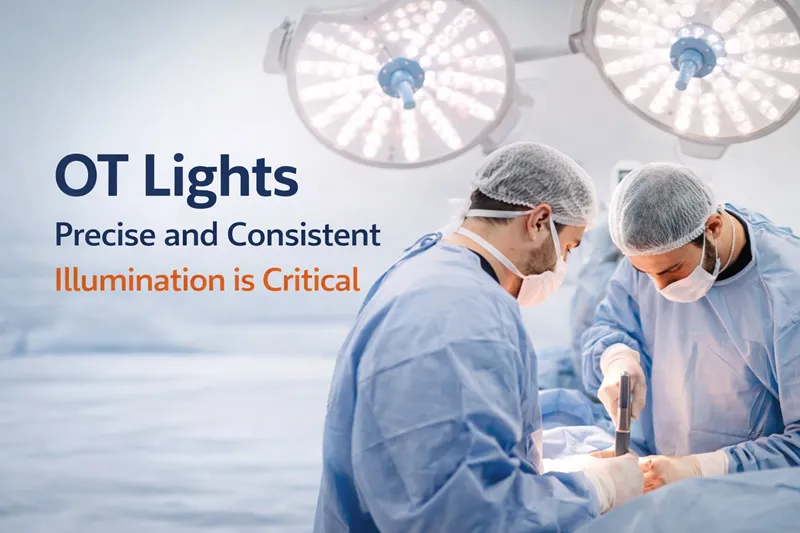
In today’s healthcare landscape, operation theatres are no longer limited to short, open procedures. Hospitals routinely perform long-duration, minimally invasive, microsurgical, and image-guided procedures that demand uninterrupted visual clarity for hours at a time. OT lights are designed to meet these demands by providing focused, uniform, adjustable, and shadow-free illumination that adapts to changing surgical conditions.
As patient safety standards rise and surgical techniques become more complex, OT lights have evolved from simple overhead lamps into highly engineered medical lighting systems. Modern OT lights deliver accurate colour rendering, heat-free illumination, ergonomic control, and compatibility with advanced OT equipment. This makes precise and consistent illumination a non-negotiable requirement for every modern operation theatre.
Why Lighting Quality Matters in Surgery
Surgery is a visually intensive medical discipline. Surgeons rely on minute visual cues to make critical decisions in real time. Poor lighting can mask bleeding points, distort tissue colour, or create shadows that hide vital structures.
High-quality OT lighting ensures:
-
Accurate differentiation between tissues
-
Clear identification of blood vessels and nerves
-
Better depth perception
-
Reduced risk of accidental tissue damage
-
Faster and more confident decision-making
Even slight inconsistencies in illumination can increase surgical stress, prolong procedures, and raise complication risks. OT lights are therefore not a comfort feature but a clinical safety requirement.
Importance of Precision in OT Illumination
Precision illumination means delivering light exactly where the surgeon needs it, without spillover or blind spots. Surgical sites vary in depth, size, and orientation, and lighting must adapt accordingly.
-
Focus light on deep cavities without loss of intensity
-
Maintain clarity when surgical instruments block direct light paths
-
Adjust beam diameter and brightness for different procedures
-
Provide uniform lighting across the entire surgical field
This precision reduces eye strain, enhances concentration, and supports meticulous surgical technique, especially in specialties like neurosurgery, orthopaedics, ENT, plastic surgery, and cardiovascular surgery.
Role of Consistent Lighting in Patient Safety
Consistency in illumination is as important as brightness. Sudden changes in light intensity, flickering, or shadow formation during surgery can break the surgeon’s focus at critical moments.
-
Maintains uniform brightness throughout long procedures
-
Prevents visual fatigue and headaches for surgical staff
-
Supports steady surgical rhythm
-
Reduces intraoperative errors caused by poor visibility
Stable lighting conditions help surgeons maintain accuracy from the first incision to final closure, directly improving patient safety and surgical outcomes.
Key Features of Modern OT Lights
Modern OT lights are designed to meet the demands of advanced surgical environments. Some of the most important features include:
Shadowless Illumination
Multiple LED light sources are arranged to eliminate shadows, even when hands, instruments, or staff obstruct light paths.
Adjustable Intensity and Focus
Surgeons can adjust brightness and beam size based on the procedure, patient anatomy, and personal preference.
High Colour Rendering Index (CRI)
A high CRI ensures that tissues appear natural, allowing accurate differentiation between healthy and affected areas.
Heat-Free Lighting
LED technology minimizes heat generation, preventing tissue drying and improving comfort for both patients and surgical teams.
Smooth Movement and Positioning
Balanced arms and ergonomic handles allow effortless positioning without disrupting sterility.
Types of OT Lights Used in Healthcare Facilities
Different healthcare setups require different OT lighting solutions:
Ceiling-Mounted OT Lights
Most commonly used in major operation theatres due to stability, wide coverage, and integration with other OT equipment.
Wall-Mounted OT Lights
Suitable for minor procedure rooms, outpatient surgery units, and smaller hospitals.
Mobile OT Lights
Used in emergency rooms, secondary OTs, and situations where flexibility is required.
Single Dome and Double Dome OT Lights
Single dome lights are sufficient for minor and routine surgeries, while double dome systems are preferred for complex, multi-field procedures requiring enhanced depth and coverage.
OT Lights and Surgical Workflow Efficiency
Efficient surgical workflow depends on equipment that adapts seamlessly to procedural needs. OT lights contribute significantly to workflow optimization by:
-
Allowing quick adjustments without interrupting surgery
-
Reducing the need for repositioning or external lighting aids
-
Integrating smoothly with OT tables, imaging systems, and surgical equipment
-
Supporting faster procedure completion through improved visibility
When lighting works intuitively with the surgical team, operation theatres function more efficiently, benefiting both patients and hospital operations.
Hygiene, Durability, and Maintenance
OT lights must meet strict hygiene and durability standards due to constant exposure to sterilization protocols and intensive use.
High-quality OT lights feature:
-
Smooth, sealed surfaces for easy cleaning
-
Resistant materials that withstand disinfectants
-
Enclosed LED systems to prevent contamination
-
Long operational life with minimal maintenance needs
Reliable OT lighting reduces downtime, prevents procedural delays, and supports consistent OT availability in busy hospitals.
OT Lights in Different Surgical Specialties
Different specialties place unique demands on OT lighting:
-
Neurosurgery requires intense, focused illumination with excellent depth perception.
-
Orthopaedic surgery needs broad, shadow-free lighting for large surgical fields.
-
Laparoscopic and minimally invasive surgery requires adjustable lighting compatible with imaging systems.
-
Plastic and reconstructive surgery demands high colour accuracy for aesthetic precision.
Modern OT lights are designed to support this diversity of surgical needs without compromise.
Role of Aarogyaa Bharat in OT Lights Procurement
Aarogyaa Bharat supports hospitals, surgical centres, and healthcare institutions by enabling access to high-quality, clinically compliant OT lighting solutions from verified manufacturers. The platform focuses on:
-
Performance reliability
-
Safety and regulatory compliance
-
Suitability for different surgical specialties
-
Long-term value and durability
By simplifying procurement and providing transparent product information, Aarogyaa Bharat helps healthcare facilities build and upgrade operation theatres with confidence.
Future of OT Lighting Technology
The future of OT lights is driven by innovation focused on smarter, safer, and more integrated surgical environments. Emerging trends include:
-
Touchless and gesture-based controls
-
Camera-integrated OT lights for teaching and documentation
-
Smart intensity adjustment based on surgical depth
-
Energy-efficient designs with lower operating costs
-
Integration with digital and hybrid operation theatres
Despite technological evolution, the fundamental requirement remains unchanged: precise, consistent, and reliable illumination.
Conclusion
OT lights are indispensable in modern healthcare because precise and consistent illumination is critical for surgical accuracy, patient safety, and operational efficiency. From enhancing visibility and reducing surgeon fatigue to supporting advanced surgical techniques, OT lights form the visual foundation of every successful surgical procedure.
For hospitals committed to delivering safe, efficient, and modern surgical care, investing in high-quality OT lighting is not an option it is a necessity.