From delivering essential nutrition and medications to
relieving gastric pressure and preventing complications, the Ryle’s tube plays
a vital role in emergency care, intensive care units (ICUs), surgical wards,
and long-term home care.
At Aarogyaa Bharat, we believe that understanding medical
equipment empowers caregivers, patients, and healthcare professionals to make
safer and more informed choices. This comprehensive guide explains the parts of
a Ryle’s tube, how each component functions, and why it is clinically so
important.
What Is a Ryle’s Tube?
A Ryle’s tube, commonly referred to as a nasogastric (NG)
tube, is a long, flexible tube inserted through the nose, passed down the oesophagus,
and positioned inside the stomach.
It is used when oral intake is not possible, unsafe, or
insufficient.
Common Indications for Using a Ryle’s Tube
- Stroke
or neurological disorders affecting swallowing
- Unconscious
or critically ill patients
- Post-operative
recovery
- Severe
malnutrition
- Intestinal
obstruction or gastric distension
- Long-term
illness requiring assisted feeding
Material & Design of a Ryle’s Tube
Modern Ryle’s tubes are designed for maximum safety,
comfort, and durability.
Common Materials
- Medical-grade
PVC
- Polyurethane
- Silicone
(for long-term use)
Design Characteristics
- Soft
and flexible to reduce nasal and oesophageal trauma
- Smooth
surface for easy insertion
- Resistant
to kinking and collapse
- Non-toxic
and biocompatible
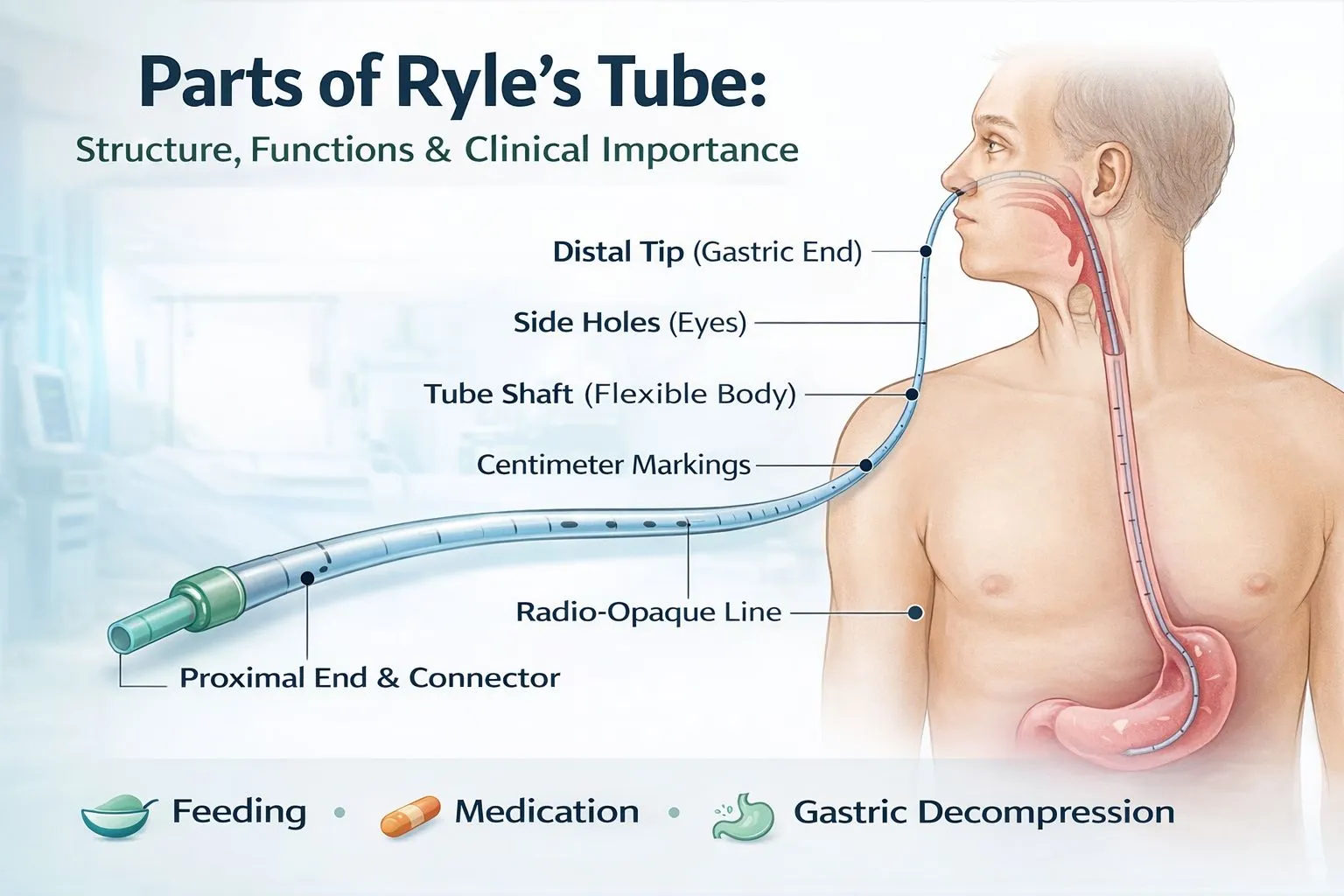
Main Parts of a Ryle’s Tube (Detailed Explanation)
Each part of a Ryle’s tube has a specific role. Together,
they ensure effective feeding, medication delivery, and gastric decompression.
1. Distal Tip (Gastric End)
Location: The end that rests inside the stomach
Key Features
- Rounded
and smooth
- Sometimes
weighted for better positioning
Function
- Allows
safe placement inside the stomach
- Minimizes
irritation and injury to the stomach lining
Clinical Importance
A well-designed distal tip reduces the risk of ulcers, bleeding, and discomfort
during prolonged use.
2. Side Holes (Eyes)
Location: Just above the distal tip
Function
- Permit
entry and exit of:
- Liquid
nutrition
- Medications
- Gastric
fluids and secretions
Clinical Importance
Multiple side holes ensure continuous flow even if one opening is blocked,
reducing feeding interruptions and aspiration risk.
3. Tube Shaft (Main Body)
Material: Flexible medical-grade polymer
Function
- Acts
as the primary channel for:
- Feeding
- Medication
administration
- Suction
or drainage
Clinical Importance
The shaft’s flexibility allows patient movement without tube displacement,
while its strength prevents collapse during suction.
4. Centimetre Markings
Location: Printed along the length of the tube
Function
- Helps
determine insertion depth
- Assists
in monitoring tube migration
Clinical Importance
Markings are essential for verifying correct placement and preventing
accidental lung insertion, a serious and potentially fatal complication.
5. Radio-Opaque Line
Feature: A contrast line embedded along the tube
Function
- Visible
on X-ray imaging
Clinical Importance
Radiological confirmation is the gold standard for checking correct placement,
especially in unconscious or critically ill patients.
6. Proximal End (External End)
Location: Outside the patient’s nostril
Function
- Connects
to:
- Feeding
syringes
- Enteral
feeding pumps
- Suction
systems
Clinical Importance
A secure proximal end prevents leakage, contamination, and accidental
disconnection during feeding or medication delivery.
7. Funnel or Connector
Function
- Facilitates
easy attachment of feeding devices
- Allows
controlled flow of nutrition or drugs
Clinical Importance
Proper connectors improve hygiene, reduce spillage, and enhance caregiver
convenience.
Sizes of Ryle’s Tubes
Ryle’s tubes are measured in French (Fr) units, selected
based on patient age and condition.
|
Patient
Category |
Typical
Size |
|
Neonates |
5-8 Fr |
|
Children |
8-10 Fr |
|
Adults |
12-18 Fr |
Choosing the correct size ensures comfort, efficient
feeding, and minimal complications.
Clinical Importance of a Ryle’s Tube
The Ryle’s tube is a cornerstone of supportive medical care
across specialties.
1. Enteral Nutrition
- Provides
life-sustaining nutrients when oral feeding is unsafe
- Prevents
malnutrition and muscle wasting
2. Medication Administration
- Enables
accurate dosing for patients unable to swallow tablets or liquids
- Ensures
consistent drug delivery
3. Gastric Decompression
- Removes
excess gas, blood, or fluid
- Relieves
nausea, vomiting, and abdominal distension
4. Diagnostic Use
- Aspiration
of gastric contents for analysis
- Monitoring
gastrointestinal bleeding
Care, Hygiene & Safety Guidelines
- Confirm
tube placement before every feed
- Flush
the tube before and after feeding or medication
- Maintain
nasal and oral hygiene
- Replace
the tube as recommended by healthcare professionals
- Watch
for warning signs such as coughing, choking, or discomfort
Why Quality Ryle’s Tubes Matter
A high-quality Ryle’s tube ensures:
- Lower
infection risk
- Better
patient comfort
- Accurate
feeding and medication delivery
- Reduced
tube blockage and replacement frequency
At Aarogyaa Bharat, we emphasize safe, reliable, and clinically approved medical devices suitable for hospitals, clinics, and home healthcare environments.
Conclusion
Though modest in appearance, the Ryle’s tube is a powerful
medical aid that supports nutrition, medication delivery, and gastric care when
patients need it most. Every part from the distal tip to the radio-opaque line plays
a crucial role in ensuring safety, effectiveness, and patient recovery.
For more expert healthcare blogs, medical equipment guides,
and trusted information, rely on Aarogyaa Bharat your partner in informed,
compassionate, and reliable healthcare solutions.