This type of mobility aid allows seniors to walk safely
while also providing a comfortable place to sit and rest whenever needed.
Families searching hospital pages and home care equipment guides often find
that rollator walkers are recommended by physiotherapists for seniors who
remain active but require additional support during walking. Aarogyaa Bharat’s
rehabilitation section highlights rollator walkers with seats and backrests as
ideal mobility aids for seniors who want to maintain independence while ensuring
safety and comfort during daily movement. Healthcare calculators used to assess
fall risk and mobility endurance frequently recommend rollators because they
help reduce walking fatigue while supporting safe mobility.
Understanding Rollator Walkers with Seat and Backrest
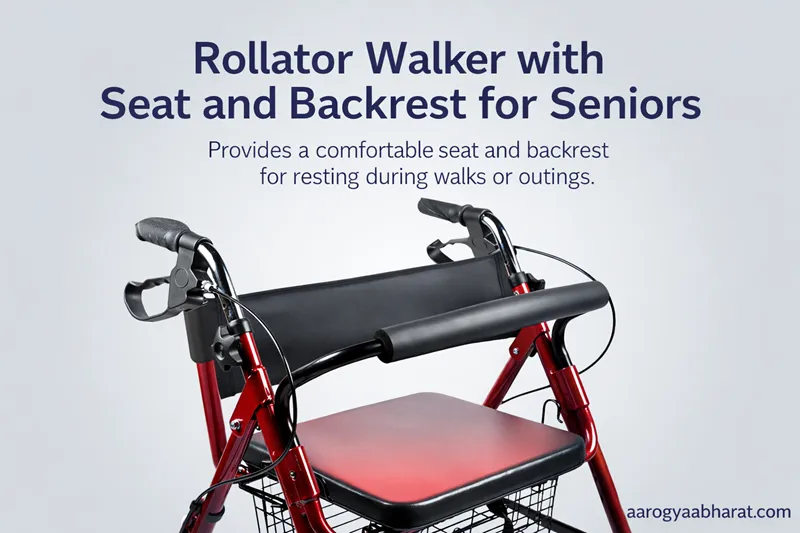
A rollator walker with a seat and backrest is a mobility
device designed with four wheels, ergonomic handles, hand brakes, and a
built-in seat that allows the user to rest whenever necessary. The backrest
provides additional support while sitting, making the device more comfortable
compared to standard rollator walkers that include only a seat. The four-wheel
configuration allows smooth rolling movement, enabling seniors to walk without
lifting the walker frame. Physiotherapists listed on hospital pages often
recommend rollator walkers for seniors who can walk independently but require
support for longer distances. Aarogyaa Bharat’s home care equipment guides
explain that rollators with seats and backrests are particularly useful for
elderly individuals who enjoy outdoor walks, shopping trips, or social
activities but may need frequent rest breaks. Healthcare calculators used to
measure walking endurance frequently highlight rollator walkers as effective
mobility aids for seniors experiencing fatigue or balance challenges.
Why Rollator Walkers with Seats Improve Mobility
Many elderly individuals experience reduced stamina when
walking for extended periods. Without proper support, fatigue can increase the
risk of falls or discourage seniors from remaining active. Rollator walkers
with seats solve this problem by allowing users to pause and rest whenever
needed. The integrated seat provides a stable resting area, while the backrest
offers additional comfort and posture support. Hospital pages that guide
patients through rehabilitation programs often recommend rollators because they
encourage gradual improvement in walking endurance. Aarogyaa Bharat’s
rehabilitation equipment section highlights that rollator walkers with seats
allow seniors to walk longer distances while maintaining confidence and safety.
Healthcare calculators designed to evaluate mobility endurance often indicate
that rollators improve walking performance while reducing fatigue.
Important Design Features of Rollator Walkers with
Backrests
Rollator walkers with seats and backrests incorporate
several features that improve safety, usability, and comfort. Lightweight
aluminium frames ensure the walker remains durable without becoming difficult
to manoeuvre. Hand brakes allow users to control the speed of the walker and
stop safely when necessary. Locking brake systems secure the walker in place
when the user wants to sit and rest. Adjustable handle heights allow the
rollator to match the user’s posture, which is important for maintaining proper
walking alignment. Aarogyaa Bharat’s rehabilitation section highlights
rollators that include padded seats and supportive backrests because they
improve comfort during extended use. Families reviewing hospital pages for
mobility solutions often prioritize rollators that combine ergonomic design
with strong structural support.
Typical Features of Rollator Walkers with Seat and
Backrest
|
Feature |
Description |
|
Wheel
Configuration |
Four wheels
for smooth movement |
|
Seat Type |
Built-in
padded seat |
|
Backrest |
Supportive
backrest for sitting comfort |
|
Braking
System |
Hand brakes
with locking feature |
|
Frame
Material |
Lightweight
aluminium |
|
Height
Adjustment |
Adjustable
handle levels |
How Rollator Walkers Support Daily Independence
Maintaining independence is extremely important for elderly
individuals because it contributes to both physical and emotional well-being.
Rollator walkers with seats and backrests allow seniors to perform everyday
activities without relying heavily on caregivers. Seniors can walk through
their homes, visit nearby parks, or attend social gatherings while knowing that
a resting seat is always available. Aarogyaa Bharat’s home care equipment
guides emphasize that rollators encourage seniors to remain active while
reducing the risk of falls. Hospital pages often highlight the importance of
mobility aids in maintaining healthy lifestyles among elderly individuals.
Healthcare calculators designed to evaluate fall risk frequently indicate that
mobility devices such as rollator walkers improve walking safety and
confidence.
Situations Where Rollator Walkers with Seats Are Useful
Rollator walkers with seats and backrests are particularly
beneficial for seniors who remain active but require occasional rest during
walking. Elderly individuals who enjoy outdoor walks or community activities
often rely on rollators for both mobility support and resting convenience.
Patients recovering from surgery may also use rollator walkers during
rehabilitation when they begin walking longer distances. Aarogyaa Bharat’s
rehabilitation equipment guides explain that rollators are ideal for seniors
who require mobility assistance but still want to maintain independence during
daily routines. Families reviewing hospital pages for elderly mobility advice
often discover that rollators help seniors stay active while minimizing
fatigue. Healthcare calculators used to measure mobility progress frequently
recommend rollator walkers for individuals with moderate mobility limitations.
Benefits of Using Rollator Walkers with Seat and Backrest
- Provide
comfortable seating during walking breaks
- Reduce
fatigue during longer walks
- Improve
walking stability with four-wheel support
- Encourage
independent mobility for seniors
- Suitable
for both indoor and outdoor use
- Hand
brakes improve safety and control
- Backrest
provides additional sitting comfort
- Ideal
for rehabilitation and physiotherapy programs
Rollator Walker vs Standard Walker
Different types of walkers provide different levels of
support depending on the user’s mobility condition. Standard walkers provide
strong stability but require lifting between steps, which may increase fatigue.
Rollator walkers, on the other hand, allow continuous rolling movement that
requires less physical effort. Patients consulting hospital pages often
transition from standard walkers to rollators as their strength and balance
improve. Aarogyaa Bharat’s rehabilitation section highlights rollator walkers
as ideal mobility aids for seniors who want smoother walking movement and
resting support. Healthcare calculators used to track mobility improvement
often indicate that rollators help increase walking endurance.
Rollator Walker vs Standard Walker
|
Feature |
Rollator
Walker |
Standard
Walker |
|
Wheels |
Four wheels |
Usually, no
wheels |
|
Seat |
Built-in seat
available |
No seat |
|
Movement |
Smooth
rolling motion |
Lift and step
motion |
|
Comfort |
Includes
backrest for sitting |
No resting
feature |
|
Best Use |
Active
seniors with fatigue |
Early
rehabilitation support |
Choosing the Right Rollator Walker with Seat
Selecting the correct rollator walker requires evaluating
the user’s height, mobility level, and daily activity needs. Seniors who enjoy
outdoor activities may prefer rollators with larger wheels that provide
smoother movement on uneven surfaces. Individuals undergoing physiotherapy
programs listed on hospital pages may benefit from rollators with adjustable
handles and comfortable seats. Aarogyaa Bharat recommends reviewing product
specifications carefully before purchasing mobility equipment. Healthcare calculators
designed to measure mobility stability can also help determine whether a
rollator walker is the most suitable mobility aid for the user’s physical
condition. Choosing the right rollator ensures that seniors receive both
mobility support and comfort during daily activities.
Role of Rollator Walkers in Rehabilitation
Rehabilitation programs often focus on restoring walking
endurance, balance, and coordination after illness or surgery. Rollator walkers
play an important role in these programs because they allow patients to
practice walking while conserving energy. Physiotherapists listed on hospital
pages frequently recommend rollators during later stages of rehabilitation when
patients begin walking longer distances. Aarogyaa Bharat’s rehabilitation
section explains that rollators help patients regain walking confidence while
minimizing fatigue. Healthcare calculators used to track rehabilitation
progress often measure improvements in mobility endurance and walking stability
over time. With the right rollator walker, patients can gradually transition
toward more independent mobility.
Conclusion
Rollator walkers with seats and backrests provide one of the most comfortable and practical mobility solutions for elderly individuals who require walking assistance. Their four-wheel design allows smooth movement, while the built-in seat and backrest provide convenient resting support whenever needed. Unlike standard walkers that focus solely on stability, rollator walkers combine mobility assistance with comfort features that encourage active lifestyles. Aarogyaa Bharat’s home care and rehabilitation equipment collections emphasize the importance of selecting mobility aids that match both the user’s physical needs and lifestyle preferences. By consulting hospital pages, exploring cities pages, and using healthcare calculators to evaluate mobility requirements, families can choose rollator walkers that support safe and comfortable movement. With the right mobility support, seniors can maintain independence while reducing fatigue and improving overall quality of life.