Why Incorrect Seat Height Is a Leading Cause of Toileting
Accidents
Most toileting accidents at home occur not because the user
cannot walk, but because they cannot safely sit down or stand up at the toilet.
When a seat is too low, users must bend their knees and hips deeply, shift
their centre of gravity forward, and rely heavily on weak leg muscles, often
resulting in knee buckling, sudden imbalance, or collapse. When a seat is too
high, feet may not rest flat on the floor, causing instability, sliding, or
tipping during transfers. Elderly users and post-surgery patients are
especially vulnerable because joint stiffness, muscle loss, pain, and delayed
reflexes prevent quick recovery from imbalance. Fixed-height toilets and basic
commode chairs fail to accommodate these variations, turning a routine activity
into a high-risk movement repeated multiple time daily. Adjustable-leg commode
chairs directly address this risk by aligning the seat height with the user’s
physical ability, enabling controlled, confident, and predictable transfers
instead of forced, unsafe effort.
What a Commode Chair with Adjustable Legs Actually Is
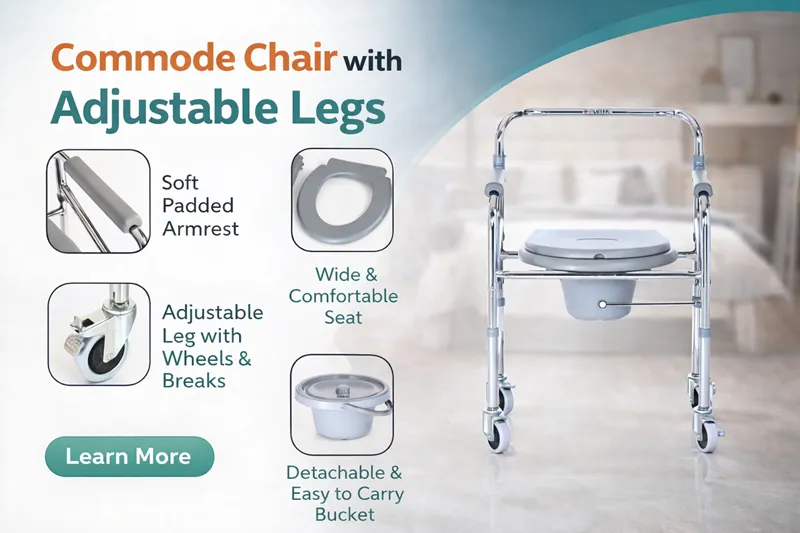
A commode chair with adjustable legs is a portable toileting
chair engineered with telescopic or modular leg sections that allow the overall
seat height to be increased or decreased in measured increments. Each leg is
secured using locking pins or clips to maintain structural rigidity once
adjusted. This design allows caregivers to fine-tune the chair height according
to the user’s leg length, bed height, joint limitations, balance level, and
recovery stage. Unlike fixed-height chairs that may suit only one phase of
care, adjustable-leg commode chairs evolve with the user, remaining suitable as
strength improves or declines. Once properly locked, the chair functions as a
solid, stable structure comparable to fixed chairs, but with far greater
adaptability and long-term usability.
How Adjustable Leg Height Improves Sitting and Standing
Safety
The safest toileting posture places the user’s hips slightly
higher than their knees, allowing gravity and muscle mechanics to work together
rather than against the body. Adjustable legs make this posture achievable for
users of different heights and abilities. When the seat height is correct, the
user can lower themselves slowly using armrests, maintain balance while seated,
and stand up using controlled movements instead of sudden effort. This reduces
stress on knee joints, prevents backward falls, and minimises dizziness caused
by sudden posture changes. For elderly users and weak patients, this difference
can mean the ability to toilet independently rather than requiring full
assistance.
Role of Adjustable Legs in Post-Surgery Recovery at Home
After surgeries such as knee replacement, hip replacement,
spinal surgery, abdominal procedures, or fracture repair, patients are often
advised to avoid deep bending and low seating to protect healing joints and
surgical sites. Recovery is not linear; pain, swelling, and mobility can
fluctuate daily. Adjustable-leg commode chairs allow the seat height to be
raised during early recovery when movement is restricted and gradually lowered
as strength and flexibility improve. This supports progressive rehabilitation
without changing equipment, reduces pain during transfers, protects surgical
outcomes, and encourages safe independence at home.
Benefits for Elderly Users with Arthritis and
Degenerative Joint Conditions
Elderly individuals commonly live with osteoarthritis,
osteoporosis, joint degeneration, and muscle weakness, which make low seating
painful and dangerous. Even a small difference in seat height can determine
whether toileting feels manageable or terrifying. Adjustable-leg commode chairs
allow height adjustments based on daily comfort levels, stiffness, or fatigue.
On difficult days, the seat can be raised slightly to reduce strain; on better
days, it can be lowered to support mobility maintenance. This flexibility
reduces fear, encourages regular toileting, prevents accidents caused by
hesitation, and preserves dignity and confidence in elderly users.
Reduced Physical Strain and Injury Risk for Caregivers
Caregivers frequently suffer from back, shoulder, and knee
injuries while assisting patients during toileting, particularly when lifting
or supporting weight from low seating positions. Adjustable-leg commode chairs
position the patient at an optimal height for assisted transfers, reducing the
need for bending, awkward lifting, or sudden load shifts. This protects
caregiver health, reduces fatigue, and allows care to be provided calmly and
safely over long periods. Sustainable caregiving is only possible when
caregiver safety is considered alongside patient needs.
Adaptability to Indian Home Layouts and Floor Conditions
Indian homes vary widely in design, with differences in
flooring, bed heights, bathroom layouts, and room sizes. Uneven floors, thick
tiles, raised platforms, or temporary recovery setups can make fixed-height
chairs uncomfortable or unstable. Adjustable-leg commode chairs allow height
compensation to maintain proper seating posture even on uneven surfaces. This
adaptability makes them suitable for apartments, independent houses, rented
homes, and temporary care environments across India.
Stability and Locking Safety in Adjustable-Leg Chairs
A common concern is whether adjustable-leg chairs compromise
stability compared to fixed models. High-quality adjustable-leg commode chairs
use reinforced frames, strong locking pins, and anti-slip rubber tips to ensure
that once adjusted, the chair remains completely stable under full body weight.
Proper adjustment requires all legs to be set at equal height and securely
locked. When used correctly, adjustable-leg chairs offer stability equal to
fixed chairs while providing far superior safety through customisation.
Types of Adjustable-Leg Commode Chairs and Their Uses
|
Chair Type |
Best For |
Primary
Benefit |
|
Height-Adjustable
Fixed Chair |
Elderly,
chronic care |
Safe daily
transfers |
|
Adjustable
Chair with Armrests |
Weak mobility
users |
Upper-body
support |
|
Adjustable
Cushioned Chair |
Long sitting
needs |
Pressure
relief |
|
Adjustable
Anti-Slip Chair |
High
fall-risk users |
Enhanced
stability |
|
Adjustable
Foldable Chair |
Temporary
home care |
Easy storage |
Hygiene and Maintenance of Adjustable-Leg Commode Chairs
Adjustable-leg commode chairs are designed for easy hygiene
management in home settings. Removable buckets allow controlled waste disposal,
while smooth, waterproof surfaces support daily cleaning and disinfection.
Adjustable joints should be kept clean and dry to maintain smooth operation and
secure locking. Regular inspection of locking pins and rubber tips ensures
long-term safety and reliability without complex maintenance routines.
Psychological Confidence Gained from Correct Height
Adjustment
Using a chair that feels too low or unstable creates fear,
hesitation, and anxiety, often leading users to rush movements or avoid
toileting altogether. Proper height adjustment gives users a sense of control
and predictability, allowing calm, deliberate movements. This psychological
confidence directly improves physical safety, as relaxed users move more
slowly, maintain balance, and trust the equipment supporting them.
Long-Term Value and Reusability of Adjustable-Leg Chairs
Unlike fixed-height chairs that may become unsuitable as
conditions change, adjustable-leg commode chairs remain useful across different
stages of care. They can be readjusted for different users, reused after
recovery, or repurposed for future needs. This makes them a cost-effective,
future-proof investment for families managing long-term or recurring care
needs.
Why Aarogyaa Bharat Recommends Adjustable-Leg Commode
Chairs
Aarogyaa Bharat understands that effective home care must
adapt to real people, real homes, and changing health conditions. Our
adjustable-leg commode chairs are selected to meet Indian home environments,
diverse patient needs, and long-term usability expectations. By prioritising
flexibility, stability, comfort, and dignity, Aarogyaa Bharat enables safer,
more personalised home care.
Conclusion