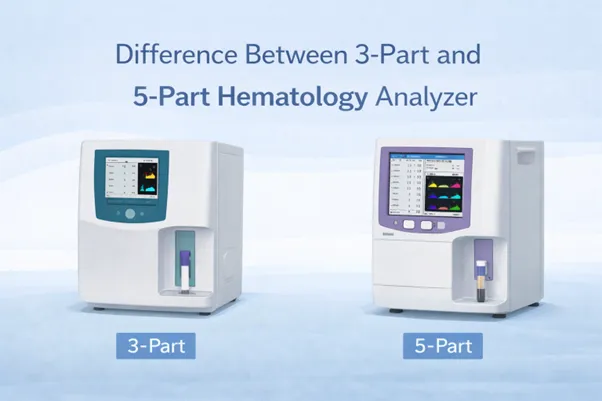
When setting up or upgrading a laboratory, one of the most
common questions buyers ask is:
Should I choose a 3-part hematology analyzer or a 5-part
hematology analyzer?
The answer depends on clinical requirements, test volume,
diagnostic depth, budget, and future scalability.
At Aarogyaa Bharat, we help labs and hospitals make practical, future-ready equipment decisions. This comprehensive guide explains the difference between 3-part and 5-part hematology analyzers, including working principles, parameters measured, clinical applications, advantages, limitations, cost factors, and FAQs in clear, easy-to-understand language.
What Is a Hematology Analyzer?
A hematology analyzer is an automated laboratory instrument
used to analyze blood samples and provide quantitative data about blood cells.
It performs a Complete Blood Count (CBC) and helps clinicians assess a
patient’s overall health and detect a wide range of diseases.
Hematology analyzers are used to:
- Measure
red blood cells (RBCs)
- Count
white blood cells (WBCs)
- Analyze
hemoglobin levels
- Evaluate
platelets
- Detect
infections, anemia, leukemia, and inflammatory conditions
hematology analyzer
Why Hematology Analyzers Are Essential in Diagnostics
Manual blood cell counting is:
- Time-consuming
- Subjective
- Prone
to human error
Automated hematology analyzers offer:
- High
speed
- Consistent
accuracy
- Standardized
results
- High
throughput
They are indispensable in routine screening, emergency
diagnostics, and disease monitoring.
Automated Blood Analysis in Laboratory
Basic Classification of Hematology Analyzers
Hematology analyzers are commonly classified based on white
blood cell (WBC) differentiation capability:
- 3-Part
Hematology Analyzer
- 5-Part
Hematology Analyzer
This “part” refers to how many types of white blood cells
are differentiated.
What Is a 3-Part Hematology Analyzer?
A 3-part hematology analyzer classifies white blood cells
into three major groups based on size and granularity.
WBC Groups in 3-Part Analyzer
- Lymphocytes
(LYM)
- Monocytes
(MON)
- Granulocytes
(GRA) - includes neutrophils, eosinophils, and basophils together
Technology Used
- Electrical
impedance method
- Basic
optical detection (in some models)
3-part hematology analyzer
Parameters Measured by 3-Part Analyzer
A typical 3-part analyzer reports:
- Total
WBC count
- RBC
count
- Hemoglobin
(Hb)
- Hematocrit
(HCT)
- Platelet
count
- MCV,
MCH, MCHC
- RDW
These parameters are sufficient for routine CBC testing.
Advantages of 3-Part Hematology Analyzer
Lower initial cost
Simple operation
Low reagent consumption
Easy maintenance
Ideal for small labs and clinics
Limitations of 3-Part Hematology Analyzer
Limited WBC differentiation
Cannot separately identify neutrophils, eosinophils, basophils
Not ideal for oncology or complex cases
May require manual smear review
3-Part Hematology Analyzer in Clinic
What Is a 5-Part Hematology Analyzer?
A 5-part hematology analyzer provides detailed
differentiation of five types of white blood cells, offering higher diagnostic
precision.
WBC Groups in 5-Part Analyzer
- Neutrophils
- Lymphocytes
- Monocytes
- Eosinophils
- Basophils
Technology Used
- Flow
cytometry
- Laser
light scattering
- Fluorescence
detection
5-part hematology analyzer
Parameters Measured by 5-Part Analyzer
In addition to all CBC parameters, a 5-part analyzer
provides:
- Individual
WBC percentages & absolute counts
- Abnormal
cell flags
- Immature
cell detection (in advanced models)
This level of detail is essential for advanced clinical
diagnostics.
Advantages of 5-Part Hematology Analyzer
Accurate WBC differentiation
Better infection & allergy diagnosis
Early leukemia detection support
Reduced need for manual smear
Suitable for high-end laboratories
Limitations of 5-Part Hematology Analyzer
Higher initial cost
More complex operation
Higher reagent consumption
Requires trained staff
5-Part Hematology Analyzer in Hospital Lab
Key Differences Between 3-Part and 5-Part Hematology
Analyzer
|
Feature |
3-Part
Analyzer |
5-Part
Analyzer |
|
WBC
Differentiation |
3 groups |
5 groups |
|
Technology |
Impedance |
Flow
cytometry / laser |
|
Diagnostic
Depth |
Basic |
Advanced |
|
Cost |
Lower |
Higher |
|
Reagent Usage |
Low |
Moderate to
high |
|
Ideal For |
Small labs |
Hospitals
& reference labs |
|
Oncology
Support |
Limited |
Strong |
difference between 3 part and 5-part hematology analyzer
Clinical Use-Case Comparison
3-Part Analyzer Is Best For
- Small
diagnostic labs
- Clinics
and nursing homes
- Routine
CBC screening
- Low
patient volume
5-Part Analyzer Is Best For
- Multi-specialty
hospitals
- Oncology
departments
- Reference
laboratories
- High
patient volume
Cost Comparison & ROI Consideration
While 5-part analyzers cost more initially, they:
- Reduce
manual smear workload
- Improve
diagnostic confidence
- Support
specialized testing
Long-term ROI is often better for medium to large labs.
Maintenance & Operational Considerations
|
Aspect |
3-Part |
5-Part |
|
Calibration |
Simple |
Advanced |
|
Maintenance |
Low |
Moderate |
|
Training |
Minimal |
Required |
|
Downtime |
Low |
Moderate |
Regulatory & Quality Considerations
Both analyzers should:
- Comply
with ISO standards
- Be
CE / FDA approved (where applicable)
- Undergo
regular quality control
Choosing a certified analyzer ensures accuracy and patient
safety.
Future Trends in Hematology Analysis
- AI-based
cell classification
- Flagging
of rare abnormalities
- Integrated
LIS connectivity
- Compact
5-part analyzers for smaller labs
The gap between 3-part and 5-part systems is narrowing as technology advances.
Conclusion
Understanding the difference between 3-part and 5-part
hematology analyzers is essential for selecting the right diagnostic equipment.
While 3-part analyzers are ideal for routine testing and small laboratories,
5-part analyzers provide advanced diagnostic depth required in hospitals and
specialty labs.
At Aarogyaa Bharat, we recommend choosing a hematology
analyzer based on clinical demand, patient volume, and future growth plans,
ensuring accuracy, efficiency, and long-term value.