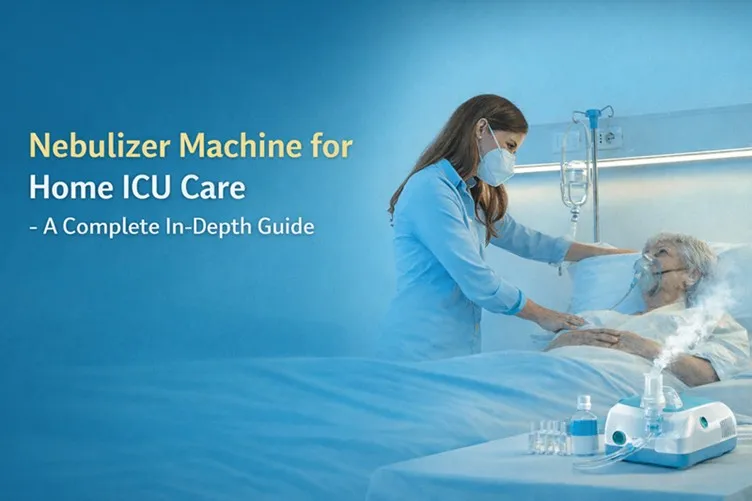
A nebulizer machine plays a life-saving role in managing
respiratory conditions by converting liquid medication into a fine mist that
can be inhaled deep into the lungs. In a home ICU setting, where patients may
be dealing with breathing difficulties, lung infections, airway inflammation,
post-COVID lung damage, or mucus build up, nebulizers become a frontline therapy
device. Unlike inhalers that require proper hand-breath coordination,
nebulizers deliver medication passively, making them ideal for weak, elderly,
or unconscious patients.
At Aarogyaa Bharat, we work closely with families setting up
home ICU environments and consistently observe that nebulizer machines are
often misunderstood or under-prioritized. Many caregivers focus more on oxygen
therapy while ignoring the equally vital role nebulization plays in stabilizing
lung function, preventing infections, and improving patient comfort. A wrong
choice of nebulizer or improper usage can lead to poor medication absorption,
delayed recovery, and unnecessary hospital readmissions.
This comprehensive guide explains everything families and
caregivers must know about nebulizer machines for home ICU care including how
they work, why they are essential, the best types for critical patients, key
selection criteria, safety protocols, maintenance routines, and real-world use
scenarios. By the end of this guide, you will be fully equipped to choose and
manage a nebulizer machine confidently for long-term home ICU support.
Why Nebulizer Machines Are Critical In-Home ICU Care
In home ICU environments, respiratory stability is often the
most fragile and continuously monitored parameter. Patients admitted to home
ICU setups typically suffer from serious conditions such as chronic obstructive
pulmonary disease (COPD), severe asthma, pneumonia, pulmonary fibrosis,
bronchiectasis, post-COVID lung scarring, neuromuscular disorders, or
post-surgical respiratory weakness. In such cases, maintaining open airways and
effective oxygen exchange is absolutely essential for survival and recovery.
Nebulizer machines play a foundational role by delivering
medication directly into the lungs in mist form. This bypasses the digestive
system and bloodstream, ensuring rapid action, higher bioavailability, and
fewer systemic side effects compared to oral medications. For ICU patients who
cannot swallow tablets, use inhalers properly, or follow breathing
instructions, nebulizers become the safest and most reliable method of drug
delivery.
Another critical advantage of nebulizers in home ICU care is
medication versatility. Doctors can prescribe bronchodilators to open airways,
corticosteroids to reduce inflammation, antibiotics to fight infections,
mucolytics to thin mucus, and saline solutions to hydrate airways all delivered
using a single nebulizer device. This adaptability allows respiratory therapy
plans to evolve with the patient’s condition without changing equipment.
Nebulizers also play a preventive role in home ICU care.
Regular nebulization keeps airways moist, prevents mucus plugging, improves
lung compliance, and reduces the risk of secondary infections such as
aspiration pneumonia. For bedridden patients, neurological cases, or
individuals with weak cough reflexes, nebulizers are not just treatment devices
they are essential life-preserving tools.
How a Nebulizer Machine Works in an ICU Environment
A nebulizer machine functions by converting liquid
medication into a fine aerosol mist that can be inhaled through a mask or
mouthpiece. This mist contains tiny drug particles that travel deep into the
lungs, reaching the bronchi, bronchioles, and alveoli where gas exchange
occurs. This direct delivery ensures faster therapeutic action compared to oral
medications or injections.
In compressor nebulizers, compressed air passes through the
liquid medication, breaking it into fine droplets. Ultrasonic nebulizers use
high-frequency sound waves to create mist, while mesh nebulizers push liquid
through a vibrating micro-mesh to form ultra-fine particles. Each technology
has unique benefits, and choosing the right one depends on patient condition,
medication type, and comfort needs.
In a home ICU environment, nebulizers are often integrated
with oxygen therapy. Many advanced nebulizer models allow oxygen input from a
concentrator or cylinder, enabling simultaneous medication delivery and oxygen
supplementation. This dual-function capability is particularly useful for
critically ill patients with low oxygen saturation levels.
Nebulizer sessions typically last between 5 to 15 minutes
depending on medication volume and device efficiency. During this time,
patients inhale medication passively, making it ideal for those who are
unconscious, confused, or physically weak. The simplicity of this process makes
nebulizers a cornerstone device in long-term critical home care.
Types of Nebulizer Machines Suitable for Home ICU Care
Choosing the right nebulizer type is one of the most
important decisions when setting up a home ICU. The three primary types are
compressor nebulizers, ultrasonic nebulizers, and mesh nebulizers, each with
specific advantages and limitations.
Compressor nebulizers are the most widely used in home ICU
care due to their robustness, affordability, and medication compatibility. They
can handle all types of respiratory drugs, including thick suspensions and
antibiotics. Although slightly bulky and noisy, their reliability makes them
ideal for long-term daily therapy in serious respiratory cases.
Ultrasonic nebulizers operate using sound waves and are
quieter and faster than compressor models. However, they are not compatible
with all medications, particularly steroids and thick suspensions. In home ICU
care, ultrasonic nebulizers are typically used for saline therapy or light
bronchodilator treatment rather than full-spectrum drug delivery.
Mesh nebulizers represent the most advanced category. They
use a vibrating mesh to create extremely fine mist particles, resulting in
superior drug absorption and faster relief. They are extremely quiet, compact,
and battery-powered, making them ideal for night-time therapy and continuous
care. While more expensive, mesh nebulizers are often preferred for premium
home ICU setups focused on patient comfort.
Key Benefits of Nebulizer Machines in Home ICU Care
One of the most significant benefits of nebulizer machines
is their ability to deliver medication without requiring patient effort. Unlike
inhalers, which require breath coordination, nebulizers work passively, making
them ideal for critically ill, elderly, or unconscious patients.
Nebulizers provide faster symptom relief by delivering
medication directly into the lungs. This rapid action is particularly important
during asthma attacks, COPD exacerbations, or respiratory infections where
immediate airway opening is required.
Another major advantage is improved medication adherence.
Patients are more likely to complete nebulization therapy sessions compared to
inhaler use, especially when caregivers supervise the process. This leads to
better treatment outcomes and reduced hospital readmissions.
Nebulizers also support combination therapy. Multiple drugs
can be administered sequentially or combined as prescribed by doctors, making
nebulizers versatile tools for complex respiratory treatment regimens in
ICU-grade home care.
Features to Look for in a Home ICU Nebulizer Machine
When selecting a nebulizer for home ICU use, particle size
output is a critical factor. A good nebulizer should produce particles between
1-5 microns for deep lung penetration and optimal drug absorption.
Medication compatibility is equally important. ICU patients
often require diverse medications, and the nebulizer must support
bronchodilators, steroids, antibiotics, saline, and mucolytics without clogging
or malfunctioning.
Noise level matters significantly in ICU care. Loud machines
can disturb patient sleep and increase anxiety. Mesh nebulizers and low-noise
compressor models are ideal for maintaining a calm healing environment.
Ease of cleaning and maintenance is another essential
factor. Poor hygiene can turn nebulizer parts into bacterial breeding grounds,
increasing infection risk. Devices with detachable, dishwasher-safe components
simplify cleaning routines.
Nebulizer Safety Guidelines in Home ICU Care
Safety is paramount when using nebulizer machines in a home
ICU environment. Always follow the medication dosage and frequency prescribed
by the doctor. Overuse can cause airway irritation, drug resistance, or
cardiovascular side effects.
The nebulizer should be placed on a stable surface away from
dust, moisture, and heat. Electrical safety is equally critical. Avoid
extension cords, overloaded sockets, and unstable power connections.
Always wash hands before handling nebulizer components. Use
only sterile or distilled water for dilution if required. Never mix medications
unless specifically instructed by a doctor.
After every session, disassemble and clean nebulizer parts
using warm soapy water. Weekly disinfection using boiling water or approved
disinfectants is essential for infection control.
Nebulizer Machine Comparison Table for Home ICU Care
|
Feature |
Compressor
Nebulizer |
Ultrasonic
Nebulizer |
Mesh
Nebulizer |
|
Medication
Compatibility |
Very High |
Medium |
Very High |
|
Noise Level |
Moderate |
Low |
Very Low |
|
Portability |
Low |
Medium |
High |
|
Nebulization
Speed |
Medium |
Fast |
Fast |
|
Cleaning Ease |
Medium |
Medium |
High |
|
Ideal ICU Use
Case |
Long-term
therapy |
Light therapy |
Premium ICU |
Who Needs a Nebulizer in Home ICU Care
Patients with COPD, asthma, interstitial lung disease,
bronchiectasis, and pulmonary fibrosis are the most frequent users of
nebulizers in home ICU setups. These patients require daily nebulization to
prevent airway collapse and maintain lung function.
Post-COVID patients often suffer from persistent lung
inflammation, mucus build up, and breathlessness. Nebulizers help accelerate
lung recovery and improve oxygen absorption in these individuals.
Elderly patients with weak immune systems and compromised
respiratory capacity benefit greatly from nebulization therapy. Regular
sessions reduce infection risk and improve long-term breathing stability.
Neurological patients such as stroke survivors, spinal cord
injury patients, and coma patients require nebulizers to prevent mucus plugging
and aspiration pneumonia, making nebulization a preventive and therapeutic
necessity.
Conclusion
Nebulizer machines are indispensable devices in modern home
ICU care, forming the backbone of respiratory therapy, infection control, and
airway management. From delivering life-saving medication directly into the
lungs to supporting oxygen therapy integration, nebulizers enable
hospital-grade respiratory support in home environments.
Choosing the right nebulizer type, maintaining strict
hygiene routines, and following proper safety protocols can significantly
improve patient comfort, recovery speed, and long-term health outcomes. Whether
managing chronic lung disease, post-surgical recovery, or critical illness, a
reliable nebulizer transforms home care into a true ICU-grade healing
ecosystem.
At Aarogyaa Bharat, we offer a carefully curated range of
high-quality nebulizer machines suitable for home ICU care, along with expert
guidance on selection, setup, and long-term usage. Our mission is to empower
families with safe, reliable, and affordable medical equipment that brings
hospital-level care into the comfort of their homes.
If you need personalized assistance selecting the right
nebulizer machine for your home ICU setup, Aarogyaa Bharat is always here to
support your journey toward better respiratory health and patient well-being.