Many families buy cylinders out of panic, without understanding when they are truly necessary, how long they last, or whether an oxygen concentrator might be a safer and more economical option.
This detailed guide explains when an oxygen cylinder is needed at home, who should have one, how it compares to oxygen concentrators, safety precautions, cost considerations, and how Aarogyaa Bharat helps families choose the right oxygen solution.
Understanding Oxygen Therapy for Home Use
Oxygen therapy is a medical treatment that provides supplemental oxygen to patients whose blood oxygen levels fall below safe limits. It is commonly used for patients with respiratory and cardiac conditions, post-surgical recovery, and emergency breathing difficulties. Normal oxygen saturation levels in healthy individuals range from 95% to 100%. When saturation drops below 90%, organs and tissues do not receive enough oxygen, leading to breathlessness, fatigue, confusion, and potentially life-threatening complications. Home oxygen therapy is typically delivered through either an oxygen cylinder or an oxygen concentrator, depending on the patient’s condition, duration of therapy, and emergency preparedness needs.
What Is an Oxygen Cylinder and How Does It Work?
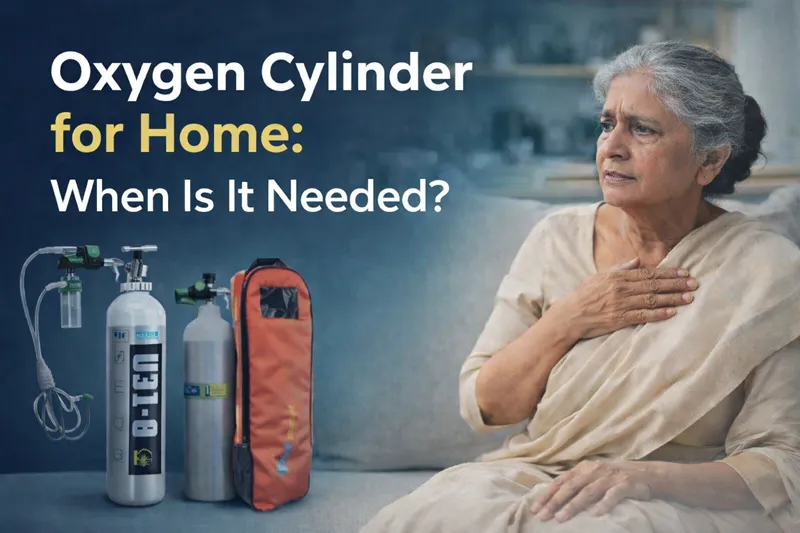
An oxygen cylinder is a pressurized metal tank filled with medical-grade oxygen. It releases oxygen through a regulator and flow meter, allowing controlled delivery to the patient via a nasal cannula or oxygen mask. Unlike concentrators, oxygen cylinders do not generate oxygen. They store a fixed quantity of oxygen and must be refilled or replaced once empty. Cylinders come in various sizes, ranging from small portable units for travel to large stationary cylinders for home use. The duration of oxygen supply depends on cylinder size and flow rate.
When Is an Oxygen Cylinder Needed at Home?
Not every patient requires an oxygen cylinder at home.
However, in certain situations, having one available can be life-saving.
1. During Medical Emergencies
Oxygen cylinders are most critical during sudden respiratory
emergencies such as:
- Severe
asthma attacks
- Acute
COPD exacerbations
- Pneumonia-related
breathlessness
- Post-COVID
respiratory distress
- Heart
failure episodes
- Accidental
choking or smoke inhalation
In such cases, an oxygen cylinder provides immediate
oxygen support without waiting for a concentrator to start or for
electricity to be restored.
2. As a Backup for Oxygen Concentrators
For patients using oxygen concentrators at home, a cylinder is an essential backup. In India, power cuts, voltage fluctuations, and equipment failures are common. If the concentrator stops working during a power outage or mechanical fault, an oxygen cylinder ensures uninterrupted oxygen supply until power or repairs are restored. Doctors strongly recommend keeping a backup oxygen cylinder for all patients on long-term home oxygen therapy.
3. For Short-Term Oxygen Therapy
Oxygen cylinders are ideal for patients who require oxygen
only for a few days or weeks, such as:
- Post-surgical
recovery patients
- Short-term
pneumonia recovery
- Temporary
breathlessness after illness
- Mild
COVID recovery patients
In such cases, renting a cylinder may be more economical
than purchasing a concentrator.
4. For Patients Without Reliable Electricity
In areas with frequent power outages or unstable voltage, oxygen concentrators may not be reliable. For such households, oxygen cylinders provide a dependable oxygen source that does not require electricity, making them suitable for rural or semi-urban regions.
5. For High-Flow Oxygen Requirements
Some critically ill patients require very high oxygen flow rates (10-15 LPM or more), which many standard home concentrators cannot provide. In such cases, oxygen cylinders are often used temporarily until hospital transfer or stabilization.
When Is an Oxygen Cylinder NOT the Best Option?
- While oxygen cylinders are useful in emergencies, they are not always ideal for long-term home care.
- They are not suitable for patients requiring continuous oxygen for months or years because frequent refilling becomes expensive and logistically challenging.
- Cylinders are heavy, difficult to move, and require careful handling due to high-pressure storage.
- They also create anxiety for families because oxygen supply can suddenly run out if not monitored properly.
- For long-term oxygen therapy, an oxygen concentrator is usually safer, more economical, and more convenient.
Oxygen Cylinder vs Oxygen Concentrator: Which Is Better
for Home?
|
Feature |
Oxygen Cylinder |
Oxygen Concentrator |
|
Oxygen Source |
Stored oxygen |
Generates oxygen from air |
|
Electricity |
Not required |
Required |
|
Duration |
Limited |
Unlimited (with power) |
|
Refilling |
Required |
Not required |
|
Cost (Long Term) |
High |
Lower |
|
Portability |
Moderate |
Moderate |
|
Emergency Use |
Excellent |
Limited |
|
Noise |
Silent |
Produces noise |
|
Maintenance |
Minimal |
Regular cleaning & servicing |
Best practice: Use a concentrator for daily oxygen
therapy and keep a cylinder as emergency backup.
How Long Does an Oxygen Cylinder Last at Home?
The duration of an oxygen cylinder depends on its size and
the flow rate used.
For example:
- A
7-cubic-meter cylinder at 2 LPM lasts about 58 hours
- The
same cylinder at 5 LPM lasts about 23 hours
- At
10 LPM, it lasts about 11 hours
Higher flow rates drain cylinders much faster, making them
impractical for continuous high-flow therapy.
Safety Precautions When Using Oxygen Cylinders at Home
- Oxygen cylinders must be handled carefully to avoid serious accidents.
- Always store the cylinder upright in a stable holder to prevent tipping.
- Keep cylinders away from open flames, stoves, candles, and smoking areas, as oxygen supports combustion and increases fire risk.
- Never apply oil, grease, or petroleum jelly to oxygen regulators or fittings.
- Ensure proper ventilation in the room where oxygen is being used.
- Regularly check the pressure gauge to monitor remaining oxygen levels and avoid sudden depletion.
Cost Considerations for Home Oxygen Cylinders in India
- The cost of oxygen cylinders varies depending on size, location, and refill frequency.
- Rental costs typically range from ₹1,000 to ₹3,000 per month, excluding refill charges.
- Refill costs can range from ₹500 to ₹1,500 per refill, depending on cylinder size and city.
- For long-term oxygen therapy, these recurring costs often exceed the cost of purchasing a concentrator within a few months.
How Aarogyaa Bharat Helps with Home Oxygen Cylinder
Solutions
At Aarogyaa Bharat, we provide complete home oxygen
solutions tailored to each patient’s condition and budget.
We offer:
- Medical-grade
oxygen cylinders
- Multiple
cylinder sizes
- Rental
and purchase options
- Regulator
and flow meter support
- Oxygen
masks and nasal cannulas
- Emergency
backup cylinders
- Doorstep
delivery and refilling
- 24/7
customer support
We also guide families on safe usage, cylinder duration
planning, and whether a concentrator might be a better long-term solution.
Who Should Definitely Keep an Oxygen Cylinder at Home?
You should consider keeping an oxygen cylinder at home if:
- The
patient has severe COPD or heart failure
- The
patient has frequent respiratory emergencies
- The
patient uses an oxygen concentrator regularly
- Your
area has frequent power cuts
- The
patient lives far from a hospital
- The
patient is bedridden or elderly
- You
want emergency preparedness
Conclusion: Choosing the Right Oxygen Solution for
Your Home
An oxygen cylinder can be a life-saving tool when used at the right time and in the right way. It is especially valuable for emergencies, backup support, and short-term oxygen therapy. However, for long-term home care, oxygen concentrators are usually safer, more economical, and more convenient. The best approach is often a hybrid solution using a concentrator for daily needs and keeping a cylinder as emergency backup. At Aarogyaa Bharat - Live Healthy, Live Better, we are committed to helping families make informed, safe, and cost-effective decisions about home oxygen therapy.
Need an Oxygen Cylinder or Home Oxygen Setup?
Contact Aarogyaa Bharat for:
- Medical-grade
oxygen cylinders
- Rental
and purchase plans
- Oxygen
concentrators
- Emergency
backup solutions
- Regulator
and accessory support
- Doorstep
delivery across India
- 24/7
customer assistance
Your health matters. Your breathing matters. Let us take
care of the rest.