Both options serve the same fundamental purpose of providing
safe toileting support, but they differ significantly in stability, mobility,
safety, caregiver effort, and suitability for different patient conditions. In
Indian homes, where space constraints, tiled floors, narrow doorways, family
caregiving, and mixed mobility levels are common, the wrong choice can increase
fall risk, caregiver strain, and long-term frustration. A wheeled commode chair
introduces movement and flexibility, while a fixed chair prioritises stability
and simplicity. Understanding when mobility helps and when it becomes a hazard
is essential for making a safe, sustainable decision. Aarogyaa Bharat
emphasises that there is no universally “better” option; the right choice
depends on the user’s physical ability, caregiving setup, and home environment.
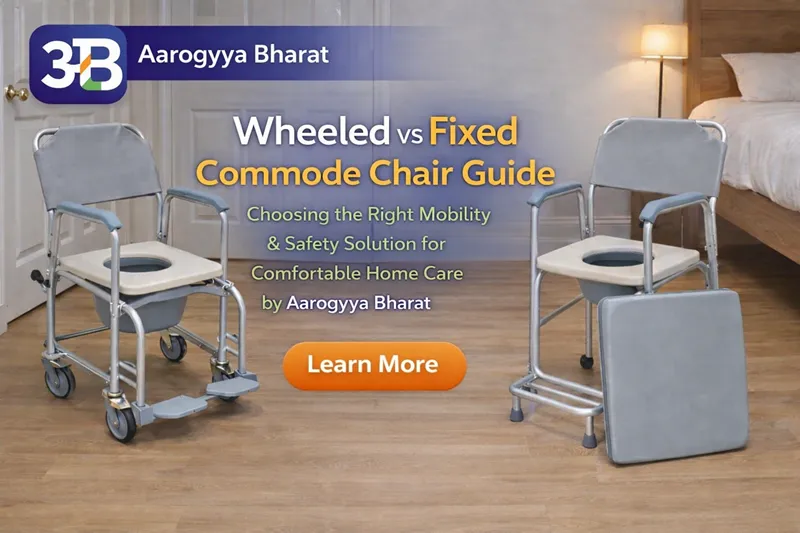
Understanding What a Commode Chair with Wheels Is
A commode chair with wheels is designed with caster wheels
attached to its legs, allowing the chair to be moved from one location to
another while the user is seated or after the user has transferred. These
wheels usually include locking mechanisms that must be engaged during use to
prevent unintended movement. Wheeled commode chairs are often chosen for their
perceived convenience, especially in homes where the user needs to be moved
between rooms or positioned over a toilet. However, the presence of wheels
introduces additional safety considerations that must be understood clearly
before use.
Understanding What a Fixed Commode Chair Is
A fixed commode chair has four non-movable legs with
anti-slip rubber tips designed to provide maximum stability during sitting and
standing. It is intended to remain stationary during use and is usually placed
beside the bed or in a designated safe area. Fixed commode chairs prioritise
balance, predictability, and simplicity, making them a common choice for
elderly users, high fall-risk patients, and night-time use. Their lack of
movement reduces complexity and error during transfers.
Core Difference Between Wheeled and Fixed Commode Chairs
The fundamental difference between wheeled and fixed commode
chairs lies in movement versus stability. Wheeled chairs offer mobility but
require correct handling, brake usage, and caregiver awareness, while fixed
chairs eliminate movement altogether, reducing the chance of unexpected
shifting. This difference affects every aspect of daily use, from transfers and
hygiene to caregiver workload and accident risk.
Stability and Fall Risk Comparison
Stability is the most critical safety factor in commode
chair use. Fixed commode chairs provide consistent stability because they do
not move, even if the user shifts weight unevenly or applies sudden force to
armrests. Wheeled commode chairs, if not locked properly or used on uneven or
tiled floors, can roll unexpectedly, leading to falls. For users with poor
balance, tremors, cognitive impairment, or weak legs, even slight movement can
cause panic and collapse. In such cases, fixed chairs offer significantly
higher safety.
Mobility and Convenience Considerations
Wheeled commode chairs are often chosen for convenience,
allowing caregivers to move users’ short distances without multiple transfers.
This can be helpful in controlled environments where caregivers are trained and
floors are even. However, in Indian homes with thresholds, uneven tiles,
carpets, or limited space, mobility may create more risk than benefit. Fixed
chairs sacrifice mobility but provide predictable positioning that many users
find reassuring.
Transfer Safety for Different User Types
Transfers are the most dangerous moments in toileting. Fixed
commode chairs provide a stable target for transfers, allowing users to focus
on sitting and standing without worrying about movement. Wheeled chairs require
brakes to be locked correctly before every transfer. Forgetting to lock even
one wheel can cause sudden movement during sitting, leading to falls. For
elderly users or family caregivers without training, fixed chairs significantly
reduce transfer risk.
Night-Time Use: Wheels vs Fixed Stability
Night-time toileting is when users are weakest and least
alert. Fixed commode chairs are generally safer at night because they do not
depend on brake engagement or user awareness. Wheeled chairs increase
night-time risk if brakes are not fully locked or if the chair is nudged
accidentally in low light. For elderly night care, fixed chairs are almost
always the safer choice.
Caregiver Effort and Physical Strain
Wheeled chairs can reduce lifting in some situations by
allowing caregivers to roll the user short distances. However, pushing,
steering, locking, and unlocking wheels also requires coordination and
strength. Fixed chairs reduce complexity, allowing caregivers to assist with
simple guided transfers rather than managing moving equipment. For long-term
caregiving, simplicity often results in less fatigue.
Suitability for Elderly Users
Elderly users often have balance issues, slower reactions,
and fear of instability. Fixed commode chairs provide psychological reassurance
because they feel solid and unmoving. Wheeled chairs may cause anxiety even
when brakes are locked, leading to hesitation or unsafe movements. For most
elderly users, especially those living at home, fixed chairs are more
appropriate.
Suitability for Limited Mobility and Disability Care
For users with partial mobility who can stand and transfer
with support, fixed chairs provide safe consistency. Wheeled chairs may be
useful in specific disability care scenarios where trained caregivers assist
with movement, but they require strict safety protocols. In family-managed home
care, fixed chairs are generally safer.
Use in Home Nursing and Professional Care
In professional home nursing setups where caregivers are
trained and routines are standardised, wheeled commode chairs may be used
safely for specific tasks such as moving patients’ short distances. Even in
these cases, brake discipline and environmental control are critical. Fixed
chairs remain the preferred option for unsupervised or family-led care.
Floor Type and Home Environment Impact
Indian homes often have smooth tiles, uneven joints, or
slight slopes that can affect wheeled chair movement. Even high-quality brakes
may not compensate fully for slippery or uneven floors. Fixed chairs with
rubber tips are more forgiving and reliable across varied home environments.
Hygiene and Cleaning Practicality
From a hygiene perspective, both chair types can be cleaned
effectively. However, wheeled chairs require additional attention to wheel
cleaning, as dirt, moisture, and waste residue can accumulate and affect
braking performance. Fixed chairs have fewer components, making cleaning
simpler and faster.
Long-Term Durability and Maintenance
Wheeled commode chairs have more moving parts, including
wheels, axles, and brake mechanisms, which require regular inspection and
maintenance. Fixed chairs have fewer failure points, making them more durable
and lower-maintenance over long-term use.
Cost vs Long-Term Value
Wheeled commode chairs are generally more expensive due to
added components. However, higher cost does not automatically mean better
safety. For many home-care situations, a simpler fixed chair offers better
long-term value through reduced risk, maintenance, and caregiver stress.
Comparison Table: Commode Chair with Wheels vs Fixed
Chair
|
Feature |
Wheeled
Commode Chair |
Fixed
Commode Chair |
|
Mobility |
Can be moved |
Stationary |
|
Stability |
Depends on
brakes |
Always stable |
|
Transfer
safety |
Medium
(brake-dependent) |
High |
|
Night-time
safety |
Lower |
Higher |
|
Caregiver
training needed |
Yes |
Minimal |
|
Maintenance |
Higher |
Lower |
|
Elderly
suitability |
Limited |
Excellent |
|
Home use
reliability |
Moderate |
High |
Common Mistakes When Choosing Between the Two
Common mistakes include choosing wheeled chairs for
convenience without considering safety, underestimating brake dependence, and
assuming mobility equals ease. Many families regret choosing wheeled chairs
after experiencing instability or near-falls. Understanding real-world use
prevents costly errors.
How to Decide Which One Is Right for Your Home
Decision-making should consider user balance, caregiver
skill, night-time use, floor type, and long-term care needs. If safety,
simplicity, and independence are priorities, fixed chairs are usually the
better choice. Wheeled chairs should only be selected when mobility benefits
clearly outweigh added risk and caregivers are trained.
Why Aarogyaa Bharat Focuses on Safe Matching Rather Than
Trends
Aarogyaa Bharat does not promote one type blindly. Our
approach focuses on matching the commode chair to the user’s condition and home
environment. In most Indian home-care scenarios, fixed commode chairs provide
superior safety and peace of mind, while wheeled chairs are recommended only
for specific, controlled situations.
Conclusion
The choice between a commode chair with wheels and a fixed chair is ultimately a choice between mobility and stability. While wheeled chairs offer flexibility, they introduce complexity and risk that may not be suitable for most home-care environments. Fixed commode chairs prioritise safety, simplicity, and confidence, making them the preferred option for elderly users, night-time care, and family-managed homes. By understanding the real differences rather than surface features, families can make decisions that protect dignity, prevent falls, and support sustainable care. Aarogyaa Bharat remains committed to guiding families toward the safest and most appropriate commode chair solutions for real Indian homes.