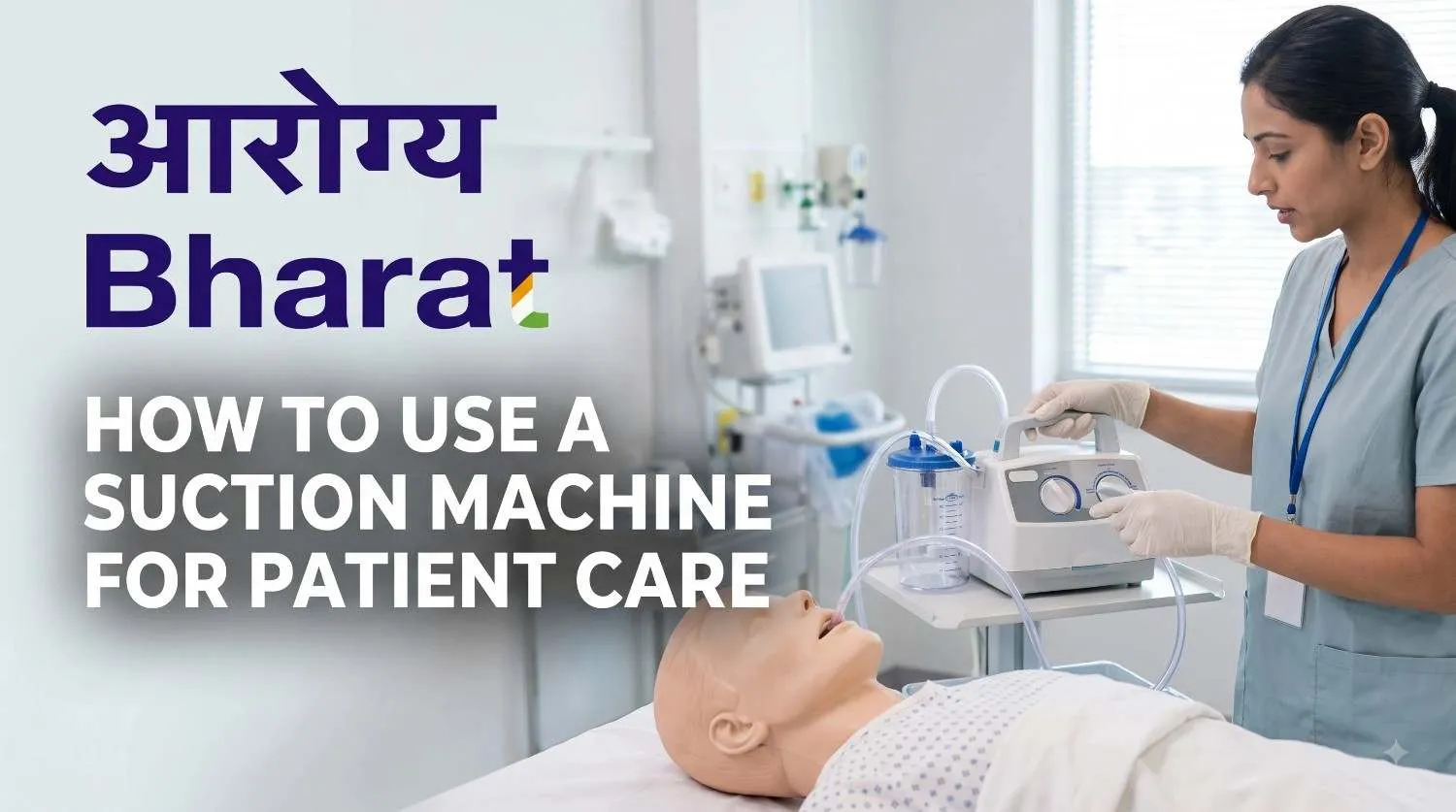
A suction machine, also called a medical aspirator, is a
device that creates controlled negative pressure to remove secretions or fluids
from a patient through appropriate tubing and suction accessories. The machine
generally consists of the suction pump, vacuum regulator, collection canister,
connecting tubing, filter, power source, and patient-side accessory such as a
Yankauer oral suction tip or another clinically prescribed catheter. Aarogyaa
Bharat describes portable, electric, manual, surgical, wall-mounted, and
home-care suction systems, with different machines suited to different clinical
environments. For home patient care, portable electric suction units are
commonly considered because they can be easier to move and some include
rechargeable battery backup. The machine itself only generates suction; safe
patient care depends on choosing the correct accessory and using it according
to the patient's care plan. A machine designed for oral secretion management
should not automatically be used for deeper airway procedures without
professional instruction.
Why Is a Suction Machine Used in Patient Care?
A suction machine may be recommended when a person cannot
effectively remove secretions through swallowing or coughing. Cambridge
University Hospitals explains that oral suction can help patients who
accumulate excess saliva or sputum because swallowing and cough effectiveness
have reduced. Hull University Teaching Hospitals similarly notes that secretion
buildup may occur when swallowing, tongue movement, mouth control, or coughing
are impaired. In practice, suction may be used for selected people with neurological
illness, advanced weakness, post-operative difficulties, tracheostomies,
impaired consciousness, or other conditions affecting secretion clearance.
Aarogyaa Bharat also identifies respiratory conditions, post-surgical recovery,
home care, elderly care, and selected neurological disorders among situations
in which suction equipment may be considered. However, suction should only be
performed when it is clinically indicated because unnecessary or aggressive
suction can irritate delicate tissues and cause discomfort, bleeding, coughing,
or other complications.
Suction Machine Components and Their Purpose
|
Component |
Purpose |
What to Check |
Important Safety Point |
|
Suction Machine |
Creates negative pressure |
Clean, stable and working |
Use only as instructed |
|
Vacuum Regulator |
Controls suction strength |
Correct prescribed setting |
Never automatically use maximum suction |
|
Collection Canister |
Holds removed secretions |
Secure lid and adequate capacity |
Do not allow it to overfill |
|
Connecting Tubing |
Transfers suction from machine |
No cracks, leaks or kinks |
Keep tubing clean |
|
Filter |
Protects machine from contamination |
Clean and correctly installed |
Replace as instructed |
|
Yankauer Tip |
Removes visible oral secretions |
Clean and appropriate for patient |
Keep away from the back of the throat |
|
Suction Catheter |
Used for specific airway procedures |
Correct type and size |
Use only when clinically trained |
|
Power Adapter |
Powers electric machine |
Cable intact and dry |
Keep away from water |
|
Battery |
Provides portable backup |
Adequately charged |
Check before travel or power cuts |
|
Gloves/PPE |
Helps reduce contamination |
Available before starting |
Hand hygiene remains essential |
Oral Suction and Airway Suction Are Not the Same
One of the most important things caregivers need to
understand is the difference between oral suction and deeper airway suction.
Oral suction generally involves removing visible saliva or mucus from the mouth
using a Yankauer-type suction tip. Cambridge University Hospitals advises
keeping the Yankauer within the visible mouth area and avoiding insertion too
far toward the back of the mouth because this can trigger gagging or choking.
Hull NHS similarly states that an oral suction unit should be used within the
mouth and recommends not passing the Yankauer beyond the back teeth.
Tracheostomy, endotracheal, or other deeper airway suction is a different
procedure with patient-specific catheter sizes, pressure settings, depths,
sterile or clean techniques, and monitoring requirements. Caregivers trained
only in oral suction should never assume they are qualified to perform
tracheostomy or deep airway suction. Those procedures require specific clinical
training and an individualized care plan.
How to Use a Suction Machine for Oral Patient Care
Step 1: Confirm That Suction Is Needed
Before starting, determine whether the patient actually
needs suction according to the care plan provided by the healthcare team.
Visible saliva or mucus accumulating in the mouth, difficulty clearing
secretions, increased drooling, audible secretions, or discomfort may indicate
that oral suction is required in patients who have already been assessed for
this treatment. Cambridge University Hospitals explains that oral suction is
used when swallowing becomes less effective and secretions cannot be cleared normally.
Suction should not automatically be performed at fixed intervals unless the
patient's clinical plan specifically instructs caregivers to do so. Repeated
unnecessary suction can irritate oral tissues and increase discomfort. If a
patient suddenly requires suction much more frequently than usual, develops
unusually thick or discoloured secretions, or has new breathing difficulty,
this may represent a change in the clinical condition rather than simply a need
for more suction and should be discussed with the healthcare team.
Step 2: Gather All Equipment Before Starting
Prepare everything needed before approaching the patient so
the procedure does not need to be interrupted while searching for supplies. A
typical oral suction setup includes the suction machine, collection canister,
connecting tubing, appropriate Yankauer tip, clean water for flushing when
recommended, gloves, and any additional personal protective equipment required
by the patient's care plan. Hull NHS lists the suction unit, filters, tubing,
canister, Yankauer catheter, clean water, gloves, goggles, and apron among
equipment used for oral suction care. Check that all components are clean,
intact, correctly assembled, and ready for use. The collection bottle lid
should be securely attached and tubing should not contain cracks or kinks.
Preparing equipment in advance reduces unnecessary delay and allows the
caregiver to keep attention focused on the patient's breathing, comfort, and
response throughout suctioning.
Step 3: Wash Your Hands and Use Appropriate PPE
Good hand hygiene helps reduce contamination when handling
suction equipment that will come close to the patient's mouth or airway. Wash
and dry your hands thoroughly before handling the Yankauer or other
patient-contact equipment and use gloves or other protective equipment
according to the training provided by the healthcare team. Cambridge University
Hospitals and Hull NHS both include hand washing and appropriate protective
equipment as part of preparation for home oral suction. Gloves should not be
considered a substitute for hand hygiene because hands can become contaminated
while putting gloves on or removing them. Try to keep the patient-side portion
of the Yankauer or catheter away from bedding, floors, tables, clothing, or
other potentially contaminated surfaces. After the procedure, remove gloves
safely, clean or dispose of equipment as instructed, and wash hands again.
Step 4: Position the Patient Comfortably and Safely
Correct positioning can make secretion removal easier and
reduce discomfort during oral suction. When clinically appropriate, the patient
is usually positioned upright or with the head and upper body supported rather
than completely flat. Hull NHS advises that positioning should be discussed
with the respiratory physiotherapist or nurse and notes that some patients who
cannot sit upright may be positioned on their side. The exact position depends
on the person's mobility, swallowing ability, surgical restrictions, breathing
condition, aspiration risk, and other medical factors. Avoid changing medically
prescribed positioning simply to make suction easier. Ensure the patient is
well supported and cannot slide or fall during coughing. The machine should be
close enough that the tubing reaches comfortably without pulling, while still
being positioned on a stable surface and away from water or other electrical
hazards.
Step 5: Assemble the Machine Correctly
Connect the collection canister, tubing, filter, and
patient-side suction accessory according to the specific machine manufacturer's
instructions. A typical setup connects one side of the suction tubing to the
canister or suction outlet and the other side to the Yankauer or prescribed
accessory, but connector arrangements differ between machines. Aarogyaa Bharat
describes the collection canister, suction tubing, catheter, filter, and power
source as core parts of a suction-machine setup. Make sure the canister lid and
seals are properly seated because a loose connection can reduce vacuum
performance. Tubing should run freely without being pinched beneath furniture
or twisted. Do not substitute incompatible tubing, collection bottles, filters,
or connectors simply because they physically fit. Medical suction equipment
functions as a system, and the wrong accessory can affect performance or
safety.
Step 6: Turn On the Machine and Confirm It Is Working
Before applying suction to the patient, switch the machine
on and confirm that it generates suction normally. Follow the manufacturer's
instructions for checking vacuum function and ensure that the collection
canister, tubing, and filter are connected correctly. A sudden absence of
suction can result from loose tubing, blocked tubing, an improperly fitted
canister lid, a full collection container, a blocked filter, or a mechanical
fault rather than an incorrect clinical pressure setting. Do not respond to weak
suction by immediately turning the pressure regulator to its maximum position.
The required suction strength should be the setting demonstrated or prescribed
for that patient. If the machine cannot generate the expected vacuum despite
correct setup, stop and troubleshoot according to the manufacturer's
instructions or contact the equipment provider rather than beginning patient
suction with unreliable equipment.
Step 7: Use Only the Prescribed Suction Setting
Suction pressure should be patient-specific and
procedure-specific. Oral suction, tracheostomy suction, adults, children, and
different suction machines can all involve different settings, so caregivers
should not copy a pressure value from another patient or use the highest
setting available. Cambridge University Hospitals provides an oral-suction
range within its specific home-care protocol, while other services use
different approaches, which demonstrates why pressure should be taught for the
individual patient rather than generalized. Powerful suction can damage
delicate tissues inside the mouth, and Bradford District Care NHS specifically
warns that excessive suction strength may injure oral tissue. Use the pressure
established by the patient's healthcare team and make sure everyone providing
care knows the correct setting. If secretions become difficult to remove, do
not simply increase vacuum strength without professional guidance.
Step 8: Insert the Yankauer Only Into the Visible Mouth
Area
For oral suction, gently introduce the Yankauer into the
mouth and direct it toward visible saliva or mucus rather than blindly pushing
it toward the throat. Cambridge University Hospitals describes gently moving
the Yankauer through the cheek areas and warns against inserting it too far
back because this can trigger gagging and choking. Hull NHS gives similar
guidance, advising that the suction tip should not pass beyond the back teeth
or into areas that cannot be safely seen. Avoid keeping the tip pressed against
soft tissue because strong local suction can cause pain or tissue injury. Oral
suction equipment should also not be used to try to retrieve solid food,
foreign objects, or an obstruction from the back of the throat because this can
push material deeper into the airway. A suspected airway obstruction is an
emergency and requires appropriate first-aid and medical response rather than
routine suction-machine use.
Step 9: Apply Suction Briefly
Oral suction should be brief rather than continuous.
Cambridge University Hospitals recommends limiting each oral suction period to
no longer than about 10 seconds in its home-care protocol. Hull NHS provides
the same 10-second maximum within its oral suction instructions. Other services
may teach slightly different limits depending on technique, so caregivers
should use the duration specifically taught for their patient. Continuous or
prolonged suction can increase discomfort and tissue irritation, and some
patients may temporarily hold their breath during suctioning. Bradford District
Care NHS therefore advises stopping regularly to allow the patient to rest. If
more secretions remain, allow recovery and repeat only as instructed rather
than performing one long suction attempt. The patient's breathing and comfort
should guide the pace of care.
Step 10: Watch the Patient Throughout the Procedure
The patient should remain the caregiver's main focus
throughout suctioning. Observe breathing effort, skin and lip colour, coughing,
gagging, level of alertness, discomfort, and any monitoring equipment that the
healthcare team has instructed you to use. Oral suction can cause gagging,
coughing, anxiety, or tissue injury when performed incorrectly, and adult
suction guidance identifies vomiting, coughing, distress, and changes in
respiratory condition among issues caregivers should consider. Stop suctioning
if the patient develops significant discomfort, bleeding, severe gagging,
worsening breathing difficulty, or another concerning reaction. Cambridge
University Hospitals specifically advises stopping oral suction if gagging,
bleeding, or discomfort occurs. Severe breathing difficulty, blue or grey lips,
loss of consciousness, major bleeding, or another medical emergency requires
urgent professional assistance rather than repeated suction attempts.
Step 11: Flush the Tubing When Instructed
After oral suction, many home-care protocols recommend
drawing a small amount of clean water through the Yankauer and tubing to clear
visible secretions into the collection canister. Cambridge University Hospitals
advises flushing tubing with water after use, while Hull NHS similarly
recommends using clean water to clear secretions from the suction pathway. The
exact cleaning method should follow the patient's training and equipment
instructions because not all accessories have identical maintenance requirements.
Do not use cleaning solutions or disinfectants inside the tubing unless
specifically approved. The purpose of flushing is to prevent mucus from drying
inside the tubing and blocking future suction. If the tubing remains visibly
contaminated, damaged, discoloured, cracked, or difficult to clear, replace it
according to the manufacturer's or healthcare team's instructions rather than
continuing to use it indefinitely.
Step 12: Turn the Machine Off and Dispose of Secretions
Safely
Once suction is complete and the tubing has been managed
according to the care plan, turn the suction machine off. Inspect the
collection canister and empty it before it reaches the manufacturer's
maximum-fill level. Secretions should be disposed of according to the
instructions provided by the healthcare or home-care team, using appropriate
gloves and avoiding splashing or unnecessary contact. After emptying a reusable
canister, clean and dry it according to the equipment manufacturer's
instructions. Some machines use disposable liners or collection containers,
while others have reusable systems, so the same cleaning procedure cannot be
applied universally. Never allow secretions to overflow into the filter or
suction pump because this can contaminate or damage the machine and reduce its
reliability when it is next needed.
Important Safety Points While Using a Suction Machine
- Use
suction only when it has been recommended for the patient.
- Ensure
caregivers receive practical training before home use.
- Keep
the machine clean and ready for use.
- Confirm
tubing, canister and filter connections before starting.
- Use only the pressure prescribed or demonstrated for the patient.
- Never
automatically turn the suction regulator to maximum.
- Use
the correct Yankauer or catheter.
- Wash
hands before and after suction care.
- Use
gloves and protective equipment when instructed.
- Keep
patient-contact accessories away from contaminated surfaces.
- Position
the patient according to their clinical care plan.
- Use
oral suction only in areas of the mouth that are safely visible.
- Do not
push a Yankauer toward the back of the throat.
- Do not
use oral suction to retrieve solid foreign objects.
- Keep
each suction attempt brief.
- Allow
the patient time to breathe and recover.
- Watch
continuously for distress, gagging or bleeding.
- Stop
if the patient's condition worsens.
- Empty
the collection bottle before it overfills.
- Keep
tubing free from bends and blockages.
- Clean
reusable components according to manufacturer instructions.
- Replace
disposable equipment as instructed.
- Check
filters regularly.
- Keep
portable machines appropriately charged.
- Maintain
an emergency plan for patients who depend on suction.
How Often Should a Patient Be Suctioned?
There is no universal schedule that applies to every
patient. The need for suction depends on the person's medical condition,
ability to swallow, cough strength, amount and thickness of secretions, airway
type, and treatment plan. Aarogyaa Bharat's existing guidance notes that some
patients require suction several times during the day while others need it only
occasionally, depending on their condition. Oral suction is generally performed
when secretions have accumulated and cannot be managed through normal
swallowing or coughing, unless the healthcare team has prescribed a particular
schedule. Performing suction unnecessarily can irritate the mouth or airway and
make the patient uncomfortable. Conversely, a sudden increase in suction
frequency may indicate thicker secretions, respiratory infection, dehydration,
worsening swallowing, or another change that deserves clinical review. Families
should therefore record any major change in secretion volume, colour, smell,
thickness, or suction frequency and discuss it with the healthcare team when
appropriate.
How Long Should Suctioning Last?
For oral Yankauer suction, the procedure should be brief.
Cambridge University Hospitals and Hull NHS both recommend limiting individual
oral suction attempts to approximately 10 seconds within their home-care
instructions. This should not be taken as a universal timing rule for every
suction procedure because children, tracheostomy patients, deeper airway
suction, and different medical situations may have different clinical limits.
Caregivers should follow the exact duration taught for the patient. If secretions
cannot be removed easily within the recommended technique, allow the patient to
recover before another attempt rather than continuing suction continuously.
Persistent difficulty may indicate that the secretions are unusually thick, the
tubing is blocked, the filter is restricted, the machine is malfunctioning, or
the patient's respiratory condition has changed. Increasing pressure or
extending suction duration without guidance is not a safe substitute for
troubleshooting or clinical review.
Using a Suction Machine for a Tracheostomy Patient
Tracheostomy suction should only be performed by someone who
has received specific hands-on training because it involves inserting a
catheter through an artificial airway and carries different risks from oral
suction. The catheter size, insertion depth, suction pressure, timing,
infection-control technique, oxygen requirements, and number of passes are
patient-specific. A caregiver who understands how to use a Yankauer for oral
secretions is not automatically trained to perform tracheostomy suction. Pediatric
airway guidance from Cambridge University Hospitals explicitly records
patient-specific maximum catheter depth and suction pressure, illustrating why
these values should be prescribed rather than guessed. If the patient has a
tracheostomy, caregivers should follow the written plan and competency training
provided by the tracheostomy or respiratory team. Unexpected catheter
resistance, fresh bleeding, severe distress, inability to clear the tube,
falling oxygen levels, or difficulty breathing should be managed according to
the patient's emergency airway plan and professional medical guidance.
Cleaning the Suction Machine After Patient Care
Proper cleaning helps keep the suction system functional and
reduces buildup inside components that come into contact with secretions.
Cambridge University Hospitals advises cleaning reusable oral suction tubing
and Yankauer equipment with soap and warm water as needed within its specific
home-care protocol and recommends routine replacement when components become
discoloured or worn. The collection canister should be emptied and cleaned
according to manufacturer instructions before it becomes excessively full. The
external machine housing can usually be wiped appropriately but should never be
immersed in water because it contains electrical and mechanical components.
Filters may be disposable or replaceable and should be managed according to the
exact suction-machine manual. Do not use bleach, strong disinfectants, boiling
water, or harsh household chemicals unless specifically approved for the
component being cleaned. After cleaning, allow reusable components to dry
appropriately before reassembly and store patient-contact equipment in a clean
location.
Suction Machine Filter Care
The filter helps protect the suction pump from contamination
and fluids, making it an important part of the equipment rather than an
optional accessory. If the collection jar overfills or secretions reach the
filter, suction performance may be reduced and the device may require filter
replacement or professional inspection. Filter designs and replacement
intervals differ between suction machines, so users should check the equipment
manual instead of following a generic schedule from another brand. Cambridge
University Hospitals notes annual servicing and filter changes within its own
home suction equipment program, demonstrating that filter care forms part of
routine maintenance. A visibly wet, contaminated, blocked, or damaged filter
should not be reused if the manufacturer requires replacement. Caregivers
should keep compatible replacement filters available when the patient's suction
needs are frequent and should know how to obtain service support if suction
performance suddenly falls.
Battery and Power Safety for Portable Suction Machines
Portable suction machines can provide greater flexibility
for home care and travel, but the battery needs to be kept ready if the patient
relies on suction away from mains electricity. Cambridge University Hospitals
advises keeping its specified portable suction equipment charged when it is not
in use. Battery-management instructions differ by model, so follow the
manufacturer's charging schedule and periodically test that the machine
operates correctly from battery power. Keep the power adapter and cable dry and
inspect them for cuts, exposed wires, loose connections, unusual heat, or other
damage. Do not place the suction machine next to water containers where spills
could reach electrical parts. Patients who rely on suction for essential airway
management should have a clinically approved backup plan for power cuts or
machine failure. Improvised battery connections, unsuitable inverters, or
unauthorized electrical modifications should not be used with medical suction
equipment.
Suction Machine Use for Elderly and Bedridden Patients
Elderly or bedridden patients may have difficulty clearing
saliva or mucus because of reduced strength, impaired swallowing, neurological
illness, limited mobility, or a weak cough. A suction machine can sometimes
help manage oral secretions when the patient's healthcare team has determined
that suction is appropriate. Aarogyaa Bharat identifies elderly and bedridden
patients among common home-care users of suction equipment. Caregivers should
be particularly gentle because older adults may have fragile oral tissues,
loose teeth, dentures, reduced awareness, or difficulty communicating
discomfort. Worcestershire adult oral-suction guidance specifically identifies
loose teeth as an additional concern because of the risk of dislodgement.
Dentures, oral hygiene, positioning, aspiration risk, and the patient's ability
to cooperate should therefore be considered in the care plan. Suction should
support appropriate oral care and secretion management rather than replace
regular medical assessment or treatment of the underlying condition.
Monitoring Secretions During Patient Care
Caregivers should become familiar with the patient's usual
secretion pattern so they can recognize meaningful changes. Important
observations can include the amount, colour, thickness, smell, frequency of
suction, and whether blood is present. Worcestershire's adult suction guidance
includes recent secretion volume and colour among factors to assess when
preparing for suction. A sudden increase in thick secretions, foul smell,
unusual colour, repeated blood staining, fever, or worsening breathing may require
professional medical review. Mild irritation can occasionally occur after
suction, but recurrent bleeding should not simply be accepted as normal. The
caregiver should also notice whether the patient is coughing more, tiring
during suction, or requiring progressively more frequent procedures. These
observations can provide useful information to the respiratory or treating team
when determining whether the patient's illness, hydration, humidification,
airway care, or equipment needs have changed.
When to Stop Suctioning Immediately
Stop suctioning if the patient develops significant
bleeding, severe gagging, marked discomfort, worsening breathing difficulty,
sudden colour change, loss of consciousness, or another concerning reaction.
Cambridge University Hospitals specifically advises stopping oral suction if
gagging, bleeding, or discomfort occurs. The patient should be allowed to
recover and their airway and breathing should be assessed according to the care
plan. Severe breathing difficulty, blue or grey lips, loss of consciousness,
uncontrolled bleeding, choking, suspected airway obstruction, or another
emergency requires immediate medical assistance rather than repeated routine
suction. Caregivers supporting high-dependency patients should know the
patient's emergency plan before an urgent situation occurs, including whom to
contact, what backup airway equipment is available, and which procedures they
have been trained to perform.
Common Mistakes When Using a Suction Machine
One common mistake is treating suction pressure like a power
control and automatically turning it higher when secretions are difficult to
remove. Another is pushing a Yankauer too far toward the back of the mouth,
where it can trigger gagging, choking, tissue injury, or vomiting. Cambridge
University Hospitals and Hull NHS both advise keeping oral suction away from
the back of the throat and limiting each suction attempt to a short period.
Other mistakes include skipping hand hygiene, allowing tubing to touch
contaminated surfaces, using damaged accessories, leaving the canister
overfilled, forgetting filter maintenance, repeatedly suctioning when the
patient needs rest, or attempting deeper airway suction without clinical
training. Trying to remove solid food or a foreign object from the throat using
routine oral suction is another dangerous mistake because it can worsen an
obstruction. Safe patient care requires following the specific procedure taught
for that individual rather than improvising.
Quick Suction Machine Patient-Care Checklist
Before suction:
- Confirm
that suction is actually required.
- Check
the patient's care plan.
- Gather
all equipment.
- Wash
hands.
- Put on
appropriate PPE.
- Position
the patient safely.
- Confirm
that the machine is clean and functional.
- Check
the collection canister.
- Check
tubing for damage or blockage.
- Confirm
the correct patient accessory.
- Use
the prescribed suction pressure.
During suction:
- Keep
oral suction within visible areas of the mouth.
- Do not
advance the Yankauer toward the back of the throat.
- Keep
each suction attempt brief.
- Allow
the patient to breathe and recover.
- Observe
breathing, colour and comfort.
- Stop
if bleeding, significant gagging or distress develops.
After suction:
- Flush
tubing if instructed.
- Turn
the machine off.
- Empty
the collection canister appropriately.
- Clean
reusable components.
- Dispose
of single-use items correctly.
- Wash
hands again.
- Charge
portable equipment if required.
- Record unusual secretions or symptoms when appropriate.
Choosing the Right Suction Machine for Home Patient Care
The best home suction machine is not necessarily the one
with the highest vacuum rating. Selection should consider the patient's
clinical requirements, prescribed suction range, expected frequency of use,
collection-canister capacity, portability, noise, battery backup, compatible
accessories, filter availability, cleaning requirements, and access to
maintenance support. Aarogyaa Bharat's guide to suction-machine types notes
that portable units can be useful for home care and patient transport, while high-capacity
and wall-mounted systems serve different clinical settings. Families should
also consider how easy it is to obtain compatible tubing, filters, collection
jars, Yankauer tips, and other consumables. For a patient who depends on
suction frequently, reliable battery performance and after-sales service may be
more important than small differences in purchase price. The treating
healthcare professional should confirm which type of suction machine is
appropriate for the patient's airway-care requirements.
Why Choose Aarogyaa Bharat for Suction Machines and
Patient Care Equipment?
Aarogyaa Bharat provides suction machines and other home
medical-equipment solutions for patients, caregivers, hospitals, clinics, and
families managing home healthcare requirements. Its existing resources explain
suction-machine uses, types, components, patient-care applications,
portability, battery backup, cleaning, and maintenance considerations. When
selecting a suction machine, customers should consider the clinical purpose,
whether suction is oral or related to an artificial airway, machine capacity,
collection-jar size, portability, compatible accessories, battery support,
noise level, filters, cleaning requirements, warranty, and servicing. The
equipment provider can help with device operation and accessories, but the
patient's doctor, nurse, respiratory therapist, or other qualified clinical
professional should determine the suction technique and settings. Combining
appropriate equipment with proper caregiver training and professional medical
guidance is essential for safer home patient care.
Conclusion
A suction machine can be an important patient-care device
when a person cannot effectively clear saliva, mucus, or respiratory secretions
on their own. Safe use begins with understanding exactly what type of suction
has been prescribed and ensuring that caregivers receive appropriate practical
training. For oral suction, the equipment should be prepared correctly, the
patient positioned safely, the prescribed suction pressure used, and the
Yankauer kept within the visible mouth area rather than pushed toward the back
of the throat. Suction attempts should remain brief, and the patient's
breathing, comfort, and colour should be observed continuously. After use,
tubing, collection containers, filters, and reusable accessories should be
cleaned or replaced according to manufacturer and clinical instructions. Deeper
airway or tracheostomy suction requires separate professional training and
patient-specific instructions. With correct equipment, careful hygiene,
appropriate monitoring, regular maintenance, and professional support, suction
therapy can become a structured part of selected home patient-care routines.
Medical Disclaimer
This article is provided for general educational information only and does not replace professional medical advice, clinical assessment, practical suction training, respiratory therapy, tracheostomy training, emergency airway management, or the manufacturer's device instructions. Oral suction, oropharyngeal suction, tracheostomy suction, endotracheal suction, pediatric suction, and other airway procedures have different requirements and risks. Suction pressure, catheter type, catheter size, insertion depth, suction duration, frequency, oxygen requirements, positioning, and monitoring should be determined by qualified healthcare professionals for the individual patient. Do not perform invasive or deep airway suction unless you have received appropriate practical training. If a patient develops severe breathing difficulty, blue or grey lips, loss of consciousness, uncontrolled bleeding, choking, or another medical emergency, seek immediate professional medical assistance.