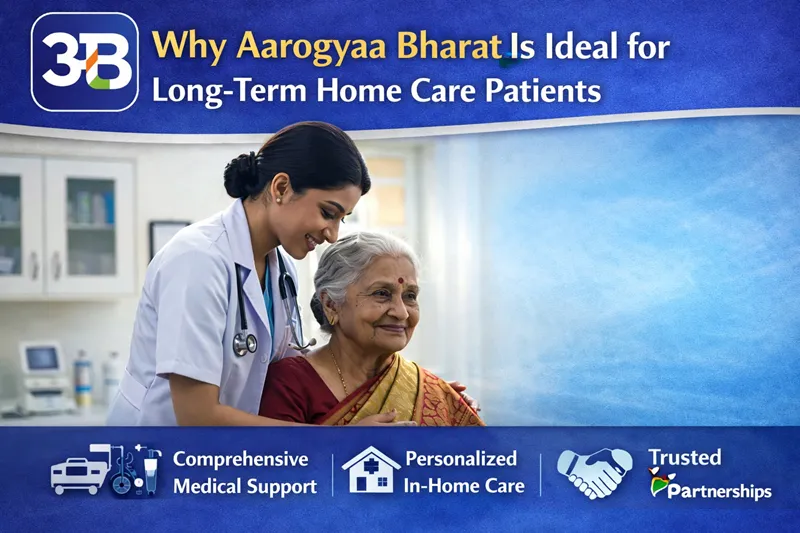
Understanding Long-Term Home Care as a Life System, not a
Medical Task
Long-term home care is fundamentally different from acute
medical treatment because it is not confined to a defined timeline or a single
medical objective. It becomes a living system within the household, influencing
sleep schedules, mobility patterns, emotional interactions, and even the
physical layout of the home. Patients requiring long-term care often experience
slow, non-linear changes in condition that demand patience and adaptability
rather than urgency. Aarogyaa Bharat approaches long-term care with this
systems perspective, recognizing that care must integrate seamlessly into daily
life rather than disrupt it. This understanding is critical because families
cannot sustain crisis-level responses indefinitely; they need calm, predictable
structures that can endure over time.
Why Long-Term Care Breaks Down Without Structure
In India, long-term home care often collapses under the
weight of improvisation. Families rely on ad-hoc solutions, local vendors, and
inconsistent advice, which may work temporarily but fail over extended periods.
Equipment wears out, routines become inefficient, caregivers experience
physical strain, and patients feel increasingly dependent and frustrated. The
absence of a structured support system turns care into a daily struggle rather
than a managed process. Aarogyaa Bharat exists precisely to prevent this
breakdown by introducing structure, continuity, and professional logic into
long-term home care environments.
Consistency as the Psychological Anchor for Long-Term
Patients
For long-term patients, uncertainty is often more
distressing than physical discomfort. Not knowing what to expect each day can
lead to anxiety, withdrawal, and resistance to care. Aarogyaa Bharat
prioritizes consistency by ensuring that equipment, routines, and support
remain stable over time. This predictability helps patients regain a sense of
control and normalcy, which is essential for emotional well-being. When
patients trust that their environment will not change unpredictably, they are
more cooperative, calmer, and emotionally resilient, even in the face of
prolonged illness.
Rental Flexibility Designed for Months and Years, Not
Weeks
Long-term care does not automatically mean permanent
ownership. Many conditions require extended support with uncertain endpoints,
making ownership risky and financially inefficient. Aarogyaa Bharat’s
rental-first model is uniquely advantageous for long-term care because it
allows families to access equipment for extended periods without irreversible
commitments. Rentals can be renewed, adjusted, or transitioned as conditions
evolve, ensuring that care setups remain appropriate without financial regret.
This flexibility is essential for families navigating long-term uncertainty.
How Aarogyaa Bharat Structures Long-Term Care Sustainably
|
Long-Term
Care Dimension |
Aarogyaa
Bharat Advantage |
|
Duration
uncertainty |
Flexible
rental extensions |
|
Progressive
conditions |
Easy
equipment transitions |
|
Caregiver
endurance |
Ergonomic,
low-strain setups |
|
Emotional
stability |
Predictable
routines |
|
Financial
planning |
Spread,
manageable costs |
Supporting Caregivers Over the Long Haul
Caregivers in long-term home care situations face cumulative
exhaustion rather than sudden burnout. Physical strain from lifting, emotional
fatigue from constant vigilance, and mental stress from decision-making
accumulate slowly over time. Aarogyaa Bharat designs its solutions to protect
caregivers from this slow erosion. Proper beds reduce repetitive lifting,
mobility aids minimize fall risks, and structured systems reduce daily decision
fatigue. By preserving caregiver health and energy, the platform ensures that
care remains sustainable over months and years, not just during initial
recovery.
Preserving Dignity When Care Becomes a Daily Reality
In long-term care, dignity becomes central to quality of
life. Patients may struggle with dependence, embarrassment, or loss of
autonomy, which can lead to emotional withdrawal. Aarogyaa Bharat prioritizes
dignity by enabling safe movement, hygienic toileting, and comfortable resting
arrangements that respect privacy and independence. When dignity is preserved,
patients are more likely to engage positively with care routines and maintain
emotional balance, which is essential for long-term well-being.
Adapting to Slow Progression and Gradual Change
Long-term care rarely involves dramatic changes; instead, it
unfolds through gradual progression or slow improvement. Aarogyaa Bharat’s
adaptability allows families to modify care setups incrementally rather than
reactively. Equipment can be adjusted to match evolving needs without
disruptive overhauls. This gradual adaptability reduces stress and ensures that
care environments remain aligned with the patient’s current condition rather
than outdated assumptions.
Financial Predictability as a Pillar of Long-Term Care
|
Financial
Challenge |
Without
Structured Support |
With
Aarogyaa Bharat |
|
Monthly
expenses |
Unpredictable |
Stable |
|
Equipment
replacement |
Frequent |
Optimized |
|
Common |
Reduced |
|
|
Long-term
affordability |
Strained |
Sustainable |
|
Financial
anxiety |
High |
Lowered |
Reducing Emotional Fatigue in Long-Term Patients
Living with a long-term condition often leads to emotional
fatigue caused by repetitive routines, perceived dependence, and social
isolation. Aarogyaa Bharat’s structured care environment helps counter this
fatigue by restoring routine and predictability. When patients feel supported
by stable systems rather than overwhelmed by constant adjustments, their
emotional resilience improves. Emotional stability, in turn, positively
influences physical health and cooperation with care.
Maintaining Balance in Multi-Generational Households
often involve multiple generations living together, which complicates long-term care dynamics. Without structure, care responsibilities can create tension and imbalance within the household. Aarogyaa Bharat’s approach integrates care into daily life in a way that minimizes disruption. By reducing physical strain and emotional stress, the platform helps families maintain harmony while providing sustained care to the patient.
Reducing Hospital Dependence for Chronic and Degenerative
Conditions
Long-term home care supported by Aarogyaa Bharat reduces the
need for frequent hospital visits, which are physically exhausting and
emotionally draining for long-term patients. By enabling consistent, safe care
at home, the platform allows patients to manage chronic or degenerative
conditions in familiar environments. This reduces hospital dependency while
preserving monitoring and safety standards.
Long-Term Home Care as the Future of Indian Healthcare
As India’s population ages and chronic illnesses increase,
long-term home care will become a permanent component of healthcare delivery.
Aarogyaa Bharat is aligned with this future by building systems that support
extended care rather than temporary fixes. Its model contributes to a
sustainable healthcare ecosystem that balances institutional care with
home-based support.
Why Aarogyaa Bharat Is Uniquely Suited for Long-Term Care
Aarogyaa Bharat stands out because it treats long-term care
as a marathon rather than a sprint. By focusing on endurance, adaptability,
caregiver support, and dignity, the platform creates a care environment that
can be sustained without breaking families emotionally or financially. This
long-view approach is what makes Aarogyaa Bharat ideal for extended home care
journeys.
Conclusion: A True Long-Term Partner in Home Care
Long-term home care requires patience, stability, and trust.
Aarogyaa Bharat provides all three by offering flexible rentals, structured
support, caregiver-friendly solutions, and dignity-cantered care. For families
navigating months or years of home care, the platform serves not just as a
service provider but as a long-term partner that transforms prolonged care into
a manageable, compassionate, and sustainable experience.