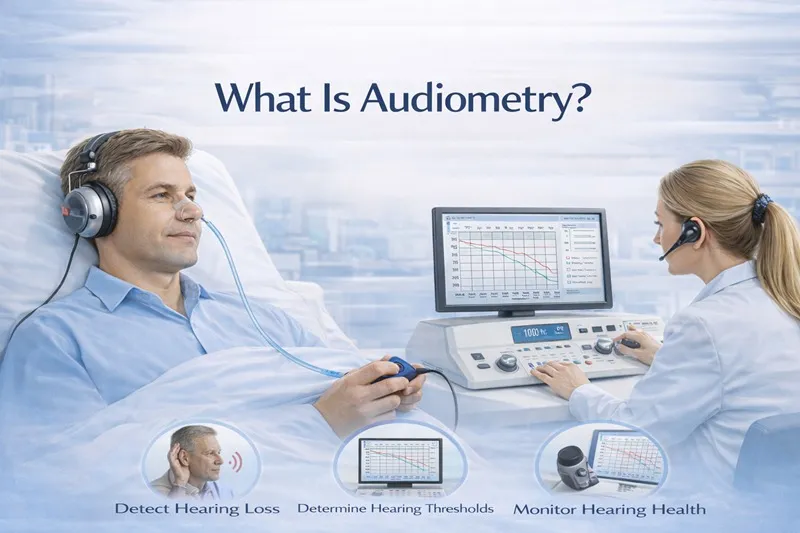
What Is Audiometry?
Audiometry is a clinical hearing test that measures the
softest sounds a person can hear at different pitches (frequencies) and
loudness levels (intensities). It evaluates how well sound travels through the
ear and how the auditory system responds.
The test is performed using a specialized device called an
audiometer, which produces controlled sounds that are delivered through
headphones or bone conduction devices. The responses are recorded to create an
audiogram, a visual chart representing a person’s hearing ability.
In simple terms, audiometry answers one key question:
How well can a person hear sounds of different types and volumes?
Why Is Audiometry Important?
Hearing loss often develops gradually and may go unnoticed
for years. Audiometry helps identify problems early sometimes even before a
person is aware of them.
Key Reasons Audiometry Is Performed
- Detect
hearing loss at an early stage
- Identify
the type and degree of hearing loss
- Monitor
hearing over time
- Evaluate
candidates for hearing aids or cochlear implants
- Assess
hearing in children, adults, and the elderly
- Support
diagnosis of ear-related diseases and nerve disorders
Early diagnosis through audiometry can significantly improve
treatment outcomes and quality of life.
Who Should Get an Audiometry Test?
Audiometry is recommended for people of all ages, especially
if they experience:
- Difficulty
understanding speech, especially in noisy environments
- Frequently
asking others to repeat themselves
- Ringing
or buzzing sounds in the ears (tinnitus)
- Exposure
to loud noise at work or through headphones
- Delayed
speech development in children
- Balance
problems or dizziness
- Age-related
hearing concerns
Regular hearing assessments are particularly important for
children, industrial workers, musicians, and senior citizens.
How Does an Audiometry Test Work?
Audiometry is a painless, non-invasive test usually
conducted in a quiet or soundproof room by a trained audiologist or healthcare
professional.
Step-by-Step Process
- The
person wears headphones or ear inserts
- Sounds
of different frequencies and volumes are played
- The
person signals when they hear a sound
- Bone
conduction testing may be done using a small device placed behind the ear
- Responses
are recorded on an audiogram
The test typically takes 15 to 30 minutes.
Types of Audiometry Tests
Audiometry is not a single test but a group of related
assessments designed to evaluate different aspects of hearing.
1. Pure Tone Audiometry
This is the most common type of audiometry test.
What It Measures
- The
faintest tones a person can hear
- Hearing
thresholds across different frequencies
Purpose
- Determines
the degree and pattern of hearing loss
2. Speech Audiometry
This test evaluates how well a person can hear and
understand spoken words.
What It Measures
- Speech
recognition ability
- Clarity
of hearing, not just loudness
Importance
- Helps
assess real-world communication challenges
3. Bone Conduction Audiometry
Instead of headphones, a bone vibrator is placed behind the
ear.
Purpose
- Determines
whether hearing loss is due to middle ear problems or inner ear/nerve
issues
4. Paediatric Audiometry
Designed specifically for infants and children.
Why It Matters
- Early
detection prevents speech and learning delays
- Uses
age-appropriate response methods
What Is an Audiogram?
An audiogram is the visual result of an audiometry test. It
shows:
- Frequencies
(pitch) on the horizontal axis
- Hearing
levels (loudness) on the vertical axis
The plotted points indicate the softest sounds the person
can hear. Audiograms help doctors:
- Identify
hearing loss patterns
- Decide
treatment options
- Track
hearing changes over time
Types of Hearing Loss Detected by Audiometry
Audiometry helps identify different kinds of hearing loss:
1. Conductive Hearing Loss
Caused by problems in the outer or middle ear
Examples: earwax, fluid, infections
2. Sensorineural Hearing Loss
Caused by damage to the inner ear or auditory nerve
Examples: aging, noise exposure
3. Mixed Hearing Loss
A combination of conductive and sensorineural loss
Understanding the type is crucial for proper treatment.
Is Audiometry Safe?
Yes. Audiometry is completely safe and does not involve
radiation, needles, or medications. It is suitable for:
- Infants
- Pregnant
women
- Elderly
individuals
Benefits of Audiometry
- Early
detection of hearing problems
- Improved
communication and quality of life
- Better
academic performance in children
- Enhanced
workplace safety
- Timely
hearing aid or medical intervention
Audiometry in Preventive Healthcare
Hearing health is often neglected until problems become
severe. Regular audiometry testing:
- Helps
preserve long-term hearing
- Reduces
social isolation
- Supports
mental and emotional well-being
Preventive hearing checks are as important as vision or
blood pressure tests.
Conclusion
So, what is audiometry?
It is a simple yet powerful diagnostic test that reveals how well we hear and
how sound shapes our daily lives. By detecting hearing issues early, audiometry
enables timely treatment, better communication, and improved overall
well-being.
At Aarogyaa Bharat, we believe that awareness is the first
step toward better health. Understanding diagnostic tests like audiometry
empowers individuals, families, and caregivers to make informed healthcare
decisions with confidence.